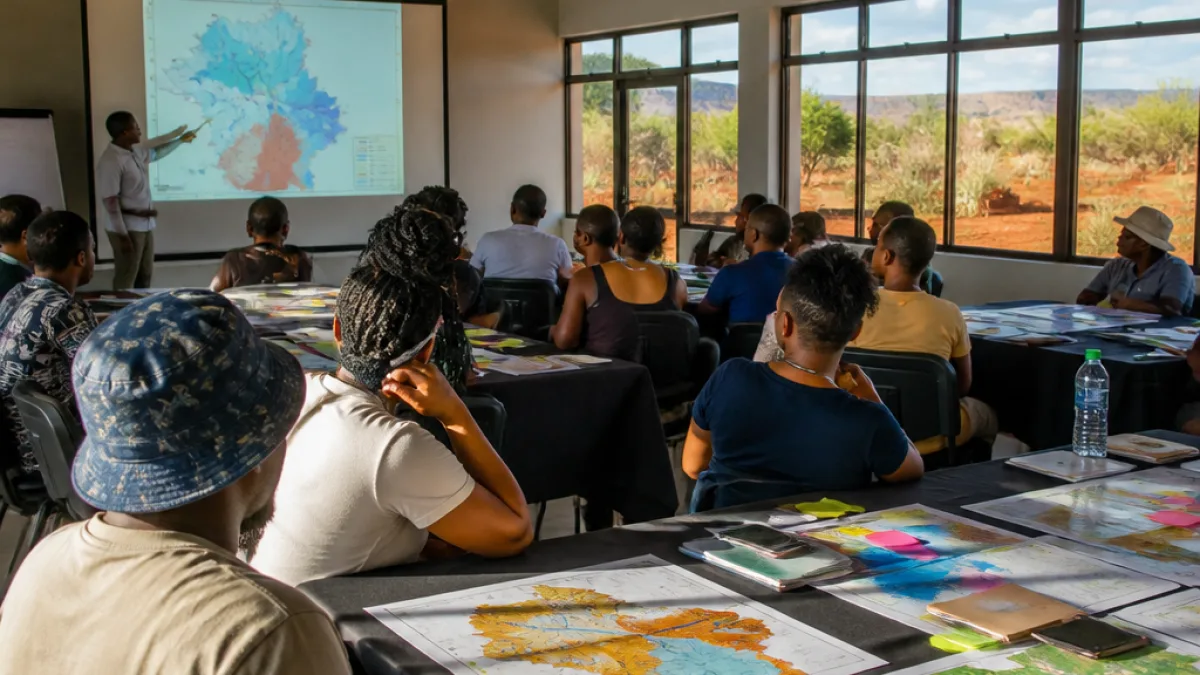
Researchers from the University of Cape Town and local partners brought climate science into a practical planning space in Tzaneen on 4 August, when a participatory workshop convened more than 80 local farmers, community leaders, students and government officials at Letaba TVET College’s Maake Campus. The event focused on making research useful for communities facing increasing pressure from droughts, floods and erratic weather patterns in the Limpopo River Basin, according to UCT’s Department of Environmental and Geographical Science.
Turning research into measures communities can use
The workshop formed part of the Pan-African and Transdisciplinary Lens on the Margins: Tackling the Risks of Extreme Events (PALM-TREES) project. UCT identified the consortium’s aim as translating academic climate studies into local preparedness and adaptation strategies. The Limpopo River Basin case study, led by Dr Phindile Sabela-Rikhotso, examines both physical and socio-economic drivers of extreme events and pays particular attention to communities most exposed to environmental and economic vulnerability, the university reported.
"The PALM-TREES project is committed to deepening our understanding of both the physical and socio-economic drivers of climate change," said Dr Phindile Sabela-Rikhotso.
Workshop organisers said the gathering brought together a broad set of actors: representatives from the mayoral office, traditional leadership structures, ward councillors, the Department of Agriculture, Letaba TVET College and local community organisations. The event was co-hosted with the Shwana Agri Cooperative, represented by Brian Mushwana.
Local priorities and shared knowledge
Participants discussed how recurring droughts and flooding are altering livelihoods and placing strain on crop producers and pastoralists in the basin. According to the project materials, the workshop created a space where scientific findings could be shared alongside indigenous and local knowledge so that adaptation measures would be both evidence-based and culturally appropriate.
Those attending explored options to bridge research and planning, including how to incorporate community-identified risks into municipal and agricultural planning cycles. Workshop sessions aimed to produce locally relevant adaptation strategies and risk metrics that can guide longer-term decision-making.
Who was present and what they sought to achieve
- Local farmers and cooperative members — to surface practical, on-the-ground measures that can protect crops and livestock.
- Traditional leaders and ward councillors — to ensure adaptation plans reflect local governance and customary land use.
- Education and research partners (Letaba TVET College, UCT) — to translate climate data into usable tools for communities.
- Government representatives from the Department of Agriculture and municipal offices — to consider integration with service delivery and development planning.
| Participant group | Role in the workshop |
|---|---|
| Farmers / Shwana Agri Cooperative | Shared local impacts and tested practical adaptation ideas |
| Traditional leaders and councillors | Linked customary practices and governance to resilience planning |
| Academics (PALM-TREES / UCT) | Presented research and co-designed local metrics |
| Government officials | Considered alignment with departmental and municipal programmes |
What comes next for the Limpopo River Basin case study
According to the project notes, the case study—guided by Dr Sabela-Rikhotso—will continue to examine the interconnected drivers of extreme events, seeking to create tools that measure and monitor the impacts of climate hazards alongside social vulnerability. Workshop organisers framed this as essential for developing "inclusive risk impact metrics" that local authorities and communities can use to prioritise support and resources.
Local stakeholders said the emphasis on co-production of knowledge was particularly important for rural areas where formal data may overlook household-level experiences. Bringing municipal officials, traditional leaders and local farmers into the same conversation was presented as a practical step to ensure that scientific recommendations can be implemented in ways that respect local livelihoods and governance arrangements.
For communities across Limpopo, where agriculture remains a key source of income and food security, the integration of research with existing coping strategies could influence future planning ahead of seasonal forecasts and possible extreme weather events. The PALM-TREES project will use lessons from Tzaneen as part of a broader effort to support marginalised communities across the region, the UCT department reported.
Further events and outputs from the PALM-TREES consortium will be shared through the university and project partners as they develop tools and guidelines tailored to the needs identified in the workshop.