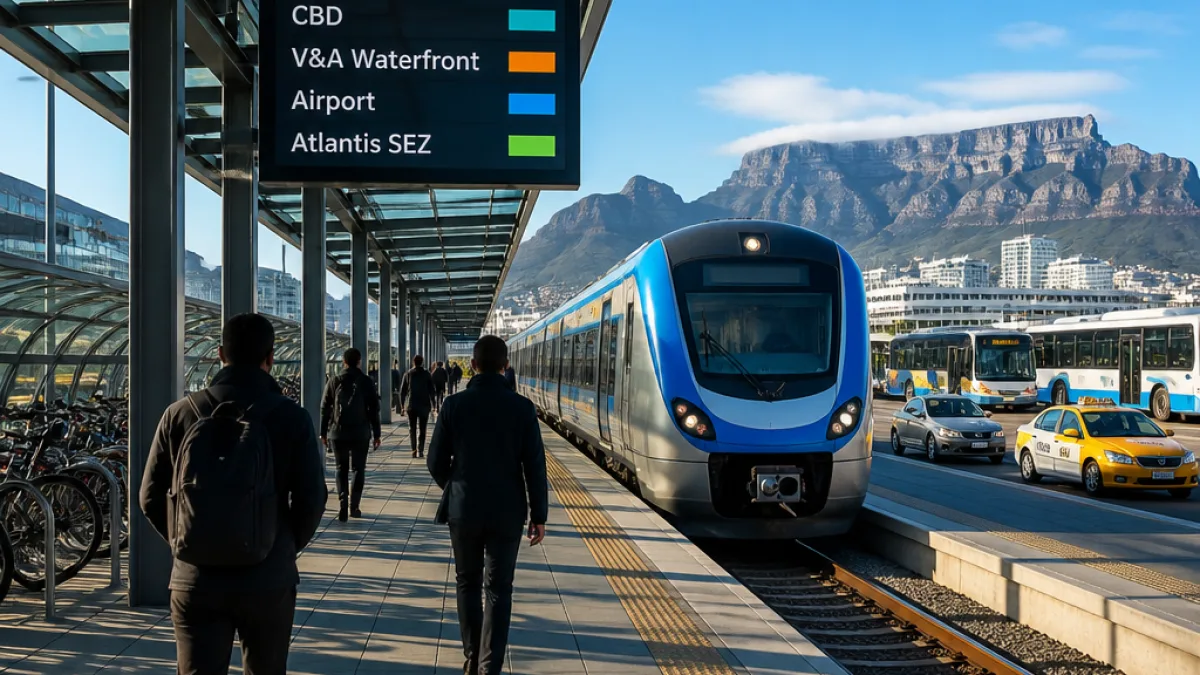
Capetrain Express has proposed a new multimodal station in Century City that its backers say would provide faster, direct links between Cape Town’s northern suburbs and major economic nodes across the metropolitan area. The plan is being positioned as a gateway to the Northern Suburbs, improving connections to the Foreshore, V&A Waterfront and several airport precincts while strengthening Century City’s role as a transport node.
What the proposal would do
According to Capetrain Express, the Century City station would enable commuters in and around Century City to reach employment centres without relying entirely on Cape Town’s congested roads. The proposed service is described as an express connection with onward links to central and coastal precincts, aiming to reduce travel times and provide a reliable alternative to private-car journeys.
The service is expected to offer direct onward connections to:
- Foreshore and the CBD precinct
- V&A Waterfront and the DHL Stadium precinct
- Cape Town International Airport and a planned Cape Winelands Airport link
- Communities to the north and north-west, including Montague Gardens, Table View, Parklands and Melkbosstrand
- Atlantis Special Economic Zone (SEZ) and Malmesbury
- Suburban nodes such as Bellville, Brackenfell and Durbanville
Local and regional implications
If realised, the station could strengthen Century City’s existing role as an economic node and transfer point. For residents commuting from the northern suburbs, an express rail connection could reduce dependence on the N1 and N2 corridors, where congestion is a daily challenge for many.
Capetrain Express frames the project as more than a single stop: it would form part of a wider network extending northwards and along the Western Seaboard, creating new cross-city links that currently require changing modes or long drives. The proposal specifically highlights improved access between residential communities and the areas where jobs and businesses are concentrated.
What is clear — and what is not
The announcement provides an outline of intended connections and the strategic role of a Century City hub, but it does not supply details on funding, a timeline, required approvals or the delivery agency. Those elements will determine whether the project remains a proposal or moves towards implementation.
For commuters, planners and local government, the critical next steps will be feasibility studies, integration with existing rail and bus services, and coordination with municipal transport plans. The alignment with airport links, the Atlantis SEZ and northern townships suggests the proposal aims to combine passenger mobility with economic development objectives.
Practical considerations for commuters
Residents considering future travel options should note the proposal emphasises faster, direct journeys and multimodal transfers. Key practical questions that remain include:
- How the Century City station would integrate with existing Metrorail services and MyCiTi bus routes
- Ticketing and fare integration across modes
- Park-and-ride and last-mile connections for surrounding suburbs
Answers to these questions will have a direct bearing on commuter uptake and the extent to which car trips are displaced.
Routes at a glance
| Direction | Destinations mentioned |
|---|---|
| South / Central | Foreshore, V&A Waterfront, DHL Stadium |
| South-east | Cape Town International Airport, Cape Winelands Airport (planned link) |
| North / North-west | Montague Gardens, Table View, Parklands, Melkbosstrand, Atlantis SEZ, Malmesbury |
| Suburban links | Bellville, Brackenfell, Durbanville |
Outlook
The proposed Century City station forms part of a wider conversation about mobility, urban growth and economic access in Cape Town. Capetrain Express presents the scheme as a fast, reliable commuter alternative that would knit together disparate parts of the metropolitan area and bolster links to employment nodes.
At this stage the proposal provides a directional vision rather than a delivery plan. Transport authorities, municipal planners and residents will need to see detailed proposals on funding, integration and construction before the full implications for travel patterns and local economies can be assessed.
Key developments to watch include any published feasibility studies, formal planning applications, municipal responses and announcements on partnerships or funding that would move the project from concept to construction.