
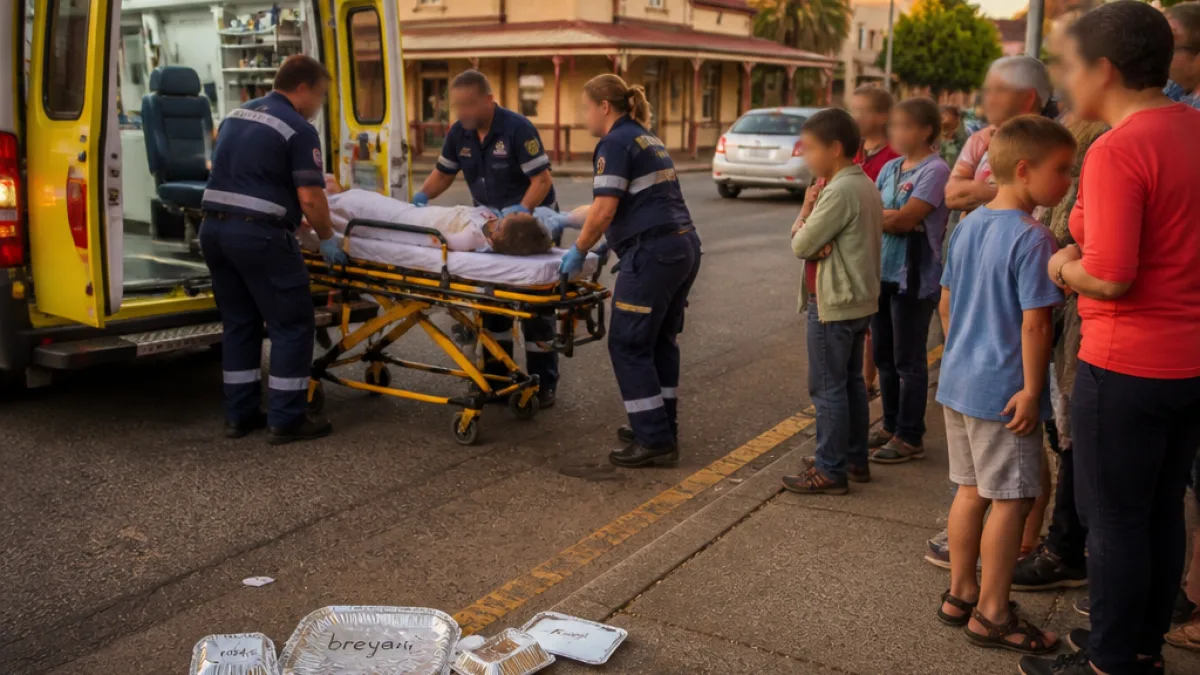
Multiple children taken to Oudtshoorn Hospital after eating street-distributed breyani
At least 33 children, between the ages of six and 13, were taken to the emergency unit at Oudtshoorn Hospital on Sunday after eating breyani that had been handed out in the street, News24 reported on 14 September 2026. The origin of the meal remains unclear and no individual or organisation has claimed responsibility.
"At least 33 children aged six to 13 have been rushed to the Oudsthoorn Hospital after eating breyani handed out in the street."
The incident has prompted concern among parents and community members in Oudtshoorn, who are awaiting a full explanation from health authorities and the municipality. Local emergency and hospital staff provided care for the children; News24's initial report did not detail their clinical conditions or whether any were admitted for longer observation.
Immediate public-health questions and local response
The circumstances — food handed out in a public space, children affected, and uncertainty about who prepared or distributed it — raise several urgent issues for local authorities:
- Whether the food was prepared in a safe environment and stored correctly before distribution.
- If the meal contained allergens or was contaminated with a biological or chemical agent.
- How to trace the distributor(s) and the preparation site to prevent further incidents.
Provincial health services and the local municipality typically have protocols for investigating suspected food-borne incidents. Those include taking samples for laboratory analysis, interviewing affected individuals and witnesses, and tracing the supply chain back to its source. At the time of the News24 report, there was no public confirmation that such steps were completed.
What this means for Oudtshoorn families
Parents and caregivers should be vigilant about accepting food from unknown sources, particularly for young children. Oudtshoorn has a mix of formal and informal community events where food is shared; while communal meals are part of social life, they carry risks if food safety standards are not observed.
| Item | Detail |
|---|---|
| Number of children taken to hospital | 33 |
| Age range | 6–13 years |
| Location | Oudtshoorn Hospital emergency unit |
Health officials normally advise that any sudden cluster of gastrointestinal illness or allergic reactions prompting multiple hospital visits be treated as a potential outbreak until proven otherwise. That means investigations by health inspectors and laboratory testing of leftover food, where available, and of clinical samples.
Political and community accountability
The distribution of free meals in public spaces is not uncommon during community events or as charity efforts. When such actions affect vulnerable groups like children, they quickly become matters of public concern. News24's coverage mentions that no one had claimed responsibility for the breyani at the time of reporting; political players have been quick to distance themselves in similar incidents elsewhere.
For Oudtshoorn residents, clarity about who organised the distribution and whether public health rules were followed will be crucial to restoring confidence. Municipal officials and the provincial Department of Health are the bodies best placed to lead that inquiry and to communicate findings clearly to the community.
Next steps and guidance
- Parents should seek immediate medical attention for children who develop vomiting, diarrhoea, fever, abdominal pain or signs of an allergic reaction after eating shared food.
- Anyone with information about the source of the distributed meal should contact local health authorities or the SAPS to assist the investigation.
- The municipality and provincial health department should publish findings from lab tests and any actions taken to prevent recurrence.
Until investigators release their results, residents are advised to exercise caution around unlabelled or unexpectedly offered food, particularly for children and those with known allergies. The community will follow the outcome of the official inquiry closely; News24's initial report provided the first public notice of the incident on 14 September 2026.












