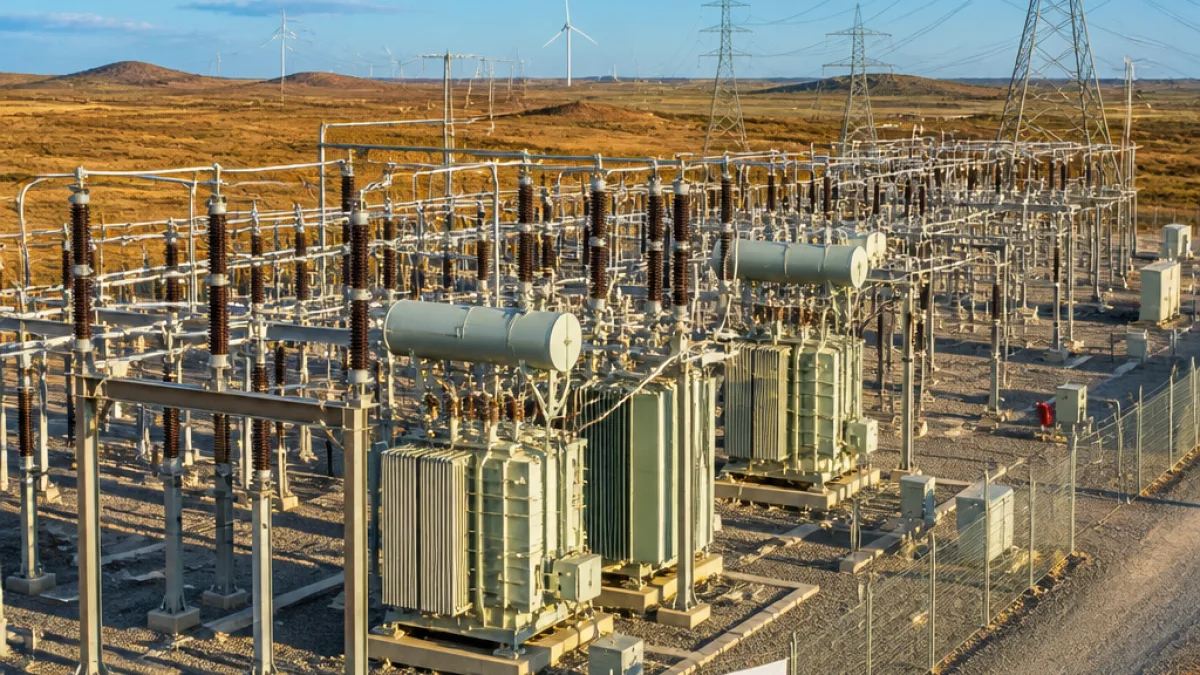
The Aquila Main Transmission Substation (MTS), a 400/132 kV facility in the Northern Cape, has been completed and formally handed over to the national grid, providing an initial transformation capacity of 500 MVA with design provision to expand to approximately 2 GVA.
What has been completed
The National Transmission Company South Africa (NTCSA) confirmed the completion of the Aquila MTS as part of its broader transmission expansion programme. The new substation will strengthen the electricity network in one of South Africa’s key renewable energy development regions, supporting the connection of new generation capacity and providing immediate transmission capacity to the grid.
Why this matters for the Northern Cape
The Northern Cape holds significant renewable energy resources, particularly for solar and wind projects. Regional developers and independent power producers have identified transmission availability as a constraint in unlocking new capacity. The Aquila MTS addresses part of that constraint by putting additional transformation capacity onto the grid while allowing for future growth through its planned expansion to around 2 GVA.
- Immediate increase in transformation capacity: 500 MVA.
- Planned expansion capacity: provision for ~2 GVA in future phases.
- Supports connection of new generation and strengthens regional security of supply.
Expected benefits and implications
According to the NTCSA, the Aquila MTS forms part of an effort to increase grid capacity to accommodate new electricity generation and to support economic growth. The substation is expected to:
- Enable new renewable energy projects to connect to the national grid.
- Reinforce regional electricity supply and help manage future demand growth.
- Contribute to investor confidence in the province’s renewable energy corridor by improving transmission readiness.
Technical snapshot
| Parameter | Detail |
|---|---|
| Nominal voltages | 400/132 kV |
| Initial transformation capacity | 500 MVA |
| Provision for expansion | Approximately 2 GVA |
Collaboration and context
The NTCSA’s announcement highlights collaboration between the transmission utility, government, independent power producers and industry partners. The Aquila MTS is one element in a nationwide transmission expansion programme intended to unlock generation capacity and strengthen the grid as South Africa’s electricity mix shifts.
In the context of the Northern Cape, where large-scale solar and wind projects are concentrated, transmission capacity has been a decisive factor for development timelines. Projects seeking grid access typically require both physical connection points and sufficient transformation capacity to evacuate generated power to demand centres.
Local impact and next steps
For communities and businesses in the region, improved transmission capacity can translate into a more reliable electricity supply, support for local investment and potential job creation linked to construction and operation of new generation. For the renewable energy sector, the Aquila MTS reduces a supply-side barrier to new projects, although generation developers will still need to secure permits, financing and contractual arrangements.
The NTCSA said the facility has been handed to the grid and is available for the connection of additional generation capacity. The next steps will include scheduling and coordinating specific generator connections, further construction if expansion is required, and ongoing maintenance and operational testing as projects come on line.
While the handover is a technical milestone, the practical realisation of additional renewable capacity will depend on project-level progress and continued coordination among state bodies, developers and financiers.
The Aquila MTS represents a tangible increase in regional transmission capability and a forward-looking design that recognises the need for scalable infrastructure as South Africa seeks to integrate more renewable generation into the national system.