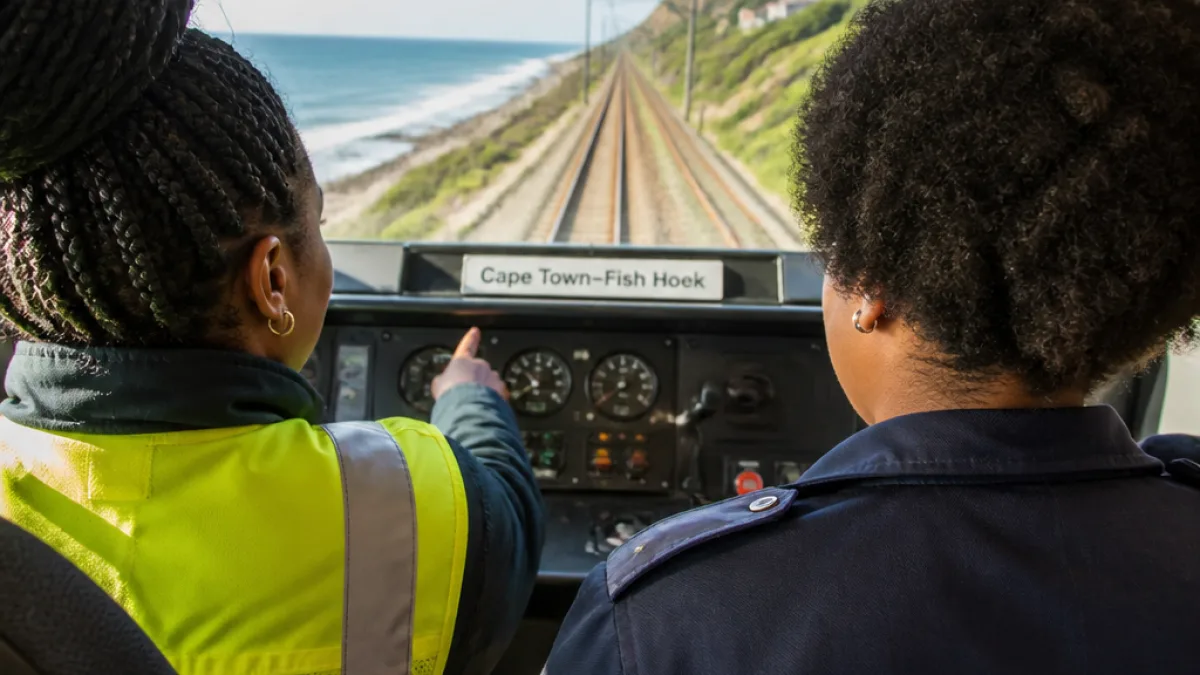
Western Cape Mobility Minister Isaac Sileku sat in the driver’s cab of a PRASA train on a Cape Town to Fish Hoek service this week to observe the work of one of the province’s female drivers and to draw attention to the role women play in moving thousands of passengers across the rail network.
Hands on a busy commuter route
The minister travelled alongside Nikita Maarman, a train driver originally from Mitchells Plain, who has worked on Cape Town’s rail system since 2009. The trip from Cape Town Station to Fish Hoek lasted about an hour and gave Sileku a close-up view of the checks and split-second decisions that come with operating commuter rail.
Maarman described routines that begin long before departure: early starts—sometimes as early as 04:00—preparing the train, checking the day’s safety bulletins and maintaining constant vigilance for signals, speed limits and station stops while on the move.
“What I enjoy most about this career since I started back in 2009 is the daily responsibility of getting people safely to their destinations and knowing that women have a strong, visible place in this industry,” said Maarman, who urged young women from communities such as Mitchells Plain not to be deterred from rail careers.
Women gaining ground in a traditionally male sector
PRASA Western Cape employs 65 female train drivers across the region. While the rail industry has historically been male-dominated, the minister said the on-board experience reinforced how essential the work is to commuters and how visible women are becoming in the sector.
Sileku said spending time in the cab provided perspective on both the technical complexity of operating a train and the human responsibility of transporting hundreds of residents each trip. The minister described the exercise as useful for shaping provincial thinking on mobility and commuter safety.
What it takes to be a train driver
Prospective drivers must have a Matric that includes Mathematics and Science. After that, candidates undertake roughly 18 months of combined classroom instruction and practical on-the-job training before qualifying to operate trains on the network.
- Minimum academic requirement: Matric with Mathematics and Science
- Training duration: about 18 months of theory and practical work
- Typical shift pattern: very early starts (from about 04:00) and sustained concentration while driving
Local impact and recruitment message
Maarman’s background in Mitchells Plain was highlighted during the ride as part of a wider message about opportunity and representation. She wants young women, particularly from working-class areas, to see rail as a viable career path.
For commuters, the presence of experienced drivers such as Maarman is a practical matter: safe, punctual services depend on training, operational readiness and staff who can react instantly to changing conditions on tracks and at stations.
Quick facts
| Item | Detail |
|---|---|
| Driver | Nikita Maarman |
| From | Mitchells Plain |
| Years as driver | Since 2009 |
| Route observed | Cape Town Station to Fish Hoek |
| Female drivers in region | 65 |
What this means for passengers and the sector
The minister’s ride-along served both symbolic and practical functions: it signalled provincial attention to commuter rail operations and amplified a message about equity of access to skilled employment. It also underlined that the delivery of safe rail services relies on well-trained staff who can manage early starts and operational pressures.
As the Western Cape continues to seek improvements in public transport reliability, recruitment and training of drivers — and encouraging broader demographic representation in those roles — will remain part of the conversation between provincial government, PRASA and the communities that rely on rail.
For residents considering a career in rail: ensure your Matric includes Mathematics and Science, investigate PRASA training intakes, and be prepared for intensive practical training and early shift starts.
By taking a seat in the cab, Sileku and Maarman offered commuters a moment of transparency about what it takes to run Cape Town’s trains — and issued a public reminder that the rail workforce is changing, one qualified driver at a time.