
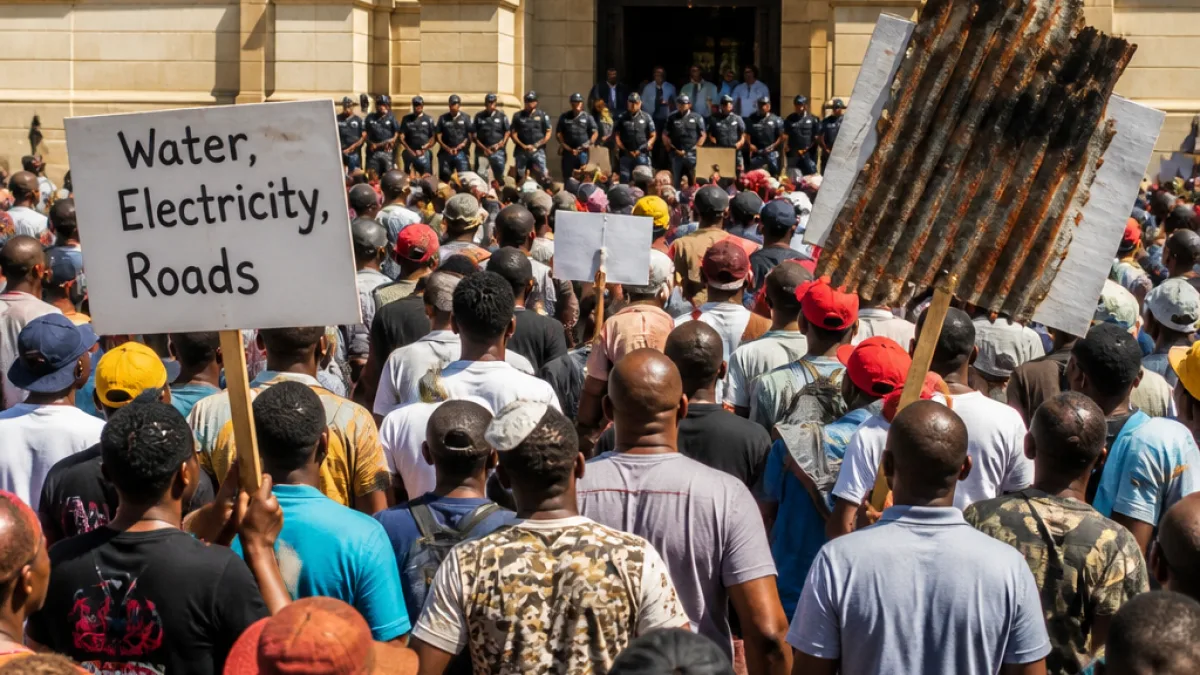
More than 100 residents from the Mfuleni area of the Cape Flats marched to the Western Cape Premier’s office and the Civic Centre in Cape Town on Friday to press for basic services, including reliable water supply, electrification and access roads into informal settlements.
Immediate demands and the threat to escalate
Protest organiser Bathandwa Gali told reporters the group would intensify actions if their memorandum is not addressed. He warned that demonstrators could “shut down the N2” — a major arterial route — should their demands be ignored, signalling a readiness to disrupt commuter traffic and commerce to draw attention to longstanding service gaps.
“If we don’t get what we want, we won’t return here, we will shut down the N2,” said Gali, according to reporting.
Residents said the protest followed a fatal shack fire in November last year in which Noyiba Thini and her son sustained severe burns; Thini later died in hospital. Community members say the absence of on-site water and electricity leaves them vulnerable to fires and limits emergency response.
Daily hardships cited by residents
Several residents described the everyday consequences of living without adequate services. Siphumelelisa Gogotya, who cares for two grandchildren, said she limits their reading to daylight because the household relies on candles and firewood for light and cooking. Gogotya reported spending about R200 a month on firewood and borrowing money to buy candles.
She also said water collection consumes hours of her day: she wakes before dawn to queue at a communal tap in a neighbouring informal settlement to avoid long lines. Community leader Phumeza Maxakatho said many shack dwellers must rely on taps and toilets at adjacent formal houses in Extension 6, and that residents are sometimes denied access when homeowners lock their facilities.
Safety, policing and road access
Organisers argued that constructing roads into informal settlements would improve policing and emergency services’ reach, which they say would reduce crime and speed up responses to fires. “The crime rate is high in our areas because the police can’t patrol. Once we get roads, the police will patrol and the crime rate will decrease,” Gali said, according to reporting.
Officials accept memorandum
Provincial and city officials who met the group accepted the memorandum. Albert Dlwengu, director for policy and strategy at the Western Cape Department of Local Government, said he would deliver the document to the Premier. Andre Louw of the City of Cape Town’s public participation department told the demonstrators he would hand the memorandum to the relevant city offices.
The officials’ acknowledgements do not include a timetable for action in the reporting. The protest highlighted tensions between urgent community needs and the logistical, planning and budgetary constraints that governments cite when addressing informal-settlement upgrading.
Context: service delivery and informal settlements in Cape Town
Informal settlements around Cape Town have long campaigned for formal water taps, sanitation and safe electrification. Fires in these areas can spread rapidly because of closely spaced structures and flammable building materials; residents say the lack of internal access for emergency vehicles worsens outcomes.
Advocacy groups and urban planners have repeatedly urged scaled-up investment in in-situ upgrading and targeted road and service infrastructure inside informal settlements, but progress is uneven and often delayed by land-use, funding and municipal coordination challenges.
What residents want
- On-site water taps to avoid long queues and early-morning trips to communal taps;
- Electrification of shacks to reduce reliance on candles and firewood and free up grant money for food;
- Access roads within settlements so police and emergency services can reach homes quickly;
- Sanitation facilities that do not depend on access to neighbouring formal houses.
| Issue | Impact cited by residents |
|---|---|
| Water | Long queues, pre-dawn collection, limited dousing capacity in fires |
| Electricity | Use of candles and firewood; monthly cost burden (~R200); fire risk |
| Road access | Poor policing, delayed emergency response, higher crime and fire damage |
For now, residents have left the memorandum with provincial and city officials and warned of further action if there is no meaningful response. The protest underscores persistent service-delivery gaps in Cape Town’s periphery and the pressure such gaps place on vulnerable households.
Reporting from the demonstration was used as the basis for this article; officials from the Western Cape government and the City of Cape Town confirmed receipt of the memorandum but did not provide a schedule for interventions in the reporting.














