
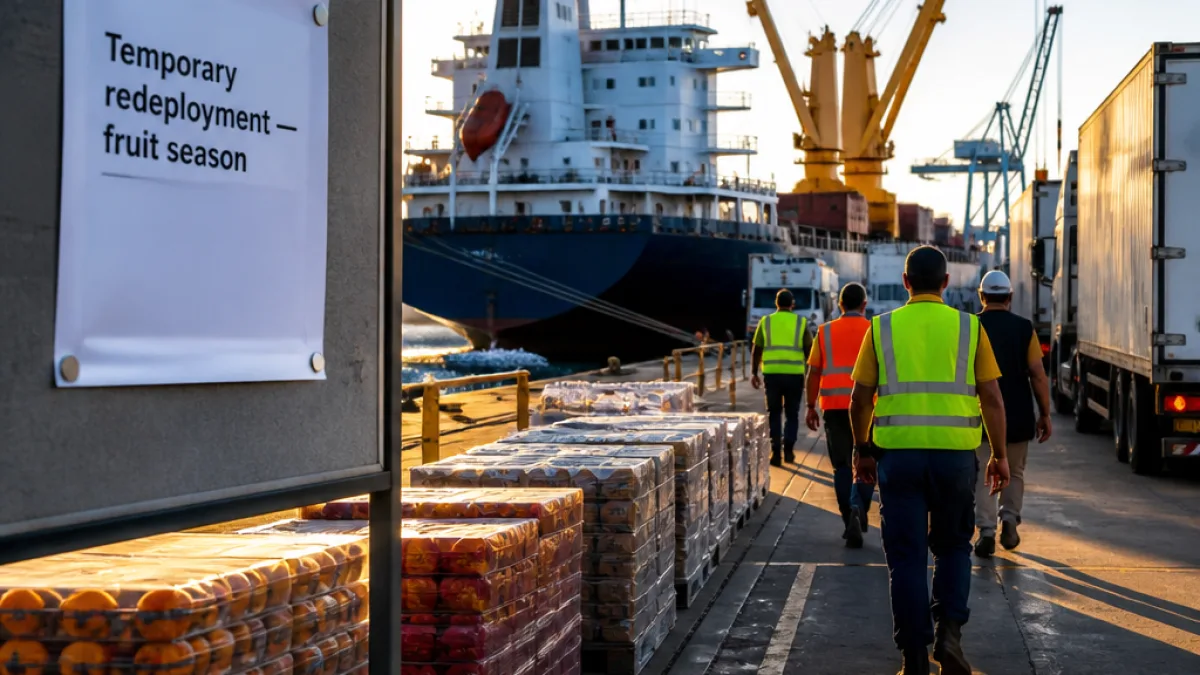
Port labour redeployment announced to protect fruit exports
Transport Minister Barbara Creecy has said that port workers from Durban and Gqeberha will be transferred to the Port of Cape Town to assist during the summer fruit export season. The move is intended to ensure South Africa meets export schedules during a critical period for the fresh-produce trade.
The announcement, reported by News24, said the transfers would be temporary and that cargo would also be diverted to Cape Town to cope with the surge in fruit volumes over the summer months. No further operational details or timelines were provided in the report.
What this means for Gqeberha
The decision to redeploy labour and divert cargo has immediate local implications. Gqeberha is one of the country’s key port cities, and the redeployment of skilled dockworkers could affect throughput, daily operations and short-term employment patterns at the port. Seasonal transfers can preserve export earnings nationally but alter work schedules and logistics locally.
Local exporters, stevedoring firms and transport operators that rely on steady dock labour may need to adjust. Municipal and private-sector freight planning, road haulage schedules and cold-storage logistics could also be affected if containers and fruit consignments are routed through Cape Town rather than shipped directly from Gqeberha.
- Who: Transport Minister Barbara Creecy (reported).
- Action: Transfer of port workers from Durban and Gqeberha to Cape Town; diversion of cargo to Cape Town.
- Purpose: Assist with the summer fruit export season and protect export windows.
Minister Creecy said port workers will be transferred to Cape Town Port to assist with the fruit export season during the summer months, according to News24.
Local questions remain
Several practical questions remain unanswered in the report: how many workers will move, whether transfers are voluntary or contractual, the expected duration of redeployment, and how pay and allowances will be handled for those working away from their home ports. The report did not include comment from labour unions, port operators or the National Ports Authority.
For Gqeberha’s economy, the arrangement is a double-edged sword. On one hand, protecting the national fruit export season supports farm incomes, shipping contracts and foreign exchange earnings linked to the Eastern Cape agricultural supply chain. On the other hand, short-term labour movements can strain local operations and add costs for companies that must reroute cargo by road or rail to Cape Town.
| Item | Known detail (from report) |
|---|---|
| Origin of workers | Durban and Gqeberha |
| Destination | Port of Cape Town |
| Reason | Fruit export season (summer) |
Industry stakeholders commonly stress the importance of clear communication from the Department of Transport and Transnet when labour shifts are proposed. Ports operate as integrated systems: staffing changes in one hub can ripple across shipping schedules and hinterland connections.
Gqeberha residents and local businesses seeking clarity should watch for further statements from the Department of Transport, Transnet and the National Ports Authority. Unions and employer bodies will also be key to understanding the mechanics of any movement of workers and the protections for staff sent to other ports.
For now, the announcement underscores how national priorities during peak export seasons can prompt exceptional operational measures — measures that aim to protect export windows but which require careful coordination to limit disruption at origin ports such as Gqeberha.














