
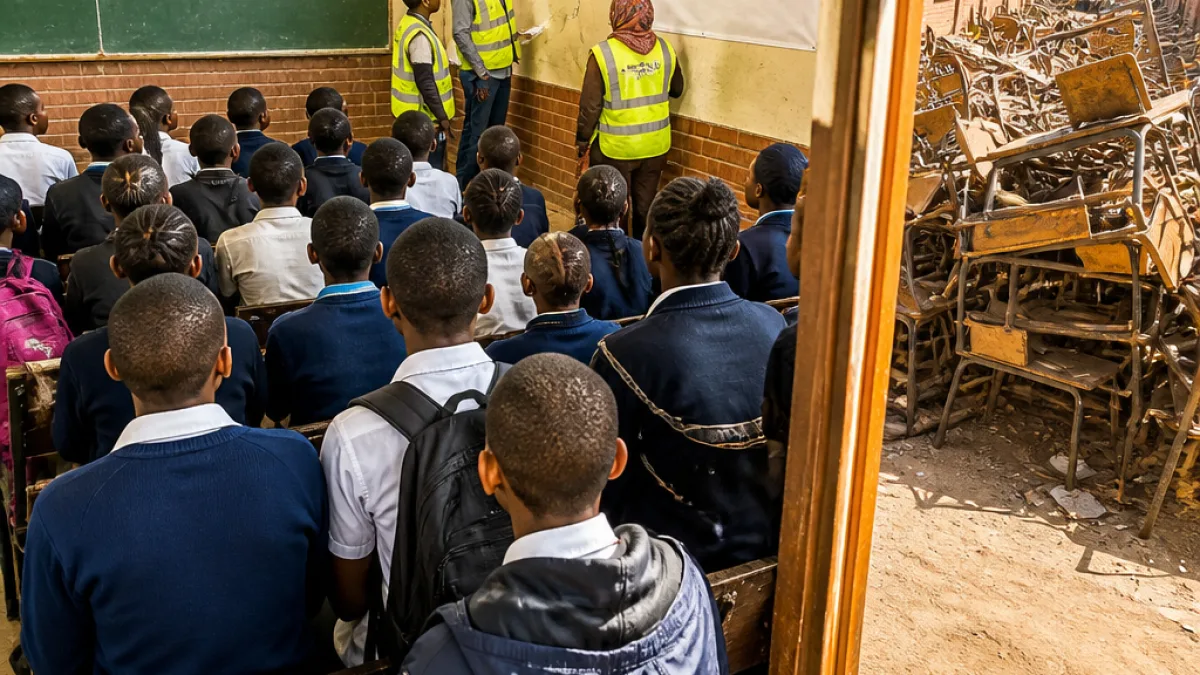
Gauteng Education MEC Lebogang Maile says the provincial department is turning a wave of community concerns into concrete action to relieve chronic overcrowding, address severe furniture shortages and fix dangerous school infrastructure.
From meetings to actions
Maile announced the move following a week-long outreach that reached every one of the province’s 15 education districts. The department’s #ItTakesAVillageToRaiseAChild programme held 41 community meetings that drew 11 294 people, as well as 25 school visits and 24 sports-hub visits.
He said the goal was not simple consultation but to ensure every complaint has a responsible official, a planned intervention and a clear route to resolution.
“Matters that can be resolved immediately must be resolved,”
The message underlines a shift towards faster, accountable responses where possible, Maile said at a media briefing on Monday, 10 August.
Overcrowding: a province-wide squeeze
Gauteng has more than 2 000 public ordinary schools serving roughly 2.4 million learners. The outreach found that 1 021 schools — about 48% — are oversubscribed or overcrowded.
Secondary schools are particularly strained: they are accommodating about 943 089 learners while infrastructure capacity sits at approximately 855 081, leaving a deficit of about 88 000 learner spaces. The department is pursuing a mix of temporary relief measures, strategic expansions and better utilisation of nearby school capacity to ease the pressure.
Furniture gaps prioritised
The 2026 school readiness audit exposed acute shortages of classroom furniture across both primary and secondary sectors. The department is consolidating verified needs and prioritising deliveries so schools receive resources based on evidence rather than ad hoc requests.
- Primary schools: short of 67 855 chairs and 25 990 double desks
- Secondary schools: short of 111 333 chairs and 98 115 single desks
Infrastructure complaints escalated to technical teams
Communities also raised serious infrastructure concerns, including damaged ceilings, broken windows, unsafe floors, failing ablution facilities, water supply problems and damaged electrical systems. Schools with the most severe defects have been flagged for technical assessment and intervention.
Maile said the department will follow standard assessment procedures to determine the scope and cost of repairs before deploying contractors or technical teams. The outreach helped create a prioritised list of schools requiring immediate attention.
What parents and communities can expect
Officials say the immediate focus will be on rapid, low-cost fixes and better allocation of existing space while planning medium-term capital projects. Where classrooms are unsafe, learners may be temporarily relocated to nearby schools or alternative spaces while repairs are done.
The outreach also sought to close gaps in communication: community members were urged to raise concerns through established district offices so issues can be recorded, assigned and tracked to completion.
Data snapshot
| Measure | Figure |
|---|---|
| Public ordinary schools | 2 000+ |
| Learners in province | ~2.4 million |
| Oversubscribed schools | 1 021 (48%) |
| Secondary learner shortfall | ~88 000 spaces |
| Primary chairs short | 67 855 |
| Secondary chairs short | 111 333 |
Next steps and the bigger picture
Responding to overcrowding and infrastructure decay will require co-ordination between the education department, municipalities (for water and sanitation), provincial treasury (for capital allocations) and the schools themselves. Maile suggested that some solutions will be operational — re-purposing spaces, shifting timetables and using nearby facilities — while others will need capital investment and planning.
For parents and guardians, the department’s immediate promise is a transparent process: verified needs will be prioritised and tracked. The outreach has produced a starting point, but the scale of shortages means many fixes will be staged over months or years.
As Gauteng houses a large share of the country’s learners, the province’s approach to overcrowding, furniture and infrastructure will be closely watched by other provinces and education stakeholders. The department says it will provide progress updates as interventions are rolled out.











