
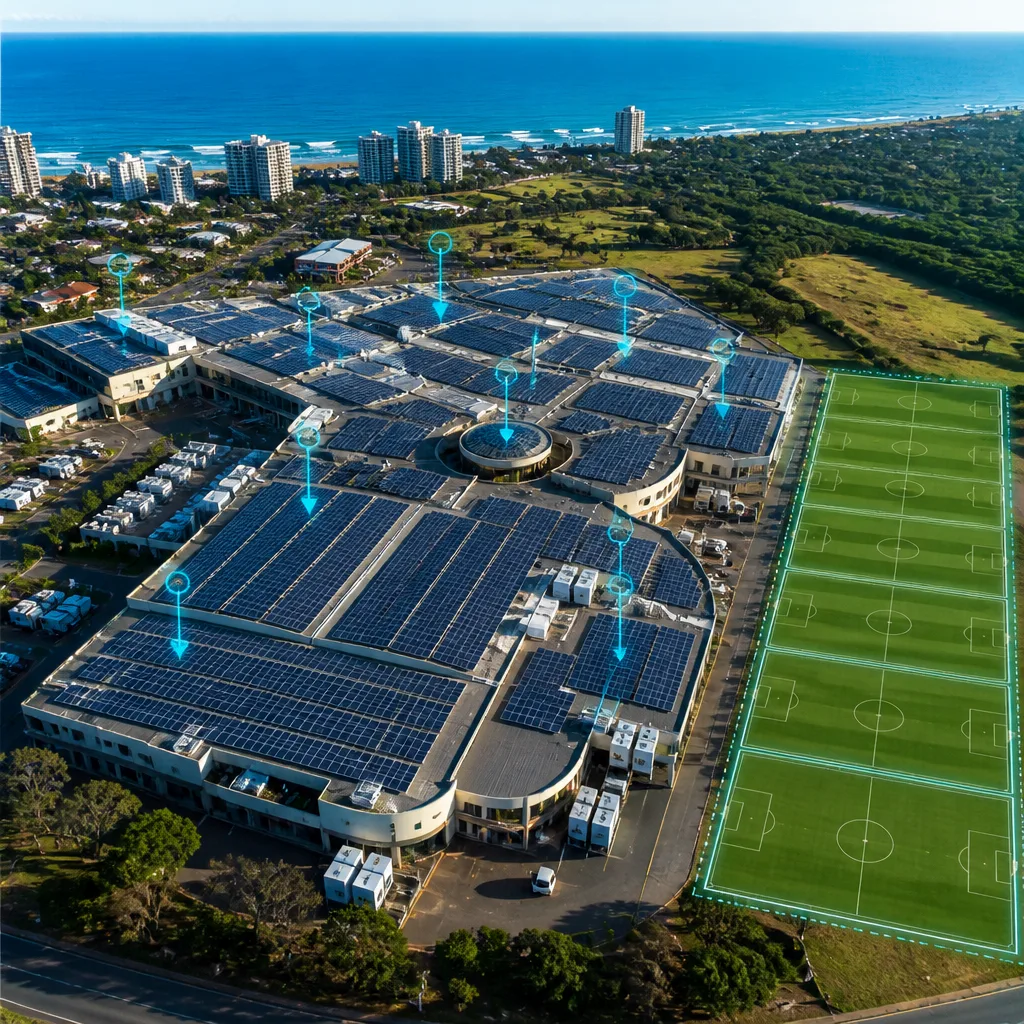
Gateway Theatre of Shopping in Umhlanga has completed a rooftop photovoltaic (PV) installation with a peak capacity of 7.67MWp, the largest mall-based system in the country, project partners reported.
Scale, equipment and logistics
The system comprises 11,353 solar panels spread across 35 roofs, occupying roughly 35,200m² — about 4.93 regulation FIFA soccer fields. Forty-two 150kW inverters, installed in nine inverter stations, convert the panels’ DC output to AC power suitable for mall appliances and services.
The installation expands on an earlier on-site rollout of 1.15MWp completed in 2022. Solink, the renewable energy consultancy involved, said coordinating work at a major shopping centre presented unique engineering and execution challenges. In a LinkedIn post the company celebrated the outcome:
“The result speaks for itself. Huge congratulations to our teams and EPC partner Rhino Energy Solutions.”
Context: malls, private generation and cost drivers
The Gateway project overtakes the system at Eastgate Shopping Centre in Germiston — a 7.263MW installation completed in late 2024 — as the country’s largest mall rooftop array. Only one other mall rooftop system has a capacity above 7MW, the SolarAfrica installation at Trade Route Mall in Lenasia, according to the reporting.
These mall installations are part of a broader expansion of private electricity generation. Since 2018, 2,619 large private generation facilities have been registered with the National Energy Regulator (NERSA). Initially, businesses installed generators and solar arrays to bolster energy security during years of load-shedding. More recently, the primary driver has shifted to cutting exposure to rising electricity tariffs.
The economics behind the switch are stark: while Eskom’s prices have climbed by over 1,000% in the last two decades, the cost of solar power equipment has fallen by more than 90%. That divergence has pushed many large energy users to consider or adopt self-generation.
What this means for malls and shoppers
- Operational resilience: a large rooftop system provides a measure of on-site generation that can reduce dependency on the grid during load-shedding periods.
- Cost management: generating a portion of their electricity can help malls insulate tenants and common-area operations from escalating tariffs.
- Technical complexity: large multi-roof installations require coordination of structural assessments, wiring, inverter placement and safety systems, especially where retail activity continues during construction.
For shoppers, the immediate benefits are indirect: more reliable lighting, escalator and lift operation during planned outages, and potential downward pressure on rental or utility recoveries if malls achieve material savings.
Numbers at a glance
| Site | Capacity (MWp) | Notes |
|---|---|---|
| Gateway Theatre of Shopping | 7.67 | 11,353 panels; 35 roofs; ~35,200m² |
| Eastgate Shopping Centre | 7.263 | Completed final phase in late 2024 |
| Trade Route Mall (Lenasia) | >7 | Installed by SolarAfrica |
Policy and market implications
The expansion of large rooftop systems at commercial properties has consequences for grid operators, regulators and municipal electricity departments. Widespread self-generation changes daytime demand profiles, can reduce peak loads on local networks, but also raises questions about grid maintenance cost allocation and tariff design.
For businesses and developers, the Gateway project highlights that rooftop solar at scale is now technically and financially viable for large commercial properties. As equipment costs continue to decline and tariffs rise, similar projects are likely to proliferate across malls, industrial estates and large office campuses.
While the Gateway system does not eliminate the need for grid power or backup generation entirely, it represents a clear example of how private investment is reshaping South Africa’s energy landscape — driven by the twin pressures of unreliable supply and long-term price increases.
Who built it: Solink and Rhino Energy delivered the project; Solink has consulted on other major mall systems, including Eastgate’s 7.263MW array.










