
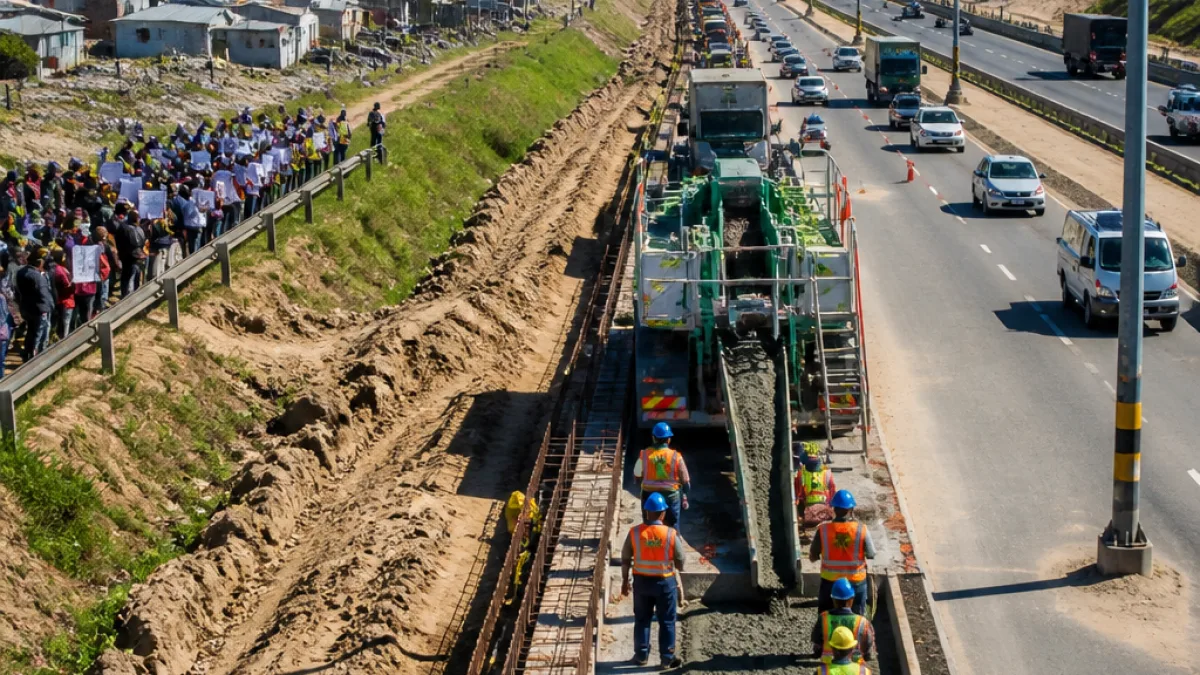
The City of Cape Town has confirmed it will proceed with the N2 Edge Safety Project, a R114.7 million programme that includes erecting a concrete barrier along a nine-kilometre section of the N2, Municipal Building and Transport offices said on Thursday. The planned rehabilitation covers the highway from the Baden Powell Road intersection near Khayelitsha through to Bhunga Avenue in Langa.
City frames wall as safety measure
Mayor and DA mayoral candidate Geordin Hill-Lewis said the City was committed to improving safety for motorists, pedestrians and surrounding communities and insisted the intervention was necessary because the existing palisade fence had “fallen into disrepair” after decades in place. He argued that allowing unrestricted pedestrian access to a national road posed an unacceptable risk and pointed to recent incidents to underline the danger.
“There is nowhere in the world where you can have unrestricted access to a national road. We have to address that,”
Hill-Lewis also referred to the recent death of a 16-year-old boy from Khayelitsha, who was struck by a vehicle on the N2 while allegedly involved in criminal activity. He said approximately 70% of pedestrian deaths in the City occur on the N2, and described the highway as particularly hazardous for people on foot.
Public debate and opposition
The decision has provoked criticism from residents, community organisations and political parties. Opponents have questioned whether a concrete barrier is the right response to the complex problems that exist along parts of the N2, including poverty and crime, and whether the R114.7 million could be better spent on housing, social development and community safety programmes.
- Supporters say the current fence is dilapidated and a physical barrier is required to prevent pedestrians accessing a busy national route.
- Critics argue the wall may hide visible poverty and displacement from motorists travelling between Cape Town International Airport and the city.
- The ANC has publicly questioned the City’s priorities and suggested alternative social interventions could achieve better outcomes.
What the project includes
The City’s budget documents list the rehabilitation as costing approximately R114.7 million. Officials describe the works as replacing the existing concrete palisade fence and controlling access along the corridor between Khayelitsha and Langa.
| Item | Detail |
|---|---|
| Length | 9 km (Baden Powell Road to Bhunga Avenue) |
| Budget | R114.7 million |
| Objective | Rehabilitation of barrier and controlled access to N2 |
City officials say the aim is to reduce pedestrian access points that create dangerous interactions between people and high-speed traffic on the national road. The proposal has already generated a heated public conversation, with residents and community organisations raising concerns about cost and whether physical infrastructure alone will address the root causes of crime and pedestrian risk.
For many Capetonians the issue raises broader questions about how municipal budgets are allocated: balancing immediate safety interventions on major transport arteries with longer-term investments in housing and social development for communities adjacent to the N2. The City has framed the project as a necessary safety upgrade; critics say it would be better paired with measures that address the social and economic pressures that bring people into contact with the highway.
As the programme moves forward, the City will need to answer detailed questions about design, community engagement and how the works will be implemented without further disadvantaging residents who live along the corridor. The debate is likely to feature in local political discourse in the run-up to the municipal elections as Capetonians weigh competing claims about safety, visibility and municipal priorities.














