The South African Border Management Authority (BMA) ran a public–private pilot that combined surveillance technology, protected mobility vehicles and cybersecurity systems at the Beitbridge (Zimbabwe) and Lebombo (Mozambique) border posts during the 2025–26 holiday travel period.
What was deployed and why it matters
Private sector partners supplied an integrated suite of tools intended to speed legitimate travel, improve incident documentation and help dismantle organised crime networks operating across the borders.
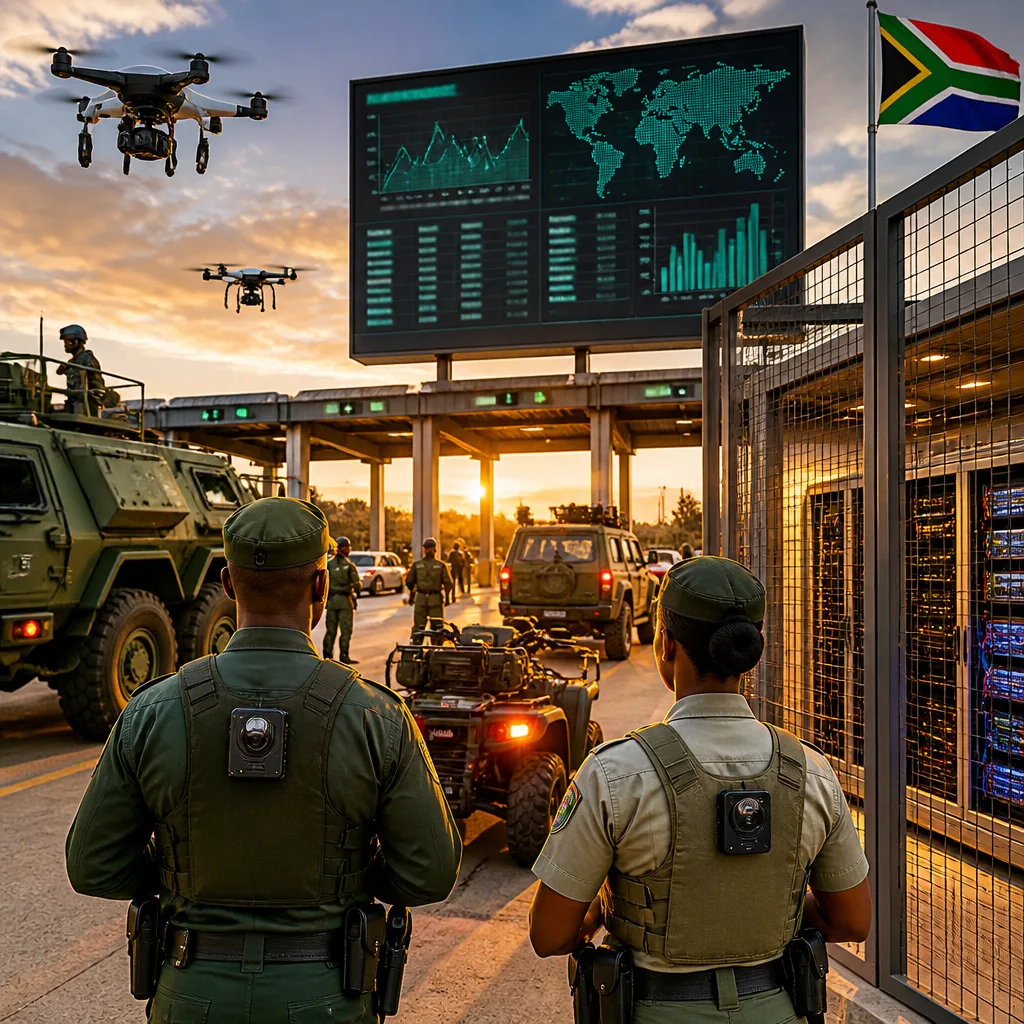
- DCD Protected Mobility provided two Springbuck personnel carriers and one all‑terrain vehicle for patrols in rugged terrain.
- Unipro Protective Wear supplied body cameras with on‑device analytical functions, including facial recognition and number‑plate recognition.
- Snode Technologies delivered cybersecurity solutions to protect systems and data used in the operations.
- A2D Geoscan and Battlecopter supplied unmanned aerial vehicles (drones) for aerial situational awareness.
The partnership was described as a pilot exercise to show what government collaboration with defence and technology firms can achieve in a border environment. The use of analytics and drones represents a growing trend in applying commercial surveillance and mobility technologies to national border management.
Operational outcomes over the holiday period
The pilot ran from 10 December 2025 to 15 January 2026. Officials reported processing more than 4.9 million travellers through the two crossings during that window. At the same time, the operation intercepted 26,852 people attempting to enter irregularly and resulted in 81 arrests for serious offences including possession of stolen vehicles, illegal firearms, drugs and explosives, according to the reporting.
| Metric | Figure |
|---|---|
| Operational period | 10 Dec 2025 – 15 Jan 2026 |
| Travellers processed | 4.9 million+ |
| Irregular entrants intercepted | 26,852 |
| Arrests for serious offences | 81 |
"The message is clear: South Africa’s borders are no longer soft targets," Authority Commissioner Dr. Michael Masiapato said, adding that the effort aimed to dismantle criminal networks while facilitating legitimate trade and travel.
Questions for oversight, privacy and long‑term strategy
While the reported results are tangible, the pilot raises questions that deserve public scrutiny. Deploying facial recognition and number‑plate recognition at busy border posts affects privacy, South Africa’s data protection obligations and the accuracy of biometric systems in diverse populations. The reporting notes the use of body cameras with analytical capability but does not specify data retention policies, who will access footage, or how false positives will be handled.
Cybersecurity also becomes a central issue when law‑enforcement and border systems are linked to commercial platforms and aerial systems. The involvement of Snode Technologies for cybersecurity points to awareness of these risks, but the details of system architecture, encryption, and resilience against tampering or hacking were not disclosed in the reporting.
Operational transparency is another matter. The pilot’s apparent success in intercepting irregular entrants and effecting arrests will be examined alongside metrics for lawful processing times, traveller experience and the protection of human rights. Independent oversight and clear reporting standards will matter if such technologies are scaled to more crossings.
What comes next
The BMA described the initiative as a demonstration project. If the technology and public–private model are rolled out at other crossings, policy choices will need to balance operational effectiveness, civil liberties and the cost of procurement and maintenance. For ordinary travellers, any expansion should aim to reduce delays and improve safety without creating new privacy burdens or error‑prone automated enforcement.
The details in this report were provided by partners and are reflected in reporting from defenceWeb. As South Africa considers broader adoption of surveillance and mobility technologies at its borders, parliament, oversight bodies and data‑protection authorities will play a key role in setting the rules that govern their use.