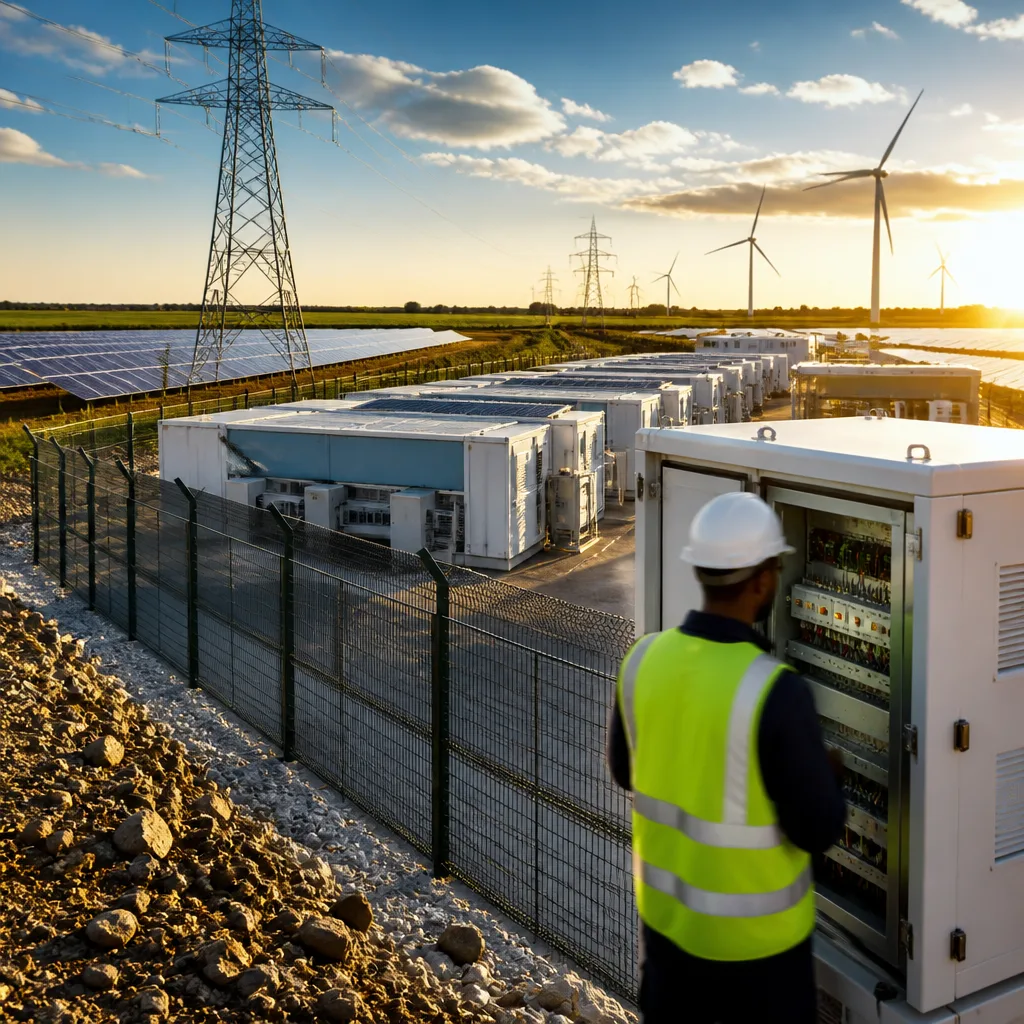
Battery energy storage systems (BESS) are fast becoming a central tool for resolving a bottleneck that now threatens South Africa’s renewable energy ambitions: the national grid’s limited capacity to connect new generation where and when it is needed. Recent reporting highlights that, while developers have advanced projects totalling large gigawatts, transmission and distribution constraints mean the electrons cannot always be delivered to businesses and homes.
Why batteries matter now
A BESS is typically a large-scale installation made up of lithium-ion batteries that store electricity generated from renewables such as wind and solar, then release it when demand is higher or the grid requires support. In practice, batteries allow generation and consumption to be decoupled by time and location, which helps to manage congestion and make better use of clean energy.
The current system pressures that make BESS critical include:
- Network congestion: Batteries can inject power where the grid is strained or absorb excess generation to prevent overloads.
- Curtailment reduction: BESS store surplus renewable output during low-demand periods instead of letting it go to waste.
- Grid stability: Batteries respond quickly to fluctuations in supply and demand, supporting frequency and voltage control.
- Peak shaving: Discharging stored energy during high-demand times reduces reliance on expensive peak generation and can lower costs for large users.
Scale of the challenge
Recent reporting notes that South Africa has 72 GW of renewable projects at advanced stages of development and a further 220 GW in the pipeline. Those figures illustrate a mismatch between generation ambitions and current grid capacity: planning and construction of wind and solar farms are moving faster than transmission and distribution upgrades.
| Metric | Capacity |
|---|---|
| Renewables at advanced stages | 72 GW |
| Renewables pipeline | 220 GW |
That imbalance means developers and grid operators are increasingly viewing BESS not as optional add-ons but as a central component of future project design. The systems can be deployed either behind the meter to serve a specific site or connected to the transmission/distribution network to provide system-wide benefits.
How BESS would change project economics and operations
Batteries can reduce the need for costly network reinforcements in the short term by managing local congestion and smoothing output from variable generation. For businesses, this could mean improved reliability and protection against load-shedding by using stored energy during outages or peak periods. For the grid, widespread BESS deployments would provide flexibility services that traditional thermal plants once supplied.
However, integrating BESS at scale raises questions about financing, regulation and market design. Developers, lenders and users need clarity on revenue streams for storage services, as well as on technical standards and interconnection procedures. Without predictable rules and incentives, the private sector may hesitate to commit the capital required for large storage projects.
Recent reporting outlines that government and industry actors are already moving: Eskom’s distributed battery energy storage programme was cited as an example of this shift. But the success of BESS as a tool to unlock the renewable pipeline will depend on aligning procurement, network planning and commercial frameworks so that storage investments are bankable and deliverable.
What this means for South Africans
For ordinary consumers and businesses, a faster roll-out of battery systems could mean better reliability and more efficient use of the renewables being built near them. For the wider energy transition, BESS offer a practical route to bring forward the benefits of wind and solar while the larger, slower work of grid expansion and reinforcement continues.
In short, batteries do not replace the need for transmission investment, but they provide a pragmatic, deployable tool to manage the present constraints. The next steps will be political, regulatory and financial: creating clear market signals so that BESS can attract long-term capital and become a stable feature of South Africa’s electricity landscape.