
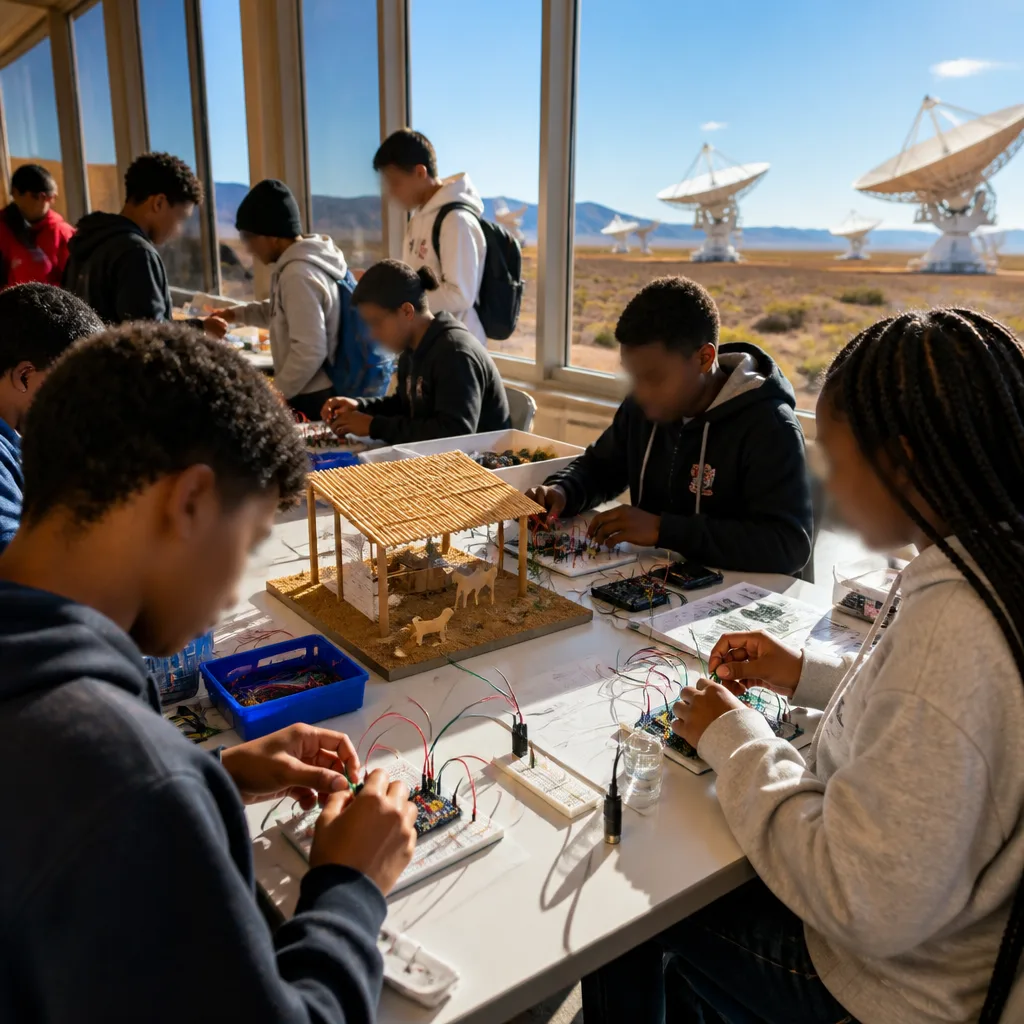
Thirty secondary school learners from Toconao and San Pedro de Atacama spent two days at the Atacama Large Millimetre/submillimetre Array (ALMA) facilities for the opening sessions of a special edition of the Atacama Makers programme. The workshops combined basic programming, circuitry and design thinking so the pupils could propose technological responses to problems in their towns.
Bringing practical STEM to the high desert
The sessions, held on 26 and 27 August, were organised by HUMM in coordination with ALMA’s education and outreach team and the observatory’s community relations officer. Participants were drawn from Complejo Educacional Toconao and Liceo Bicentenario Agropecuario Likan Antai. Each school sent 15 students, accompanied by teachers and the HUMM project team.
Using Arduino kits, pupils learnt to assemble circuits and to programme microcontrollers so that simple outputs — such as LEDs or actuators — responded to code. According to the organisers, the hands-on format allowed abstract concepts in electronics and software to become tangible: small, functioning devices created by the students themselves.
“The maker concept is about making, executing, and bringing things to completion. That’s why, in the end, they develop a prototype solution to the problem,” Paulo Cisternas, director of HUMM, said.
From observation to application
Beyond technical skill-building, the programme emphasised problem identification within the students’ own communities. Early project ideas reported by organisers include systems to:
- measure solar radiation;
- detect water suitable for consumption;
- protect animals from high temperatures.
These prototypes reflect local priorities in the Atacama region, a high-altitude desert where intense solar radiation and scarce water resources shape daily life and economic activity. Placing the workshops at an operational observatory introduced learners to the scientific environment surrounding ALMA while keeping the challenges rooted in the students’ towns.
Participation and structure
The first sessions combined instruction in basic electronics and programming with guided prototype development. The organisers described the activity as iterative: pupils tested and refined circuits and code across the two days, with the goal of completing a working prototype by the end of the module.
| Metric | Value |
|---|---|
| Number of students | 30 |
| Participating schools | Complejo Educacional Toconao; Liceo Bicentenario Agropecuario Likan Antai |
| Dates | 26–27 August |
Why this matters
Science outreach at large research facilities often seeks to connect high-end research with local communities. Hosting the Atacama Makers sessions on site at ALMA achieves two aims: it exposes young people to a scientific workplace and it supports locally relevant innovation. For learners, the experience can demystify technology and show how modest electronic projects can address everyday problems.
At the programme level, embedding makerspace pedagogy — which combines do‑it‑yourself electronics, rapid prototyping and iterative problem solving — within a scientific institution helps diversify the types of engagement ALMA offers. The approach also builds practical skills that are transferable beyond the classroom, such as debugging, teamwork and translating a local need into a technical brief.
Organisers described this edition as a milestone because it was the first time Atacama Makers held workshops within ALMA’s facilities. The initiative is part of broader efforts by observatories and research institutes to foster science, technology, engineering and mathematics (STEM) capacity in their surrounding regions.
Future sessions were not detailed in the announcement. For now, the opening workshops have left participating pupils with tangible prototypes and an introduction to both electronics and the scientific environment of one of the world’s leading radio observatories.


