
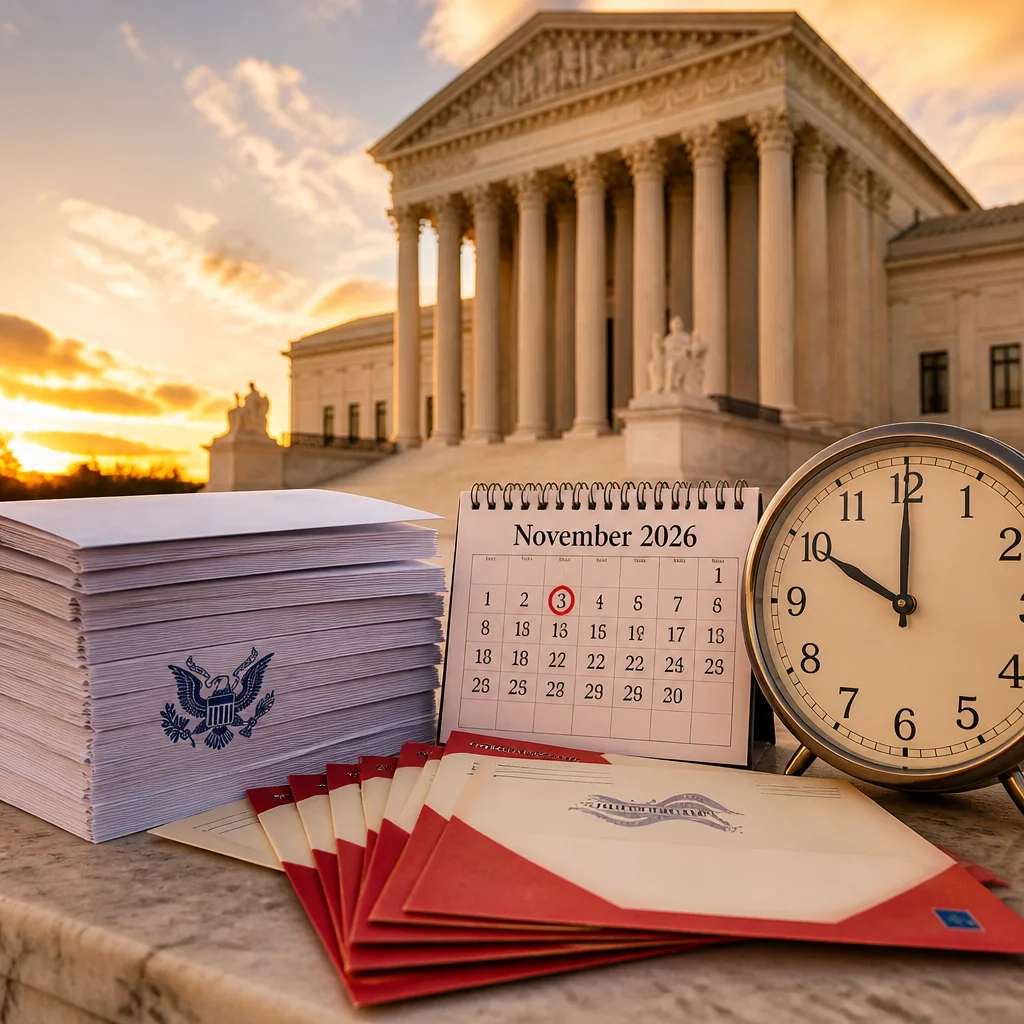
The Trump administration on Wednesday asked the U.S. Supreme Court to intervene urgently to restore a package of U.S. Postal Service rule changes that would impose new nationwide limits on mail voting, saying two recent lower‑court decisions have blocked the plan and threatened the government’s ability to implement the rules before the November midterm elections.
Emergency filing seeks rapid action from high court
Solicitor General D. John Sauer urged the Supreme Court to lift both orders, arguing that failure to act “will effectively run out the clock on the government’s ability to implement” the changes in time for the midterms and will cause “irreparable harm to the federal government, the public, and election integrity.” The petition was filed in a case already pending before the high court after a June decision by a federal judge blocked parts of the Postal Service plan.
The administration’s move came after U.S. District Judge Indira Talwani, an Obama appointee, issued a second ruling Tuesday siding with voting rights groups that had challenged the regulations, this time blocking the Postal Service measures nationwide. Talwani previously ruled in June in favor of California and 22 other states that had challenged the rules as too disruptive to implement in an election year; that June decision was upheld by an appellate court in July but applied only to the states that sued.
“That it is now less than 90 days before the November 3, 2026 midterm elections underscores the critical need for an injunction to prevent Defendants from changing election rules on the eve of the election,”
The dispute traces to an executive order the president issued in March directing the Postal Service and the Department of Homeland Security to compile state‑by‑state voter eligibility lists and implement measures to ensure what the administration called “citizenship verification and integrity in federal elections.” The rule package at issue would have established nationwide limits tied to that directive.
Legal timeline and stakes
Legal challenges quickly followed. In June, Talwani barred implementation of the rules in the 23 states that sued, concluding changes introduced so close to an election could create significant disruptions and harm voters. An appellate court affirmed that decision in July for those states. The new nationwide injunction from Talwani, entered this week after suits by the League of Women Voters and other voting‑rights plaintiffs, extended the blockage beyond the earlier geographic limits.
In its emergency filing, the administration framed the two lower‑court orders as legally erroneous and argued that delay would undermine the federal government’s ability to carry out policies it contends are necessary for election integrity. The Justice Department asked the Supreme Court to step in quickly to lift the injunctions so the Postal Service could proceed with its planned changes ahead of the Nov. 3, 2026, midterm election.
- June: District judge barred rules in 23 states that sued.
- July: Appellate court upheld June ruling for those states.
- August: District judge issued nationwide injunction after separate suits; administration filed emergency appeal to the Supreme Court.
| Decision | Effect |
|---|---|
| June district ruling | Blocked implementation in 23 states that sued |
| July appellate affirmation | Maintained blockage in those states |
| August district ruling | Blocked rules nationwide |
Consequences for the November midterms
The administration argued that the timing of the injunctions risks preventing federal implementation of the Postal Service measures before the election, a concern it framed as causing irreparable harm. Voting‑rights groups and the states that challenged the rules have warned that introducing new requirements or procedures so close to an election could confuse voters, disrupt ballot delivery and collection, and strain election administrators.
The Supreme Court’s response could determine whether the Postal Service is allowed to make operational rule changes this fall or whether the lower‑court orders stand, effectively barring nationwide implementation. If the justices decline to intervene or take time to decide, plaintiffs say the delays themselves would keep the rules from being implemented this cycle; the administration says that outcome would defeat its efforts to change election processes ahead of Nov. 3, 2026.
The case represents one of several high‑profile legal fights this year over election rules and administration, and it underscores the Supreme Court’s pivotal role in resolving disputes that affect nationwide voting procedures weeks before a federal election.