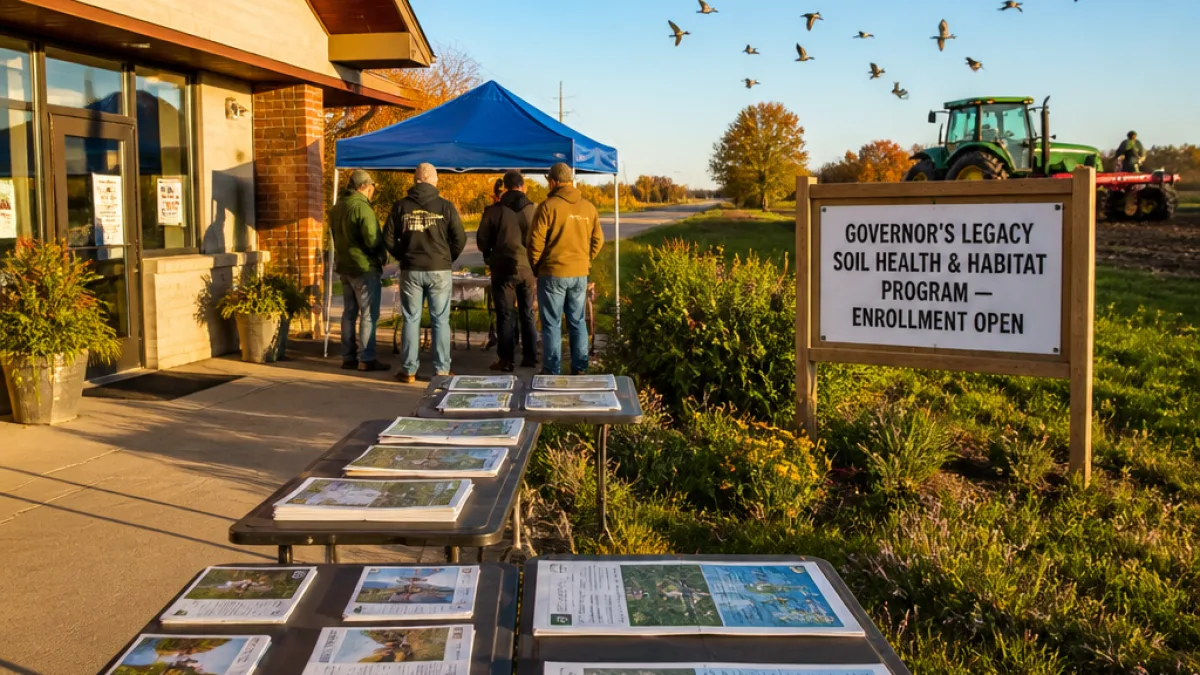
MAPLETON — State and federal officials joined farmers, ranchers and conservation leaders Wednesday as North Dakota opened the first enrollment cycle for the Governor’s Legacy Soil Health and Habitat Program, a new initiative aimed at converting less productive cropland to grassland and improving wildlife habitat.
The program, created after the Legislature approved an Outdoor Heritage Fund grant, is being administered by the North Dakota Association of Soil Conservation Districts with the North Dakota Game and Fish Department as co-applicant and partner. The initial funding totals $6.5 million, according to officials who attended a gathering at the Cass County Soil Conservation District Office south of Mapleton.
High-level turnout underscores statewide interest
Federal and state representatives attended the event, reflecting the program’s intersection of agriculture, conservation and outdoor recreation. Among those present were Richard Fordyce, U.S. Department of Agriculture under secretary, U.S. Sen. John Hoeven, Gov. Kelly Armstrong and Jeb Williams, director of the Game and Fish Department.
The gathering drew farmers, ranchers and landowners from across the region. Some traveled long distances to be part of the 9:30 a.m. meeting, emphasizing the appetite among producers for alternatives when cropland productivity is low.
“It’s a one page application.”
That was how Gov. Armstrong described the enrollment form, a selling point officials cited as they encouraged landowners to consider the program.
Program structure and incentives
Officials framed the initiative as a targeted, voluntary option for producers looking to restore grasslands, improve soil health and create wildlife habitat on acres that do not return adequate crop revenue. The program offers:
- Five-year agreements for enrolled acres;
- Annual rental payments to landowners;
- Cost-share assistance for establishing grass cover; and
- An innovative crop insurance credit for acres converted from unproductive cropland to grassland habitat.
Additional incentives are available for landowners who enroll acres in the Game and Fish Department’s Private Land Open To Sportsmen program, which expands public hunting opportunities.
Targeting marginal acres, not productive farmland
Program administrators emphasized the initiative is intended for acres where crop production offers limited return on investment. That focus aims to avoid taking productive cropland out of production while restoring ecological value to parcels that are better suited to grassland cover.
Officials said the program represents a new tool for producers who want to balance agricultural productivity with habitat restoration and outdoor recreation opportunities. They also acknowledged the limits of a single state program, particularly in light of continuing challenges at the federal level for conservation programs.
Local partners to administer enrollments
The North Dakota Association of Soil Conservation Districts will administer enrollments and work directly with landowners, while the Game and Fish Department will coordinate habitat and access incentives. The administrative partnership is intended to leverage local conservation expertise and the department’s experience with private-land access programs.
| Program element | Detail |
|---|---|
| Funding | $6.5 million from the Outdoor Heritage Fund |
| Agreement length | Five years |
| Main incentives | Annual rental payments; cost-share for grass establishment; crop insurance credit |
At the Mapleton event, organizers said they expected strong interest during the first enrollment cycle and urged landowners to review the program details with their local soil conservation district office.
While proponents described the program as an encouraging step, they cautioned that it is one tool among many needed to address habitat loss and land use challenges across the state. Still, for producers with less productive acres, the program offers a structured way to improve soil health, restore grassland and potentially expand public hunting access through voluntary participation.
Landowners interested in learning more were directed to contact their local soil conservation district or the North Dakota Game and Fish Department for enrollment information and application materials.