
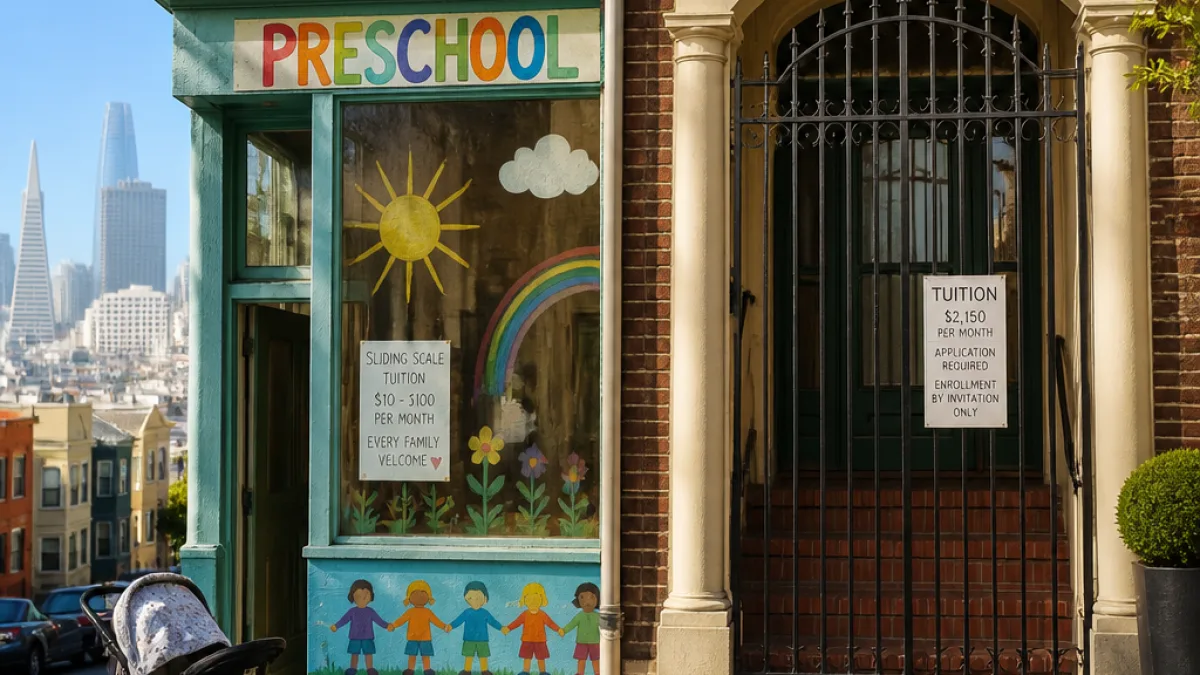
San Francisco parents seeking preschool care confront a wide range of prices, from modest part‑time options to private programs that cost several thousand dollars a month, according to an analysis of more than 300 local preschools published by the Chronicle.
High sticker prices, wide hourly gaps
For families needing coverage for a typical eight‑hour workday, the analysis finds the median monthly bill is about $2,500. Part‑time programs can be available for just a few hundred dollars a month, providing a cheaper route for families with limited hours of care.
At the top end of the market, two private K–8 schools that also enroll preschoolers stand out. La Scuola International School, in the Dogpatch neighborhood, and Children's Day School, in the Mission District, charge among the highest monthly tuition for preschool programs in the city.
| School | Program length | Monthly tuition | Approx. hourly cost |
|---|---|---|---|
| La Scuola International School | Part‑time: 4 hr 45 min/day | $3,780 | ~$37/hour |
| La Scuola International School | Full‑day: 9 hrs/day | $4,730 | ~$24/hour |
| Children's Day School | Full‑day: 10 hrs/day | $4,890 | ~$22.50/hour |
The Chronicle broke down monthly tuition into per‑hour costs for both full‑time (eight hours or more) and part‑time (less than eight hours) programs to identify the most expensive offerings on an hourly basis. That method placed La Scuola's part‑time program at the highest hourly rate — just under $37 per hour — while Children's Day's high monthly fee translates to roughly $22.50 per hour due to its extended 10‑hour day.
Program offerings and what families pay for
Several factors help explain why some preschools command higher fees. Both La Scuola and Children's Day are K–8 institutions that include preschool as part of a broader, tuition‑based program. They offer specialized curricula and amenities that appeal to families seeking language immersion or distinctive educational approaches.
- La Scuola advertises an Italian‑language immersion model, with classes conducted roughly 90% in Italian and a Reggio Emilia‑inspired approach combined with an International Baccalaureate framework.
- Children's Day incorporates Spanish instruction and experiential lessons using outdoor farm and garden space, emphasizing hands‑on learning.
“Some of the more expensive preschools may offer things like a cutting‑edge curriculum or language immersion,” the Chronicle noted in its analysis.
Public support and income thresholds
San Francisco also provides support for lower‑ and middle‑income households. For families at or below 200% of the area median income, the city’s Early Learning for All program — ELFA — offers financial assistance, the analysis says. In participating programs, preschool is free for families of four with incomes under $178,300 per year, while tiered assistance is available for incomes up to $324,200.
Those income thresholds highlight the city’s relatively high cost of living: households that would be considered middle‑class in other regions may qualify for subsidized care here. Still, the high end of the private market remains firmly out of reach for many families.
Local consequences
High preschool prices have consequences for family budgets, workforce participation and housing decisions. For many dual‑income households, a monthly tuition bill in the mid‑to‑high thousands translates into a significant portion of take‑home pay. For smaller employers and policymakers, expensive early‑childhood care factors into discussions about employee retention and the accessibility of San Francisco as a place to raise a family.
As program costs and income thresholds become focal points in debates over affordability, families will continue weighing the tradeoffs between subsidized public options and premium private offerings that promise language immersion or specialized curricula.















