Local intern moves bilingual classroom practice to state policy
A 17-year-old student from Orange is taking a campaign started at home and in a county internship to the state Capitol, seeking to broaden how public schools in California treat multilingual instruction.
The young advocate, a student at the Orange County School of the Arts, spent four weeks this summer working with the Orange County Department of Education in Costa Mesa. The placement in OCDE’s Educational Services division exposed her to curriculum work and county-level efforts on language learning, and helped shape her next step: drafting proposed legislation to explicitly recognize translanguaging as an instructional approach.
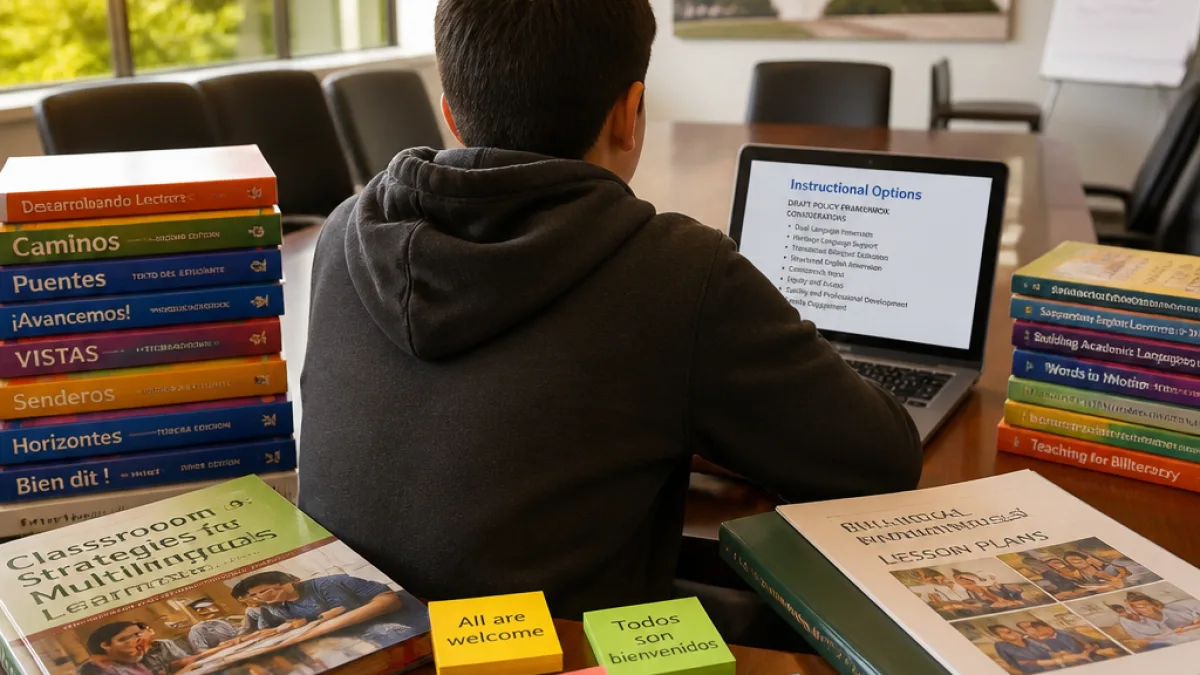
Translanguaging allows students and teachers who use more than one language to call on those languages to clarify ideas or pose questions, while the primary instruction may remain in English. Supporters say the approach acknowledges how multilingual learners actually use language and can deepen comprehension and participation.
“Especially coming from an immigrant background, I think language functions as the gatekeeper to belonging,”
The student described developing a connection to Spanish early in life that led to a broader interest in bilingual education. According to reporting in the Orange County Register, the student worked with the office of state Sen. Tom Umberg while drafting the proposal and is now searching for a legislator to sponsor the bill and carry it through the formal introduction process in Sacramento.
From county internship to state-level proposal
The OCDE internship provided hands-on experience in Educational Services, where the student spent weeks observing program work and learning how county offices support local districts. Those weeks were part of a longer, yearlong effort by the student to expand multilingual opportunities for peers in Orange County and beyond.
Local education officials and advocates have increasingly discussed how to serve a diverse student population. Orange County’s schools enroll learners from many linguistic backgrounds, and the county office of education provides guidance, professional development and program resources to districts; the student’s work sought to connect that local practice to statewide policy.
- Student: 17-year-old Orange County School of the Arts pupil.
- Experience: Four-week OCDE internship in Educational Services.
- Next step: Seeking legislative sponsorship for a bill recognizing translanguaging.
Where this could matter locally
If enacted, the proposed change would give educators and districts explicit statutory authority to use translanguaging as one option in instruction. Proponents argue this would validate instructional methods already in use informally in many classrooms and could reduce barriers for multilingual students seeking to participate fully in academic life.
Opponents of similar measures in other places have raised concerns about consistency in instruction, assessment alignment and teacher preparation. The proposal’s progress will hinge on finding a legislative sponsor, navigating committee review and addressing implementation questions tied to curriculum, professional learning and accountability systems.
| Item | Detail |
|---|---|
| Internship site | Orange County Department of Education, Educational Services |
| Student institution | Orange County School of the Arts |
| Legislative partner | Worked with the office of Sen. Tom Umberg; seeking a bill sponsor |
The student’s work follows other county education initiatives. The OCDE recently recognized educators and community leaders for contributions to STEM and career-focused learning, reflecting the county office’s broader role in highlighting instructional practices and workforce pathways.
Whether the translanguaging proposal becomes law, or prompts districts to revise local policy, will depend on several factors: legislative sponsorship, committee hearings, stakeholder input from teachers and district administrators, and consideration of how the approach would fit within existing English learner programs and state standards.
For Orange residents, the campaign highlights a local student leveraging county experience to attempt change at the state level. It also underscores ongoing debates about how to best support multilingual learners in classrooms across California.