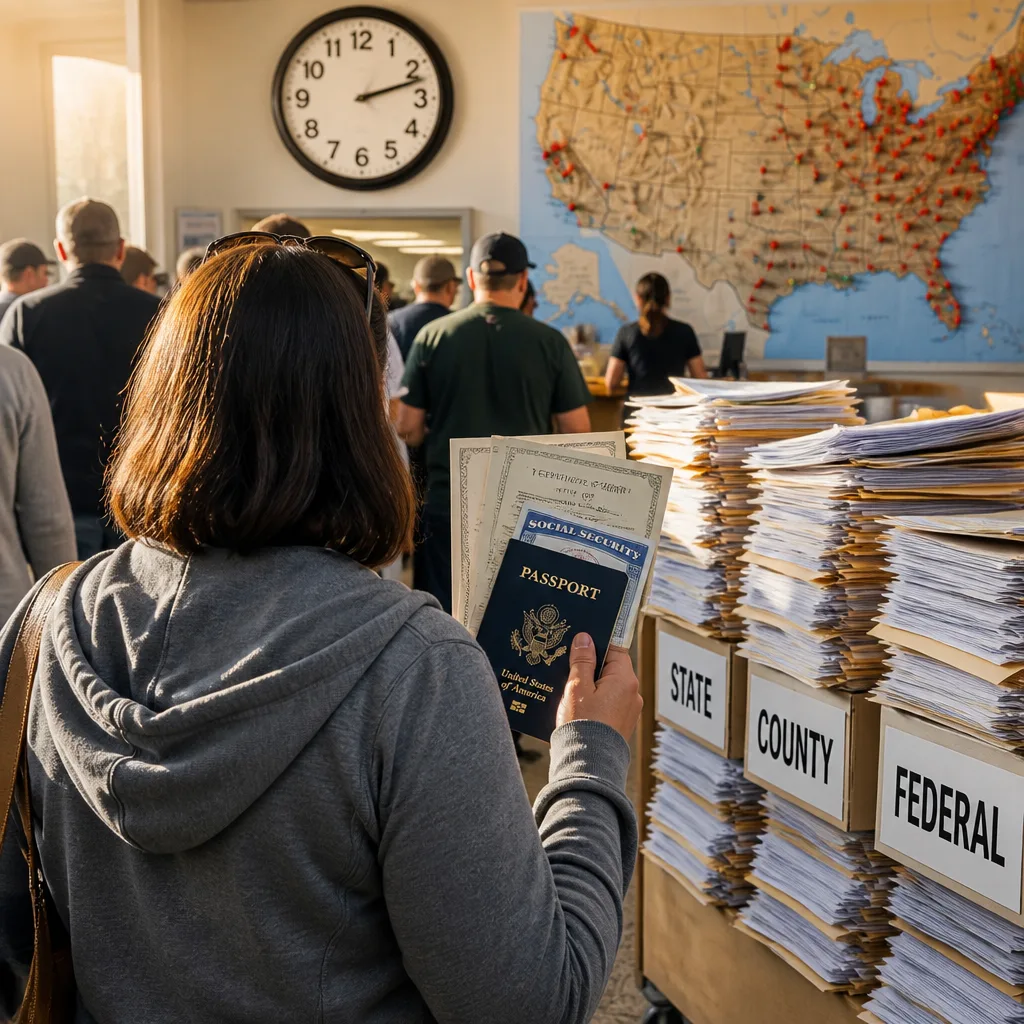
Annie Lowrey argues in her forthcoming book that Americans pay a hidden levy she calls the “time tax” — the cumulative paperwork, waiting and administrative hassles imposed by governments large and small.
Everyday errands become an administrative maze
Lowrey’s account opens with the case of a Massachusetts man who tried to transfer his driver’s license in 2001 and emerged burdened by a criminal record on government systems that did not reflect his identity. To prove he was not the other man with the same name, the individual collected a passport, birth certificate, and a replacement Social Security card, and secured a letter from New Jersey clarifying his identity — only to face later flags from an Oregon motor-vehicle agency and detentions by border officials.
“It would be nice if they would take the effort to figure out that I am not actually Jeff Miller, who is a felon, instead of putting the onus on me.”
Lowrey calls that burden the “time tax” — “a levy of paperwork, effort, delay, and aggravation imposed on Americans in exchange for rights and benefits that are putatively theirs.” She catalogues how the tax appears in routine interactions: tax filing, license renewal, insurance appeals, applications for food assistance and building permits.
Scale and cost of compliance
Federal estimates cited in the book show Americans spend roughly 12 billion hours a year complying with government paperwork requirements. Lowrey pairs that total with an economic valuation from the American Action Forum that places the labor cost at about $430 billion annually. Those figures underline the book’s argument that administrative friction is not a marginal nuisance but a major national inefficiency.
| Measure | Estimate |
|---|---|
| Annual compliance hours | 12 billion hours |
| Economic value of time | $430 billion |
Lowrey links much of the problem to the sheer fragmentation of American government. Her research counts at least 91,476 separate governmental entities — from federal agencies to school districts, tribal governments and special-purpose authorities — each operating with its own procedures and paperwork demands.
- Identity errors and mismatches can cascade across agencies and private platforms.
- Multiple levels of government maintain overlapping rules and forms.
- Individuals disproportionately carry the burden of proving eligibility or correcting records.
Consequences and context
The practical consequences range from inconvenience to significant harm: access to benefits may be delayed or denied, travel can be disrupted, and private services sometimes restrict users based on government records. Lowrey’s narrative suggests that administrative design choices — not only resource constraints — drive many of those outcomes. She also places the burden squarely on citizens, who must navigate inconsistent requirements to secure rights and services that should be routine.
By compiling personal stories and national estimates, the book reframes paperwork as a policy problem with measurable costs. That framing invites policymakers and administrators to consider reforms that reduce duplication, improve identity verification, and shift some verification responsibilities away from citizens and toward more integrated government systems.
Lowrey’s diagnosis stops short of prescribing a single solution but emphasizes that the scale of the burden makes piecemeal fixes insufficient. The evidence she presents — both individual anecdotes and aggregated national data — underscores how administrative friction shapes lived experience in ways that are often invisible until problems arise.
As Americans interact with dozens of governmental organizations over a lifetime, the book asks whether those encounters should default to placing the operational burden on individuals or whether governments can better shoulder the work of ensuring accurate, timely access to services and rights.