
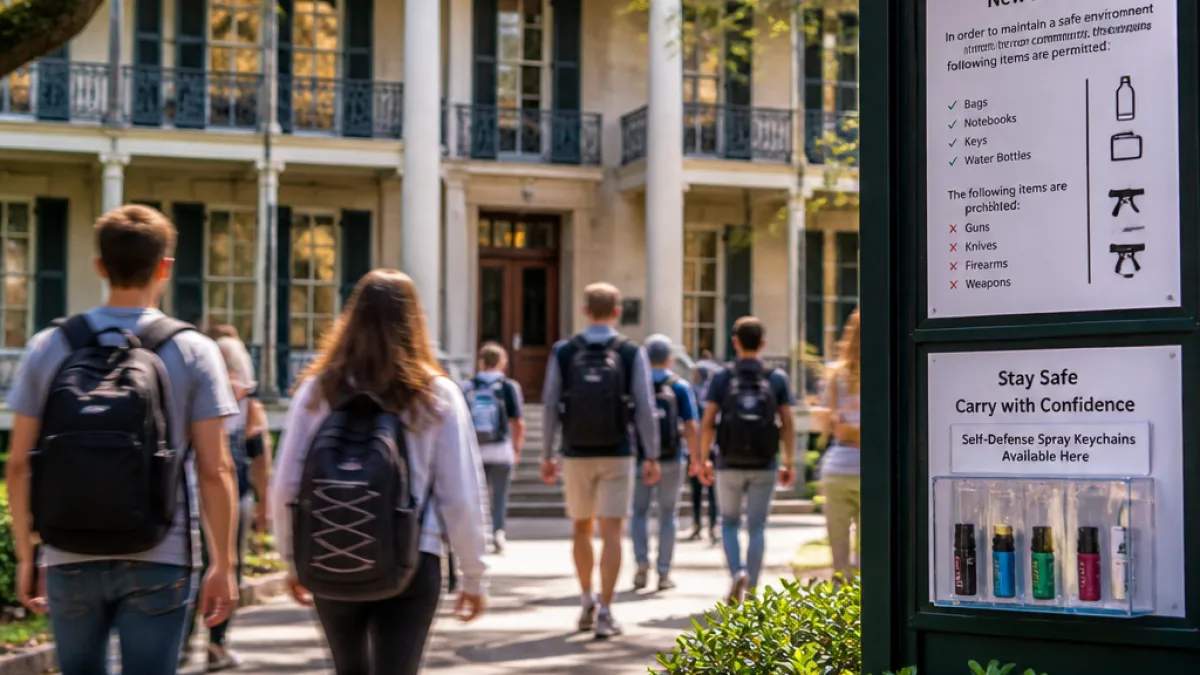
NEW ORLEANS — A new Louisiana law that went into effect Aug. 1 gives students at public colleges and universities the legal right to carry self‑defense chemical spray on campus, prohibiting those institutions from banning such items in most campus locations.
What the law does
Authored by Rep. Michael Bayham, R‑Chalmette, the statute forbids public postsecondary institutions from imposing blanket bans on the possession of self‑defense chemical spray by students. The change was presented by supporters as a way to give students a means of protection in situations where immediate police response may be delayed.
“We need to give people the ability to protect themselves when the police aren’t there,” Rep. Michael Bayham said.
Bayham said lawmakers worked with university officials while drafting the measure to avoid creating policies that could generate unintended harm. The final language includes specific exceptions where campuses may still prohibit such sprays.
Exceptions and campus limits
The law allows public institutions to set prohibitions in a limited set of locations and circumstances. As written, campuses may ban possession of self‑defense chemical spray:
- at preschools, elementary schools or secondary schools operated by the institution;
- at patient care facilities located on campus;
- in campus buildings or at events where armed security is present.
Bayham said those carve‑outs reflect negotiated compromises with universities to balance student safety with mitigating potential risks associated with broader access to chemical spray on campus.
Student reaction
Some students at affected campuses welcomed the change. Laura Kaye Brown, a student at Xavier University who lives on the campus of LSU New Orleans, said she views the spray as a valuable option for self‑protection, particularly at institutions that are embedded within their surrounding communities.
“I think it’s a good form of protection, especially when you have campuses that are directly in the community,” Brown said. “A lot of times when there is no security, some students are left to defend themselves, so in that case, I think it would be pretty good for a form of self‑defense for students that may not be familiar to the area.”
Brown’s remarks underscore concerns among some students about moments when campus security manpower is thin or delayed, and the desire for nonlethal tools they can carry personally.
Implementation and enforcement questions
While the law sets a statewide baseline, it does not spell out detailed operational guidance for university police departments or campus administrators. Institutions will need to update campus safety rules and communicate to students where possession remains prohibited under the exceptions spelled out in the statute.
Key issues institutions are likely to address include:
- how campus security will enforce bans inside exempted facilities and events;
- whether specific sizes or formulations of chemical spray are permitted or restricted;
- disciplinary or criminal consequences for misuse of permitted sprays.
How campuses might respond
Bayham said lawmakers made adjustments after consulting with universities to avoid creating policies that could “create more harm than good.” That suggests institutions already had input during drafting and may have templates to incorporate the law into campus codes of conduct.
| Effective date | Who it affects | Primary restriction removed |
|---|---|---|
| Aug. 1 | Students at public colleges and universities in Louisiana | Blanket campus bans on possession of self‑defense chemical spray |
Students and parents should look for updated student handbooks and campus safety guidelines as the fall semester begins. Campus police and student affairs offices will likely be the first points of contact for questions about where possession is permitted and how to store or declare an item in housing or during campus events.
Broader context
The law is part of a national conversation about student safety, personal protection and the role of campus policies in balancing access to defensive tools with preventing misuse. Supporters point to the nonlethal nature of chemical spray as an option that can deter attackers without the risks associated with firearms. Critics of similar measures in other states have raised concerns about accidental exposures and escalation in confrontations.
For Louisiana’s public institutions, the new statute provides a clear statewide rule with narrowly defined exceptions. How university officials translate that rule into campus operations and how students adopt the change will shape its practical impact this academic year.
Rep. Bayham and university representatives were engaged in developing the language, and students like Brown have voiced support. Still, implementation details remain important for administrators to clarify so students know when and where carrying self‑defense chemical spray is lawful on campus.