
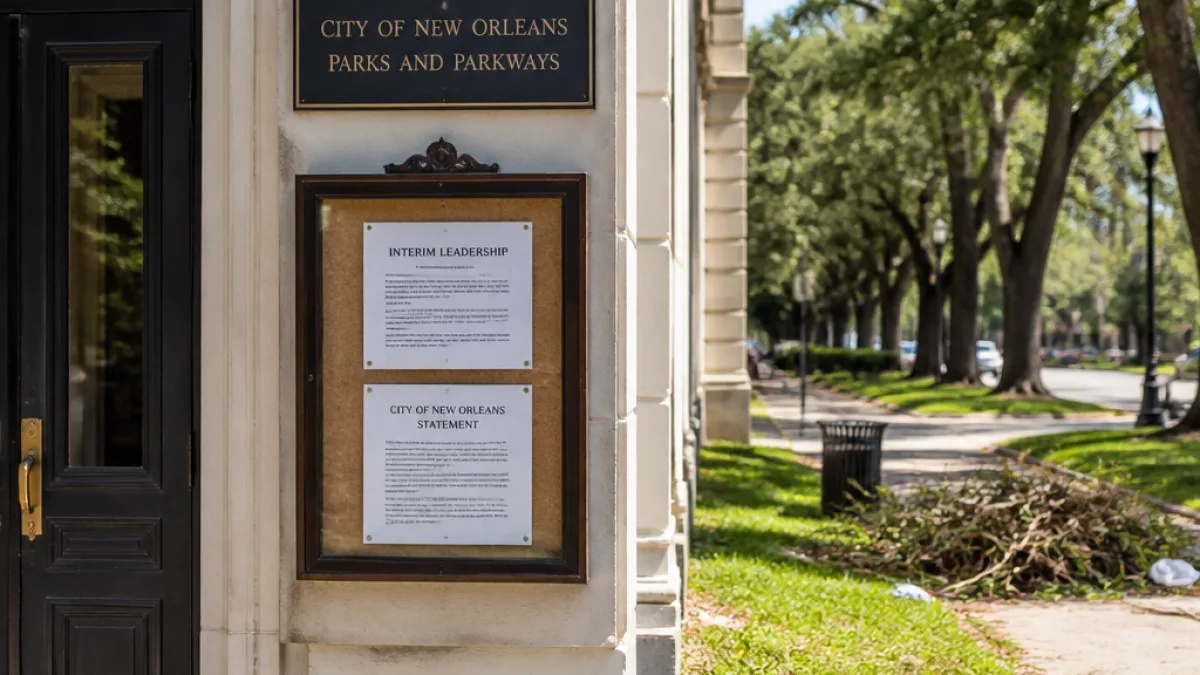
The City of New Orleans has dismissed Michael Karam as director of the Department of Parks and Parkways, a move announced one day after Councilman Jason Hughes publicly criticized the department’s performance at a City Council meeting.
Rapid leadership change amid complaints of poor service
In a statement, the city framed the change as part of Mayor’s broader effort to “improve City services, strengthen accountability, and ensure responsiveness across City government.” The statement said former Parks and Parkways Director Ann Macdonald will return on a part-time basis to support the department and assist in the search for its next permanent director.
The mayor has also elevated Sharon Franklin Brown to serve as Interim Director and named Catherine Wheeler Secretary of Parks and Parkways. The administration emphasized that its “priority is ensuring strong leadership, continuity, responsiveness, and improved services for the people of New Orleans.”
Council critique highlighted service failures
At a recent council meeting, Councilman Hughes outlined numerous constituent reports he said showed a decline in Parks and Parkways services. Residents reported problems including:
- uncut grass in public spaces;
- debris and clippings left in streets and storm drains;
- overgrown sidewalks and delayed tree maintenance;
- poor communication between the department and residents or council offices.
Hughes described instances where issues repeatedly bounced between his office, Parks and Parkways and other entities such as Audubon, and cited a dangerous tree on Benson Street that lacked a clear response or completion date. He called the quality and responsiveness of the work “unacceptable,” adding,
"If I am a councilmember being treated like a ping-pong ball, can you imagine the frustration of the residents?"
Department cites staffing and funding constraints
Officials at Parks and Parkways have attributed a backlog of work to a citywide hiring freeze and reduced funding for contractors. Those constraints were presented as factors affecting the department’s ability to respond to maintenance requests and to keep up with routine work across neighborhoods.
The department’s staffing and contracting limitations were part of the context Councilman Hughes presented when urging stronger oversight and faster fixes for residents’ complaints.
Local context and potential consequences
Changes at the top of Parks and Parkways touch day-to-day quality of life in New Orleans: lawn maintenance, street cleanliness, sidewalk access and tree pruning all factor into public safety, stormwater management and neighborhood livability. Residents who reported overgrown sidewalks or debris in drains raised practical concerns about pedestrian access and flood risk during heavy rains.
With a part-time return of a previous director and the appointment of interim leadership, the city appears to be prioritizing continuity while launching a search for a permanent director. That search will likely be watched closely by council members and residents alike, who are seeking measurable improvements in service delivery.
| Role | Person | Status |
|---|---|---|
| Parks and Parkways Director | Michael Karam | Fired |
| Interim Director | Sharon Franklin Brown | Appointed |
| Secretary, Parks and Parkways | Catherine Wheeler | Appointed |
| Part-time support | Ann Macdonald (former director) | Returning to assist |
Councilman Hughes’ public admonishment underscored political pressure on the mayor’s office to produce faster results. Karam, who was appointed to lead the department in 2020 during the previous administration, had earlier worked for six years as an attorney with the Office of Code Enforcement.
City officials have linked reduced contractor funding and a hiring freeze to a mounting backlog of work. The administration’s next steps will include the search for a permanent director and measures to demonstrate improved responsiveness to neighborhoods that have reported ongoing problems.
Residents and council offices will likely monitor whether the interim leadership and the mayor’s promised accountability measures translate into quicker repairs, cleared public spaces and more consistent communications about timelines for maintenance.

















