
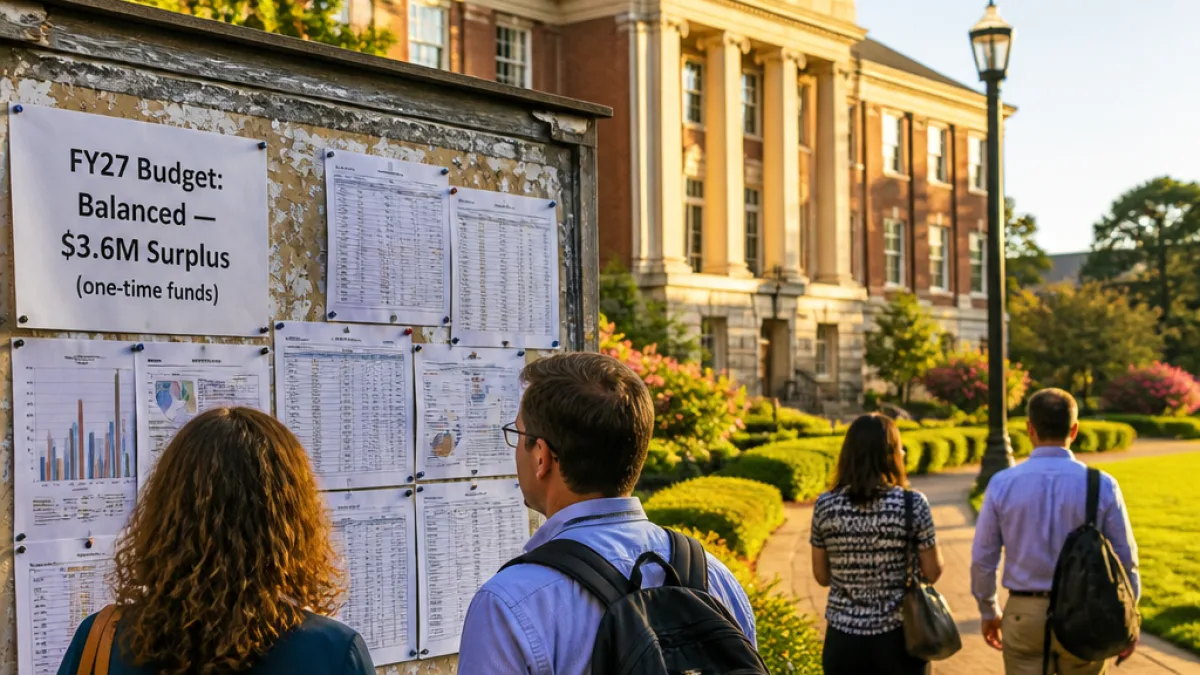
University of Louisiana at Lafayette President Ramesh Kolluru told faculty in a Sept. 10 letter that the university’s operating budget for fiscal year 2027 is balanced and begins the year with a reported $3.6 million surplus — but he cautioned that the result depends on one-time resources and spending adjustments made after a difficult prior year.
From projection to adjustment
Kolluru’s note to faculty, staff and members of the American Association of University Professors came in response to concerns raised after his Aug. 19 State of the University address, in which he said the budget was balanced for the first time in a decade. The AAUP chapter had asked for details because Kolluru had told the University of Louisiana System Board of Supervisors in June that UL Lafayette faced a projected $26 million deficit for fiscal year 2027 under a “do nothing different” scenario.
In his reply, Kolluru explained that the June projection assumed continuation of fiscal 2026 spending and revenue patterns. He said university leaders then started the FY27 budgeting process with conservative revenue estimates based on the prior year’s performance and incorporated one-time funds while aligning planned expenses with available resources.
“We then incorporated one-time resources secured for FY27 and aligned planned expenses with those available funds.”
Context of the current financial position
The university’s present finances follow a period of severe imbalance. UL Lafayette began fiscal 2026 with an announced $50 million deficit, prompting administrative changes and cost-cutting measures. Kolluru was named president in February and took over the position after Dr. Joseph Savoie stepped down on July 31, 2025; both Kolluru and Provost Jaimie Hebert had served as interim presidents through the previous fall semester.
Fiscal year 2027 began July 1 and runs through June 30, 2027. Kolluru’s correspondence frames the improved operating position as the result of conservative budgeting, use of one-time resources and alignment of expenses with those funds.
What this means for campus and community
Faculty questions, logged publicly by the AAUP chapter, focused on how the university turned a large projected shortfall into a balanced budget in a short span. The president’s explanation points to a combination of short-term financial tools and planned expense reductions rather than to a structural revenue increase.
- Short-term stability: The $3.6 million surplus provides a cushion but is connected to non-recurring resources.
- Ongoing risk: Reliance on one-time funds can leave future budgets vulnerable unless revenue growth or sustained cost reductions are achieved.
- Transparency and oversight: Faculty and governance groups are pressing for more detailed breakdowns of the actions and assumptions that produced the balanced FY27 operating budget.
Key budget figures
| Item | Amount |
|---|---|
| Beginning FY26 deficit announced | $50 million |
| Projected FY27 deficit in June ("do nothing" scenario) | $26 million |
| Reported FY27 starting surplus | $3.6 million |
University leaders have said administrative changes and cost-cutting were implemented during FY26. The correspondence from Kolluru underscores that the current balanced operating budget for FY27 is the product of conservative revenue estimates, expense alignment and the use of one-time resources rather than a reversal of structural revenue trends.
Faculty and campus groups may continue to seek more detailed fiscal documentation and long-term plans to replace one-time resources with sustainable funding. For Lafayette-area residents, the university’s fiscal health matters for employment, academic programming and partnerships across the community.
As the fiscal year progresses, both university leadership and campus stakeholders are likely to monitor enrollment, state support and expense lines to assess whether the current position can be sustained without further reliance on one-time measures.