
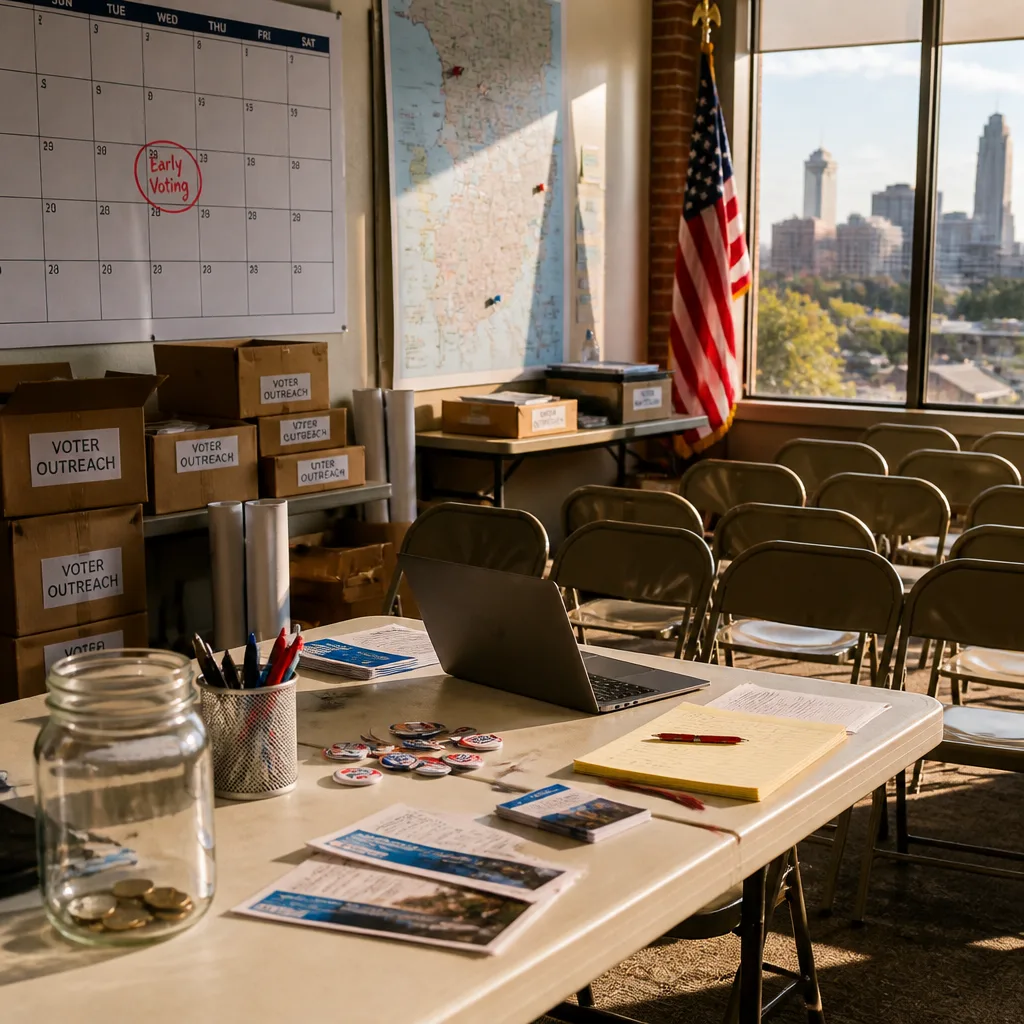
Several of the nation’s largest left-leaning voter engagement and racial justice organizations are confronting substantial funding shortfalls and staffing reductions just as voting is getting underway in a midterm election that will determine control of Congress for the final two years of President Donald Trump’s term.
Groups warn reduced resources could depress turnout
Organizers and Democratic strategists say the cutbacks have left key coordinating organizations and local partners with far fewer resources than in comparable midterms, undermining efforts to register voters, mobilize supporters and mount legal and logistical protections against potential interference.
America Votes, a coordinating hub that works with more than 400 progressive groups, told The Associated Press it has fallen "well below" the funding levels it had in the 2022 midterms. The nonprofit serves as a nerve center for groups including the NAACP, Planned Parenthood, the League of Conservation Voters, major labor unions such as the AFL-CIO and SEIU, and numerous local racial justice and civic organizations.
Leaders warn the timing is precarious: with early voting underway in many states, the window to identify, contact and convert potential supporters into voters is shrinking daily.
"There is still time to reach voters and bring them into this election, but we are no longer talking about a future opportunity," said Daria Dawson, executive director of America Votes.
Donor pullback strains grassroots operations
Organizers describe a marked retreat by wealthy individual donors and some philanthropic funders following the 2024 presidential contest. The result, activists say, is fewer paid staffers on the ground, smaller field programs, and diminished capacity for community outreach in neighborhoods that have been central to Democratic successes.
Several national and local groups that typically run large voter registration and get-out-the-vote campaigns have announced staffing reductions and cutbacks to field operations. That has prompted concern across the Democratic coalition at a moment when strategists are relying on high turnout—particularly among Black, Latino and young voters—to offset gains by Republicans.
Some racial justice organizers described funder decisions as a betrayal, arguing that new strategies offered by donors do not substitute for the boots-on-the-ground work needed to persuade and mobilize voters in communities of color.
"A retreat in donor support is handcuffing our ability to persuade our communities to vote in a year where there is no Voting Rights Act," said Esosa Osa, a Democratic strategist and founder of Onyx Impact.
Potential consequences and what’s at stake
Democratic operatives worry that reduced capacity will blunt turnout advantages in key districts and states, complicate voter protection efforts, and leave organizers less able to counter disinformation targeted at communities of color. That could have direct implications for which party controls the House and Senate for the remainder of the president’s term.
Organizers also warn that, beyond turnout, the ability to monitor polling places, provide legal assistance for voters facing problems, and coordinate rapid responses to irregularities depends on the staffing and infrastructure now in question.
- Coordinating groups like America Votes report lower funding than in 2022.
- Major partners include national civil rights, environmental, health and labor organizations.
- Impact could include reduced registration, smaller field operations and weakened voter protection efforts.
| Area | Reported effect |
|---|---|
| Funding | Below 2022 midterm levels for coordinating groups |
| Field staff | Staffing cutbacks at multiple organizations |
| Voter protection | Less capacity for rapid legal and polling-place response |
While some funders have signaled interest in different approaches, advocates say those adjustments do not make up for immediate declines in cash and personnel. With early voting underway in several states and Election Day approaching, organizers say there is limited time to restore capacity or shift strategies effectively.
Democratic strategists framed the shortfalls as a strategic problem for the party: in an election where they are aiming to drive high turnout to offset structural and political headwinds, reduced investment in the field and in voter protection could prove decisive in closely contested races for the House and Senate.
The funding squeeze highlights the broader challenge of sustaining long-term civic engagement infrastructure in an era when major philanthropic flows can shift rapidly after high-profile election cycles.