
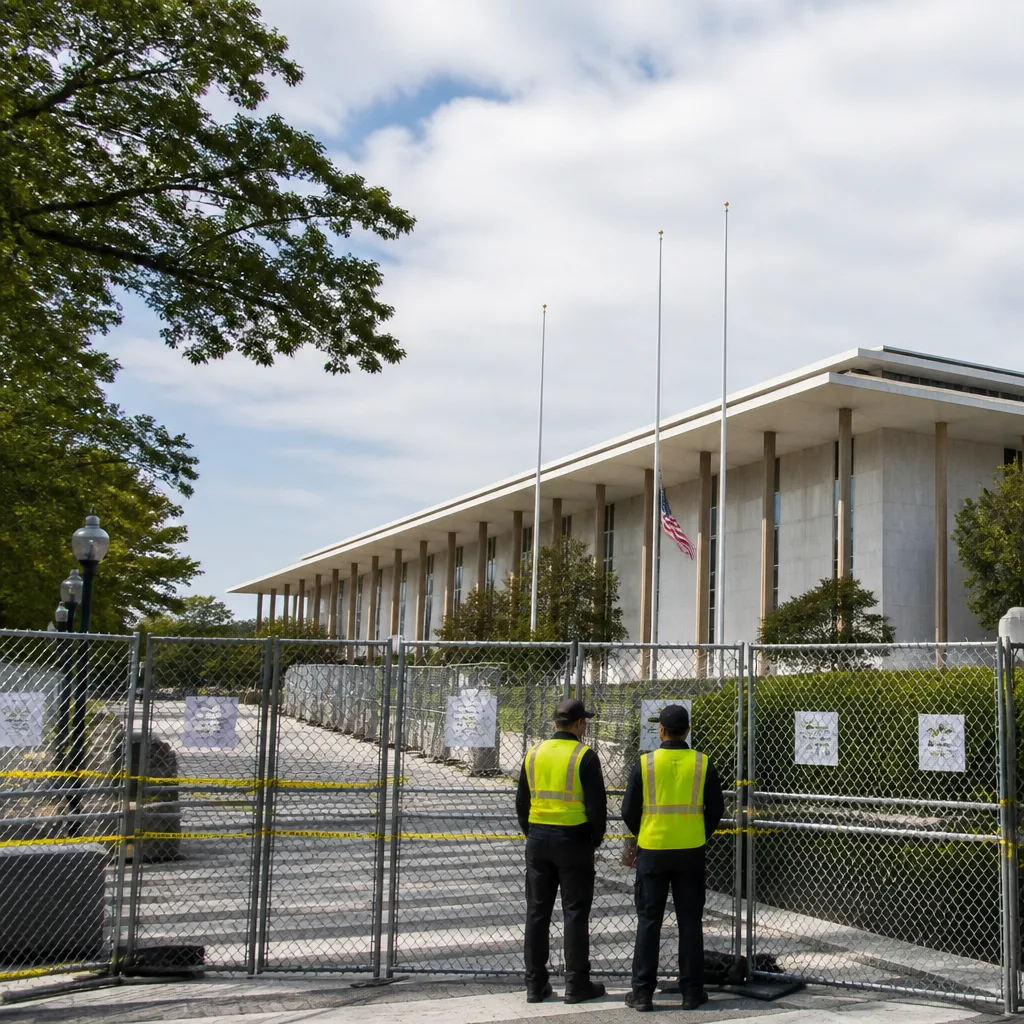
Security fencing was installed Wednesday around the John F. Kennedy Center for the Performing Arts after a board dominated by trustees aligned with former President Donald Trump voted to close most of the main building for repairs. The action followed a federal judge's order preventing the return of Mr. Trump's name to the facility and prompted a Democratic trustee to request an emergency court hearing.
Trustee challenges closure in court
Rep. Joyce Beatty, an Ohio Democrat and an ex-officio member of the Kennedy Center board, filed for emergency judicial relief Wednesday, calling the closure an "unlawful closing" and warning that it could be used to circumvent the court's directive. Beatty has led efforts to keep Mr. Trump's name from being affixed to the building and engaged in a heated exchange with him during a virtual board meeting on Tuesday.
"unlawful closing"
Beatty's legal filing asserted that the center was already closed to the public and that staff supporting her legal team were denied entry. The filing argued the abrupt shutdown could allow defendants to take immediate steps that would make public access practically impossible and thereby evade the court's order.
Board vote and presidential statements
The board's vote to close most of the main building came a day after the federal judge blocked the institution from restoring Mr. Trump's name. In a social media post, the Republican former president said the closure was necessary to make safety repairs. He also tied those repairs to his naming plans, saying the work would proceed only if the board were permitted to return his name to the building.
Congress has previously approved funding for rehabilitation work at the Kennedy Center. According to the board and public statements, the repairs are expected to be funded by a $257 million congressional allocation.
| Item | Detail |
|---|---|
| Congressional allocation | $257 million |
| Action taken | Board voted to close most of the main building |
| Legal response | Emergency court filing by Rep. Joyce Beatty |
Access and public reaction
Activists who opposed the closure reported no vehicle or pedestrian access to the Kennedy Center on Wednesday. An Associated Press reporter said a security guard at the main building confirmed the center was closed. Beatty's court filing also said a staff member for her legal team was denied entrance and was told by security personnel that the building was closed to the public.
Opponents of the closure warned that the move could effectively lock the public out of the institution and disrupt scheduled performances and programs, though the board and other officials have framed the step as necessary for safety-related repairs.
Political and operational consequences
The dispute places the Kennedy Center at the center of a broader political fight over presidential legacy and the governance of federally affiliated cultural institutions. It raises immediate operational questions about who controls access to the building, how and when repairs will proceed, and whether a court will intervene to block the board's action.
- Legal action: A trustee sought an emergency hearing to halt the closure and protect public access.
- Funding: Congress previously allocated $257 million for repairs; the board ties repairs to permitting the return of Mr. Trump's name.
- Public access: Activists and court filings indicate the building was closed and staff were denied entry.
How the court responds and whether the board proceeds with closure activities will shape the Kennedy Center's immediate future and could set a precedent for conflicts between trustees and court orders at federally funded institutions.