
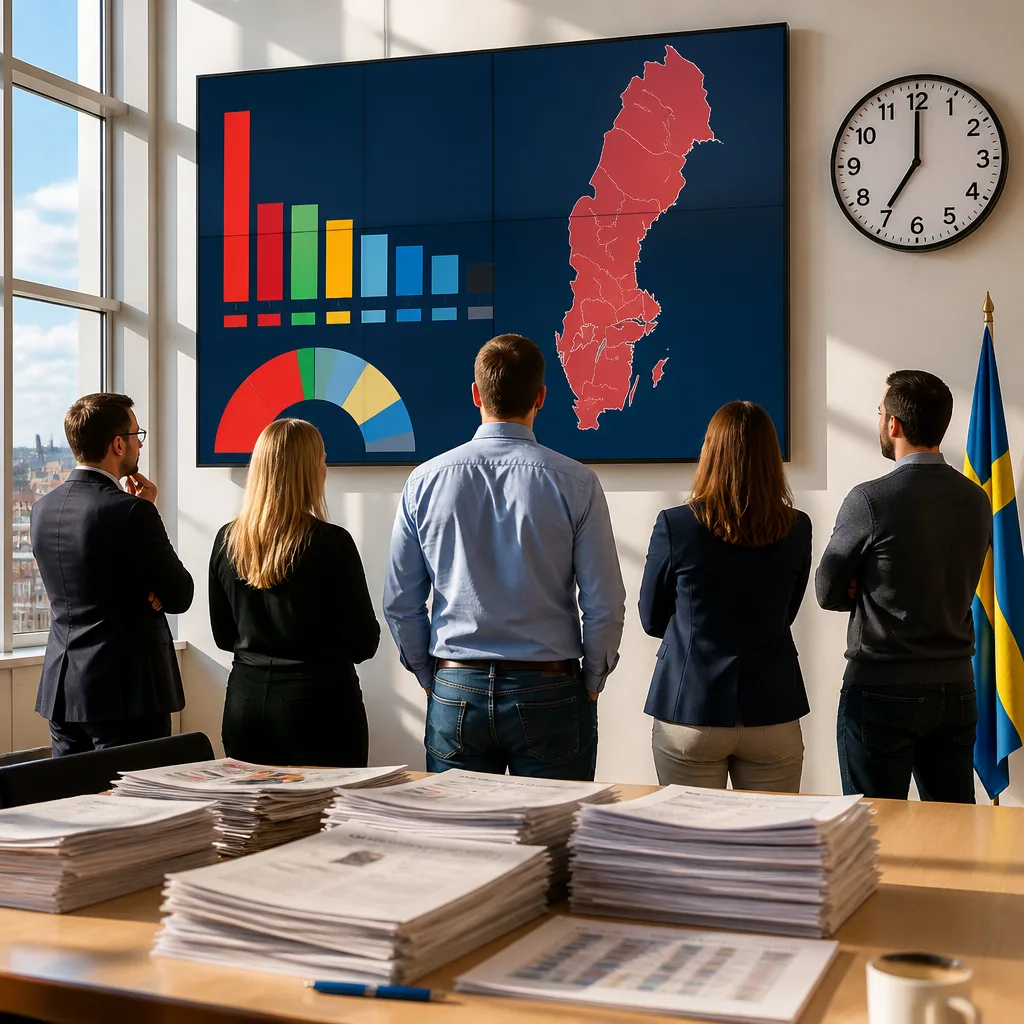
Exit polls released Sunday by Sweden’s public broadcaster SVT indicate that a coalition of left-leaning parties, anchored by the Social Democrats, is leading the vote and is projected to secure a parliamentary majority — clearing a path for former Prime Minister Magdalena Andersson to potentially return to office subject to coalition negotiations.
Immediate implications for government formation
The preliminary picture presented by the exit polls places the center-left block ahead of the incumbent three-party coalition led by Prime Minister Ulf Kristersson, who has governed since 2022 with support from the anti-immigration Sweden Democrats. Election authorities anticipated the first official results to begin arriving around 1900 GMT.
If the exit-poll projection holds and Andersson’s four-party grouping can translate that into seats, she would be positioned to lead coalition talks and seek to form a new government. The contest in Sweden has long been framed less as a single-party fight than as a race between two blocs — a four-party center-right alliance and a four-party center-left grouping — each striving to reach a working parliamentary majority.
Role of the Sweden Democrats in a rightward outcome
Kristersson’s government has depended on outside backing from the Sweden Democrats, a party that traces its origins to groups active in the 1980s with extremist roots. Under the leadership of Jimmie Åkesson, who has headed the party since 2005, the Sweden Democrats moderated rhetoric, expelled openly racist members and expanded from a marginal force into a key parliamentary player.
During the campaign Mr. Kristersson signaled that, if the right-leaning bloc wins a majority, his Moderates would allow the Sweden Democrats to take government posts, even if the Sweden Democrats were the stronger partner — a shift that would mark deeper formal inclusion of a party with far-right origins in national governance.
"This is a very important election for Sweden, if we for the first time should have a right-wing extremist party founded by Neo-Nazis in our government or if the government should be"
The comment in the exit-poll coverage underscored the controversy surrounding the Sweden Democrats’ political evolution and the stakes many Swedes see in the election outcome.
- Majority arithmetic: The election hinges on which bloc, left or right, can secure more than half the seats in parliament.
- Electoral threshold: Individual parties must clear 4 percent of the vote to win parliamentary representation.
- Leadership stakes: Andersson could return as prime minister if coalition talks succeed; Kristersson seeks to remain in power if the right retains a majority.
Context and broader consequences
The center-left Social Democrats have been dominant across much of Sweden’s post-World War II history, making the potential return of Andersson a reassertion of a long-standing political tradition. Andersson previously served as prime minister, and her party’s lead in the exit polls would represent a reversal for Kristersson’s three-party coalition, which has relied on the Sweden Democrats for parliamentary support since 2022.
Observers note that the configuration of support rather than single-party vote totals often decides Swedish government formation. A right-leaning victory could deepen the Sweden Democrats’ integration into formal government roles, while a left-leaning outcome would push policy direction back toward Social Democrat priorities and require careful negotiation among the four center-left partners.
| Key fact | Detail |
|---|---|
| Preliminary results expected | Around 1900 GMT |
| Parliamentary threshold | 4% of the vote |
| Incumbent prime minister | Ulf Kristersson (since 2022) |
The exit polls do not constitute final results, and official tallies and seat allocations could shift as ballots are counted. Still, the projected lead for Andersson’s bloc sets up a pivotal period of negotiations that will determine Sweden’s government composition and its approach to immigration, European affairs and domestic policy in the months ahead.
Election officials were beginning to process preliminary counts as the country awaited full results; until those are certified, both blocs will be preparing for the bargaining and horse-trading that typically follow Swedish elections when no single party secures outright control.