
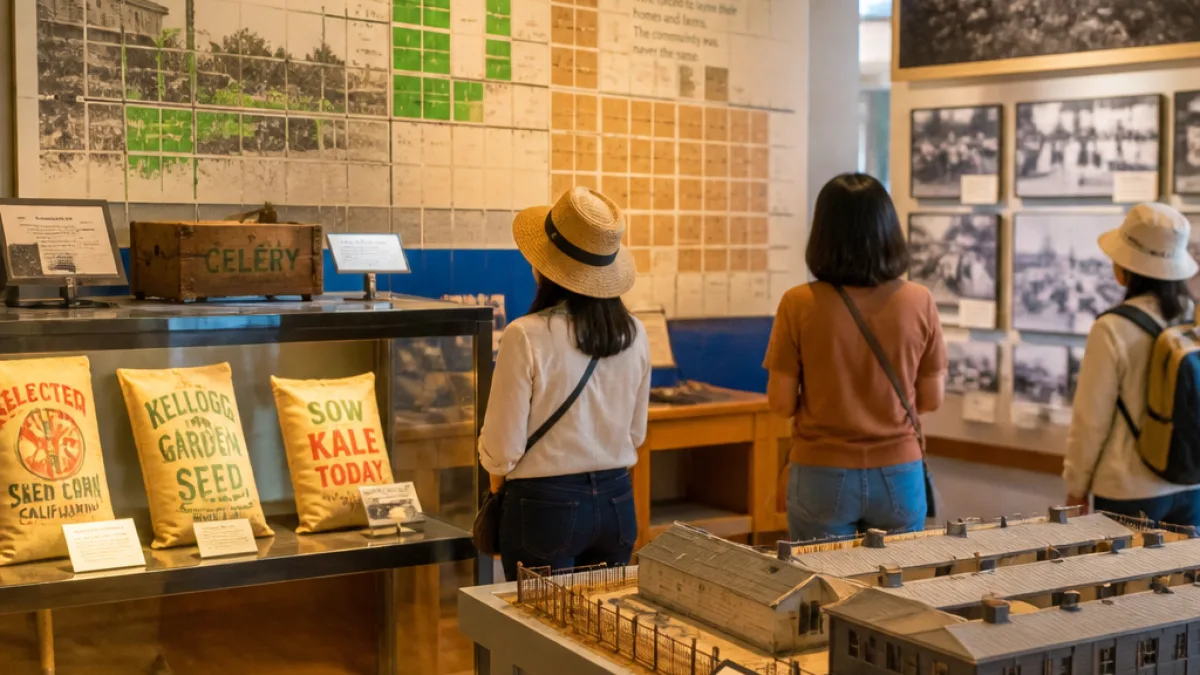
The Chula Vista Museum & History Center opened its first exhibition tracing the long and often overlooked history of the city’s Japanese and Japanese American community, museum officials said. Titled “The Japanese Story,” the show covers immigration around 1900, agricultural innovations that reshaped local farming, the World War II incarceration experience and the community’s recovery after the war.
Farming, innovation and a lost landscape
Museum board chair Pat Aguilar said the exhibition was selected to fulfill the museum’s mission of helping residents and visitors understand events that shaped Chula Vista. One of the earliest sections highlights how Japanese immigrants adapted to and changed the local agricultural economy.
“We felt that the agricultural innovations, incarceration during WWII, and subsequent recovery of Chula Vista’s Japanese American community is a significant piece of our history that is not well known and carries relevant lessons for how today’s immigrants are perceived and treated,” Aguilar said.
Among the contributions on display are techniques for growing vegetables in an area previously noted for orchards and a method developed to extend the growing season for celery, which museum materials note was once considered a delicacy. Visitors first encounter a map showing the scope of Japanese American farms in Chula Vista before and after World War II — a visual centerpiece that Aguilar said surprised many involved in the exhibit’s development.
- Arrival: Japanese immigrants came to the Chula Vista area around 1900.
- Agriculture: New farming techniques and extended celery growing seasons reshaped local production.
- Incarceration: Nearly all local Japanese Americans were held at the Poston, Ariz., camp during World War II.
- Recovery: The exhibit examines what happened to the community after the war.
Wartime incarceration and its local imprint
The exhibition documents the consequences of the Dec. 7, 1941, bombing of Pearl Harbor, when Japanese Americans across the nation faced intensified racism, discrimination and forced removal from their homes. The museum notes that almost all of Chula Vista’s Japanese American residents were sent to the Poston incarceration camp in Arizona.
“Don’t miss the first exhibit piece, which is a map showing the extent of Japanese American farms in Chula Vista both before and after WWII,”
That map is intended to emphasize both the community’s prewar economic footprint and the rupture caused by wartime policies.
Personal stories and community recovery
The exhibit places individual family stories at its center. One featured family is the Muraoka family; materials include references to Saburo Muraoka, among other local residents whose lives illustrate the broader arc from immigration and community building through dispossession and later attempts at recovery.
Exhibit organizers said the display aims to connect past patterns of exclusion with contemporary debates over immigration and civic inclusion. By attending to technical innovations alongside personal accounts, museum leaders hope visitors will see the community’s contributions as integral to Chula Vista’s history rather than peripheral anecdotes.
| Theme | Focus |
|---|---|
| Prewar Agriculture | Farming techniques; celery season extension; map of farms |
| WWII Incarceration | Forced removal; Poston, Ariz., internment camp |
| Postwar Recovery | Community rebuilding; personal family histories |
The museum’s inaugural presentation is intended to be both a historical record and a prompt for civic reflection. Officials encourage residents to view the exhibit to better understand how local institutions and families were affected by national policy decisions and social attitudes.
Admission details, hours and any related programming were not included in the initial announcement. Museum board leaders said additional context and artifacts will be displayed as the center continues to develop its collection and educational offerings.
The exhibition’s focus on labor, displacement and recovery places Chula Vista’s Japanese American history alongside similar regional and national stories, while offering local audiences a detailed look at the people and places that helped shape the city.















