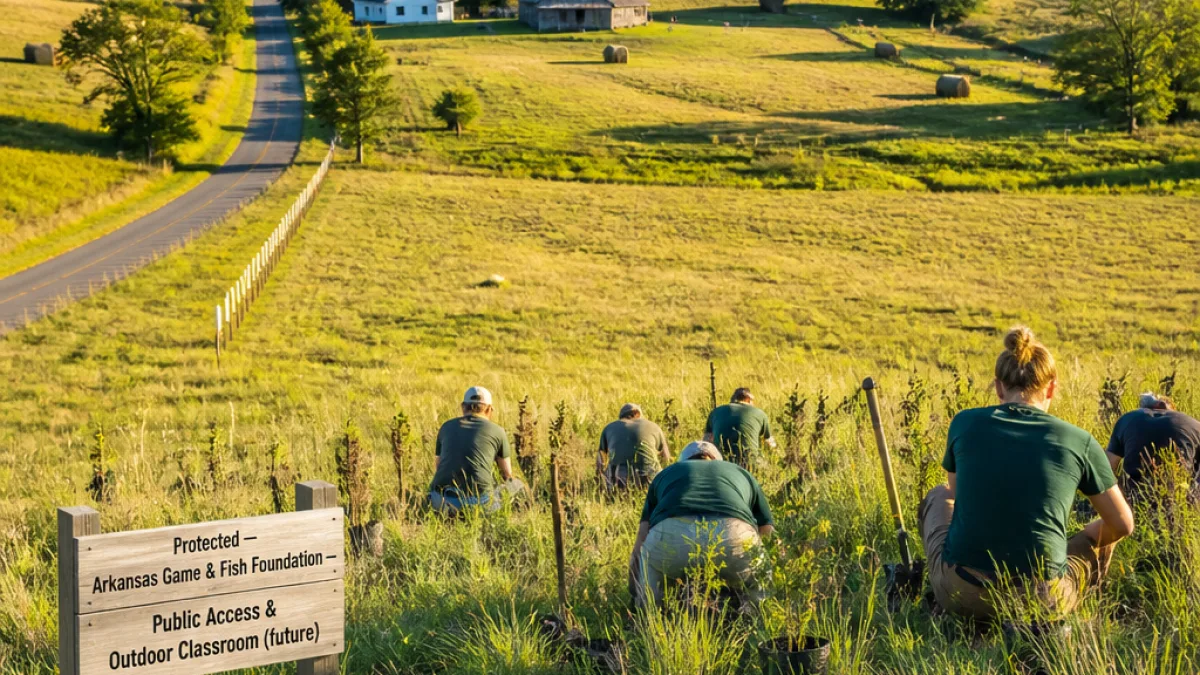
A long‑time Benton County landowner has placed his 150‑acre farm into the public conservation trust, donating the property to the Arkansas Game and Fish Foundation under a life estate that allows him to remain on the land while guaranteeing its future as conserved habitat and public access.
Largest gift in foundation history
The donation, announced this week, represents the largest single gift the Arkansas Game and Fish Foundation (AGFF) said it has ever received. The foundation — established in 1982 as a 501(c)(3) auxiliary to the Arkansas Game and Fish Commission — serves as a fundraising, lobbying and public outreach arm that helps advance conservation and outdoor education across the state.
AGFF President Deke Whitbeck said the Benton County property will become a cornerstone for conservation and engagement in Northwest Arkansas. The foundation plans to work with the Game and Fish Commission to restore native habitat, protect sensitive karst features and open the site for sustainable recreation and education.
"Mr. Henderson's foresight secures a vibrant future for the Natural State," Whitbeck said.
Life estate keeps owner on the land
The farm was donated as a life estate, a legal arrangement that allows the donor to continue to live on and work the farm during his lifetime while transferring eventual ownership to the foundation. The landowner, Arthur Henderson, told the foundation he decided against development as residential and commercial growth has transformed much of Benton and Washington counties.
"This was all open country, cattle and quail," Henderson said. "I've seen too much of this development, and I didn't really want to see this developed. After talking about it, we decided that it would be a good deal to let the Game and Fish have this because they're not going to put asphalt and concrete on it."
Under the life estate, Henderson will continue to inhabit and work the property while the foundation and commission plan the site's future use.
Planned restoration and public uses
Officials said the AGFF and the commission will return portions of the property to their original prairie and hardwood savanna conditions to support native species and safeguard karst areas, which are important for groundwater and sensitive ecosystems. The foundation also cited intentions to establish:
- habitat restoration projects focused on native prairie and savanna
- sustainable public access including hiking trails and seasonal floating
- an "outdoor classroom" for youth mentorship and conservation education
Doug Schoenrock, director of the Arkansas Game and Fish Commission, said the agency is "extremely excited" by the opportunity, signaling the commission’s likely role in long‑term management and programming.
Local context: development pressures
Northwest Arkansas has experienced rapid growth in recent decades, with farmland and open country often giving way to residential subdivisions, retail centers and other development. Donors like Henderson are increasingly rare but significant: permanent conservation easements or transfers to public institutions can preserve ecological values and recreational opportunities that would otherwise be lost to development.
The foundation said the property will serve both conservation and community purposes, creating space for public education about native ecosystems while protecting sensitive land features from impervious development.
What this means for residents
While immediate public access details and a timeline were not released, residents can expect the foundation and commission to coordinate on restoration plans and phased public amenities. Those interested in updates, volunteering or educational programming should monitor announcements from the Arkansas Game and Fish Foundation and the Arkansas Game and Fish Commission.
| Item | Detail |
|---|---|
| Size | 150 acres |
| Donation type | Life estate (donor retains right to inhabit) |
| Primary goals | Habitat restoration, public access, outdoor classroom |
The gift underscores a continuing tension across Northwest Arkansas between development and conservation. For now, the farm will remain in the hands of the man who tended it, but its future has been redirected from potential commercial or residential conversion toward public benefit and ecological restoration.
As the AGFF and the commission develop specific restoration projects and access plans, the property is likely to become a local resource for outdoor education and low‑impact recreation while protecting landscape features that are increasingly scarce in the region.