
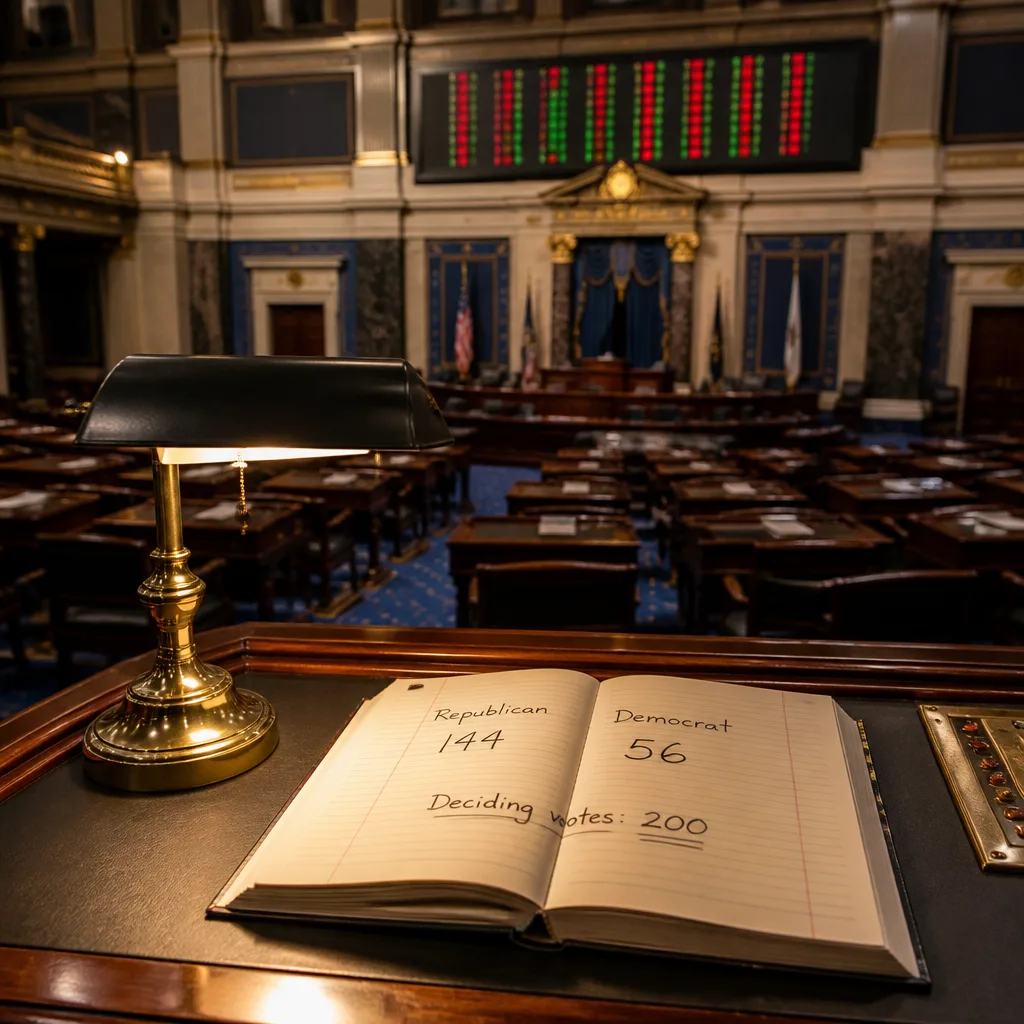
Sen. Susan Collins, R-Maine, has cast the U.S. Senate’s single deciding vote on 200 roll calls over her career, a new review of roll-call data shows — a pattern that undercuts the simple claim by critics that she only parts with her party on inconsequential measures.
Data and what it shows
The analysis, which examined roll-call records compiled by VoteView, covers Collins’ tenure from her first votes in 1997 through 2026. Out of roughly 10,076 total votes she has cast, those 200 instances represent about 2% of her voting record.
| Metric | Number |
|---|---|
| Total roll-call votes cast | 10,076 |
| Deciding votes (would have changed outcome) | 200 |
| Deciding votes that helped Republicans | 144 |
| Deciding votes that produced Democratic-preferred outcomes | 56 |
Most of those swing votes — 144, or about 72% of the deciding votes — resulted in outcomes aligned with her party. Still, the senator has cast more deciding votes that produced Democratic-preferred outcomes (56) than any other senator over the period reviewed.
Politics, perception and consequence
Democratic critics long have charged that Collins breaks with Republicans primarily when it carries little political cost. The assertion resurfaces as she seeks a sixth term in the Senate. Allies of Maine’s Democratic U.S. Senate nominee, Troy Jackson, argue that the senator’s record is less centrist than it once appeared.
“Mainers know this game,”
The review offers nuance to that critique. While Collins does not often cast what would be the chamber’s ultimate deciding vote against Republicans, her record also shows she has done so more than any other senator in the same span. The contrast — a majority of decisive breaks favoring Republicans alongside the largest raw number of decisive Democratic-favoring breaks — complicates simple partisan narratives.
Her votes on high-profile confirmations have helped fuel scrutiny. Votes in favor of former Supreme Court nominees, including Brett Kavanaugh and Neil Gorsuch, are cited by critics who point to later rulings that reshaped constitutional protections. More recently, as the Senate considered President Donald Trump’s nominee for attorney general, Todd Blanche, Collins prepared to cast a vote against the nominee, who was confirmed by the narrow Republican majority.
How the numbers fit the broader Senate picture
Quantifying "deciding" votes provides one way to assess a senator’s pivotal role in a closely divided chamber. Collins ranks seventh in the rate of party-breaking decisive votes, behind several senators with much shorter tenures and fewer total votes. That ranking indicates other members are more likely, on a proportional basis, to cast deciding votes against their party, even if Collins’ longevity produces higher raw totals.
- Longevity matters: A long Senate career increases exposure to close margins and narrow roll-call outcomes.
- Raw counts vs. rates: Collins has the highest raw number of decisive votes that produced Democratic outcomes, but not the highest rate of party-breaking decisive votes.
- Political stakes: High-profile confirmations and decisions with lasting policy impact sharpen public focus on her record.
As Collins campaigns for re-election, the mixed record is likely to feature in debates over whether she remains a pragmatic moderate or has shifted toward greater partisan alignment. For voters and analysts, the VoteView-derived figures provide a precise, if partial, metric of influence: they show how often one senator’s vote alone altered the Senate’s course — and how frequently that alteration favored her party.
That duality — both a tendency to side with Republicans in pivotal moments and an unmatched number of decisive breaks favoring Democrats in raw terms — will shape how opponents, supporters and neutral observers characterize Collins’ role in a chamber where single votes can determine law and leadership.