
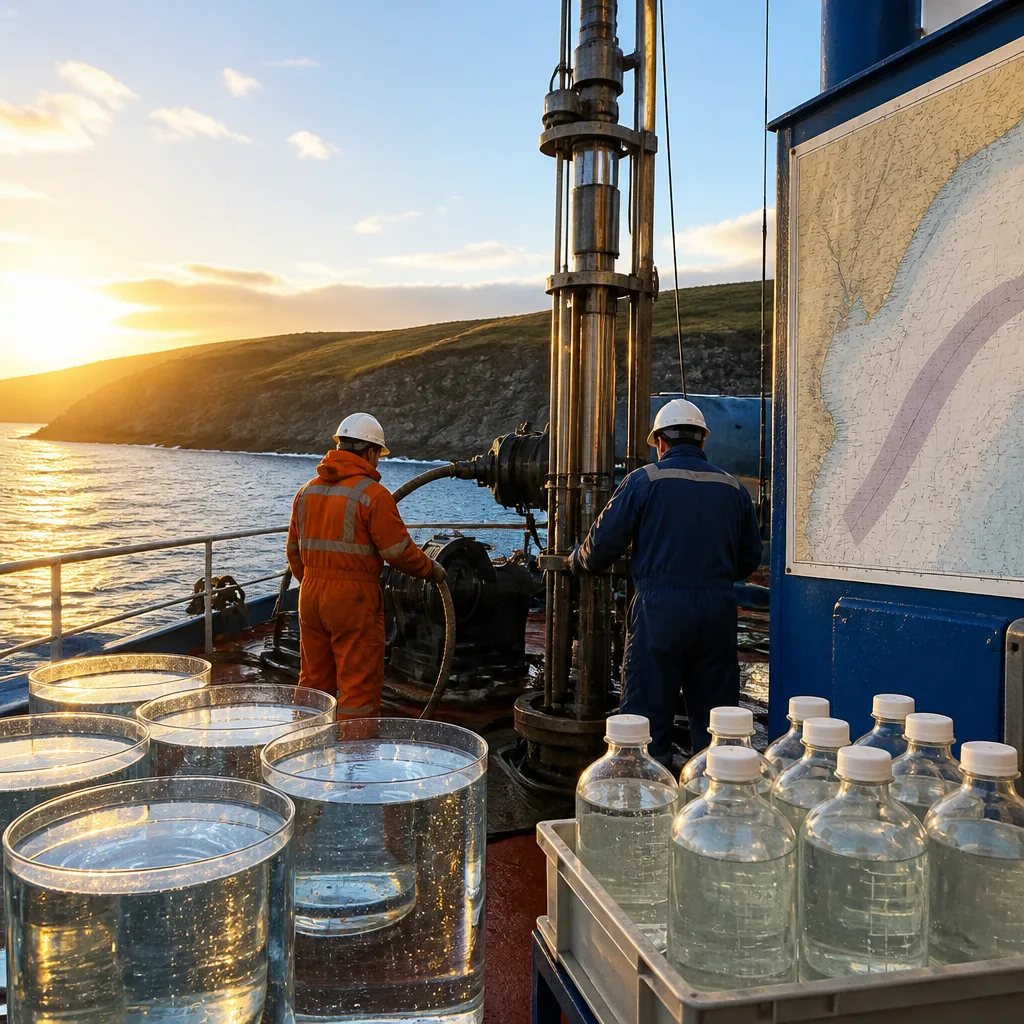
During a 2025 drilling campaign off the coast of Massachusetts researchers recovered in excess of 50,000 litres of formation fluid from layers of sand and mud beneath the Atlantic seafloor, some samples having salinity close to or below 1 practical salinity unit (PSU) — compared with roughly 35 PSU for open-ocean seawater. The results confirm that extensive low‑salinity groundwater occupies the New England continental shelf, and add weight to earlier geophysical and borehole indications that the shelf contains large bodies of freshened water.
What was found and how
An international team lowered drill pipe through tens of metres of sediment in nine pumping tests during the summer of 2025 and brought up more than 50,000 litres of formation fluid. The density and electrical conductivity of that fluid pointed clearly to freshened water occupying permeable layers beneath the seafloor.
These new direct samples complement a sequence of observations stretching back decades. Boreholes drilled in the 1960s and 1970s first encountered unexpectedly low‑salinity pore waters, though those early holes were scattered and not intended to map an aquifer. In 2015 researchers towed electromagnetic instruments offshore New Jersey and Martha’s Vineyard; because salt water conducts electricity much better than fresh water, those measurements revealed laterally continuous resistive zones interpreted as low‑salinity groundwater. A 2019 study using that dataset inferred aquifers extending as far as 90 kilometres offshore and spanning at least 350 kilometres of coastline from New Jersey toward Martha’s Vineyard.
Uncertain age and origin
The crucial remaining question is when the water entered the sediments. The new drilling does not yet resolve whether much of the recovered fluid was trapped beneath the sea at the end of the last Ice Age — when falling sea levels and glacial processes could have driven meltwater and rain into exposed shelf sediments — or whether substantial portions of the water are much younger, supplied by rain and river recharge carried slowly from onshore aquifers beneath the present-day sea.
It is also possible that a single sample contains a mixture of waters of different ages, so interpreting both the provenance and the dynamics of the system will require further geochemical and isotopic analyses, together with numerical models constrained by the new direct sampling.
Implications
The discovery has several potential consequences for water management, coastal resilience and our understanding of post‑glacial hydrogeology:
- Water resources: The sheer volume hinted at by combined drilling, borehole and electromagnetic data suggests a system that could equate to centuries of supply for a major city in a purely volumetric sense, but it is not yet a ready resource for consumption.
- Scientific value: The sediments and groundwater preserve records of past climate and sea‑level change; resolving the age of the water would help reconstruct meltwater pulses and post‑glacial drainage patterns.
- Practical constraints: Accessibility, permeability, salinity distributions and environmental impacts of any extraction remain unknown; pumping offshore through continental-shelf sediments presents technical, legal and ecological challenges.
Putting the new results into a nutshell: direct pumping in 2025 verifies what geophysics had long suggested — significant volumes of freshened groundwater lie beneath the Atlantic shelf off New England — but the leap from discovery to a utilizable water supply is substantial and unresolved.
| Parameter | Observed value |
|---|---|
| Volume recovered during 2025 tests | more than 50,000 litres |
| Salinity of some samples | ≈ 1 PSU or lower |
| Typical seawater salinity | ≈ 35 PSU |
| Inferred offshore extent from EM surveys | up to 90 km |
| Coastal span suggested by earlier work | at least 350 km |
Further work will need to combine high‑resolution sampling, age‑dating (for example using radiogenic isotopes), hydrological modelling and careful surveys of sediment architecture to determine how the system formed, how isolated it is, and whether portions of it might be tapped without unacceptable environmental cost. Until then the discovery is a striking demonstration that large, low‑salinity groundwater bodies can persist beneath continental shelves — archives of past climates and potential reservoirs for a water‑stressed future, but not yet a simple answer to present supply problems.









