
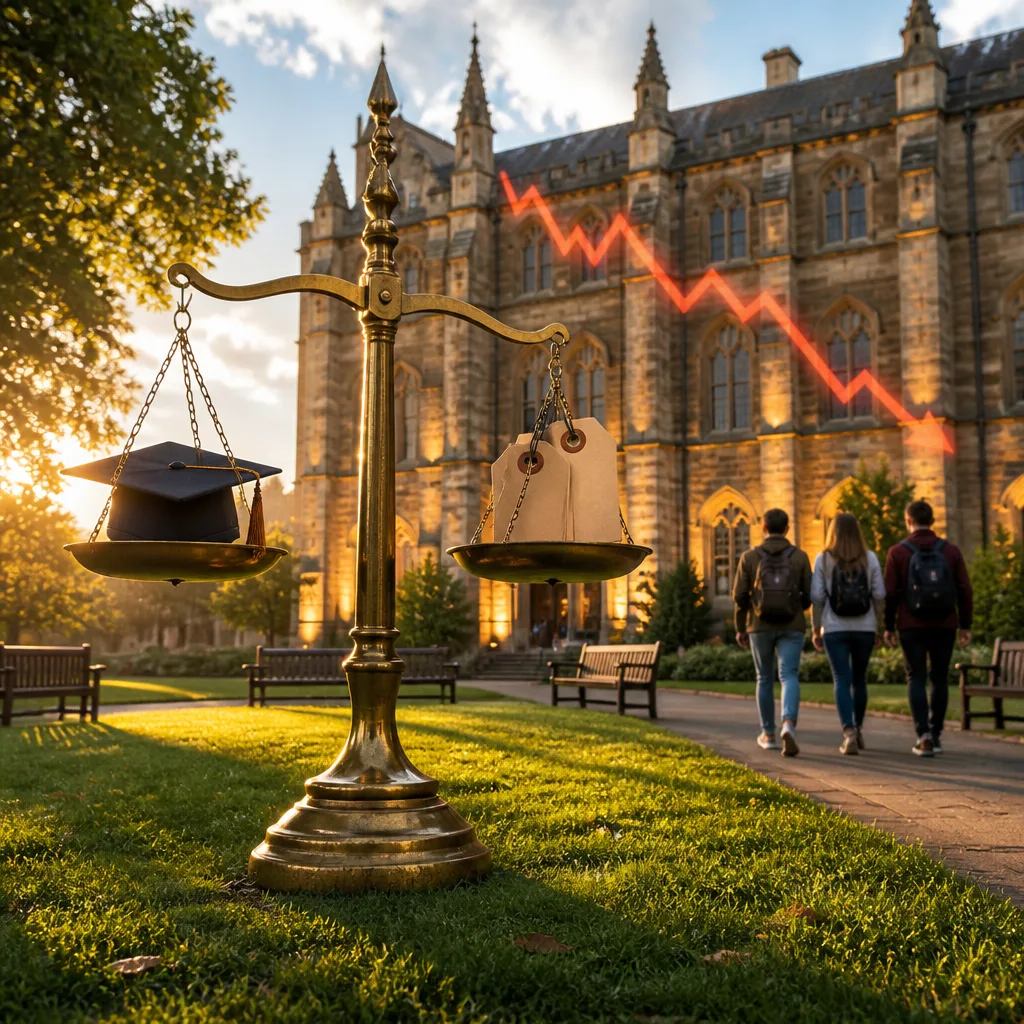
American universities are likely to undergo a period of financial adjustment rather than mass closures, a Bloomberg Opinion columnist writes, as the sector confronts long‑term demographic shifts, rising costs and a changing public perception of the value of degrees.
Market pressures meet shrinking cohorts
The columnist highlights several structural pressures facing higher education in the United States. After decades in which successive generations were larger and international student recruitment expanded campus populations, those growth engines have weakened. Domestic college attendance has stabilised at around 40% of people of college age, while future cohorts are projected to be smaller and international demand has softened.
As a result, many institutions — particularly smaller, tuition‑dependent private colleges — are under strain. Some have been using endowment resources to plug budget shortfalls while others have failed to meet recruitment targets, producing acute financial stress.
Costs, public sentiment and institutional credibility
The piece notes that the sticker price of undergraduate study has soared, with the cost of a four‑year degree approaching US$400,000 in some cases. Alongside cost pressures, the columnist points to a growing scepticism among the public about whether higher education delivers commensurate returns.
Concerns about politicisation on campuses, certain courses judged to lack clear vocational value, and a perception of grade inflation or opaque admissions processes are said to have eroded the “brand” power of a degree for some observers. Nevertheless, the columnist argues that the long‑run earnings premium for degree holders remains sizable.
Adjustment, not apocalypse
Drawing an analogy from finance, the commentary suggests the sector is experiencing a re‑pricing rather than a systemic failure. In other words, market values and the price of provision may need to come down to match demand and affordability, but the fundamental role of universities in providing education is expected to continue.
Key quantitative points cited in the analysis are summarised in the table below.
| Measure | Figure |
|---|---|
| Share who attend four‑year college | ≈ 40% |
| Typical cost of four years (noted) | ≈ US$400,000 |
| Estimated lifetime earnings premium | Nearly US$1m |
What this means for students and institutions
The columnist observes that most students still select professionally oriented subjects — business and health‑related fields are highlighted — reflecting continued demand for career‑focused training. This pattern suggests that while some disciplines or providers may face sharper adjustments, others will retain steady market appeal.
Institutions that rely heavily on tuition from a steady stream of domestic and international students are the most vulnerable to a protracted period of recalibration. The piece cites examples of universities that have missed enrolment targets and encountered budgetary crises as evidence of how pressures are already playing out.
- Enrolment stability has masked underlying demographic contraction for future cohorts.
- Cost escalation has increased scrutiny of value for money in higher education.
- Institutional reputation is affected by perceptions of politicisation and academic standards.
Rather than predicting collapse, the columnist suggests policymakers, university leaders and families should prepare for a period of pricing and structural adjustment: some institutions will need to recalibrate their business models, course portfolios or recruitment strategies, while others will leverage enduring demand for professional and vocational pathways.
The piece does not prescribe specific policy remedies but frames the unfolding challenge as one of market correction in which price, provision and expectations must be more closely aligned.
For readers watching higher education closely, the central message is that colleges are unlikely to disappear en masse; instead, the sector may look materially different in the years ahead as it adapts to fewer students, greater cost scrutiny and shifting public expectations.