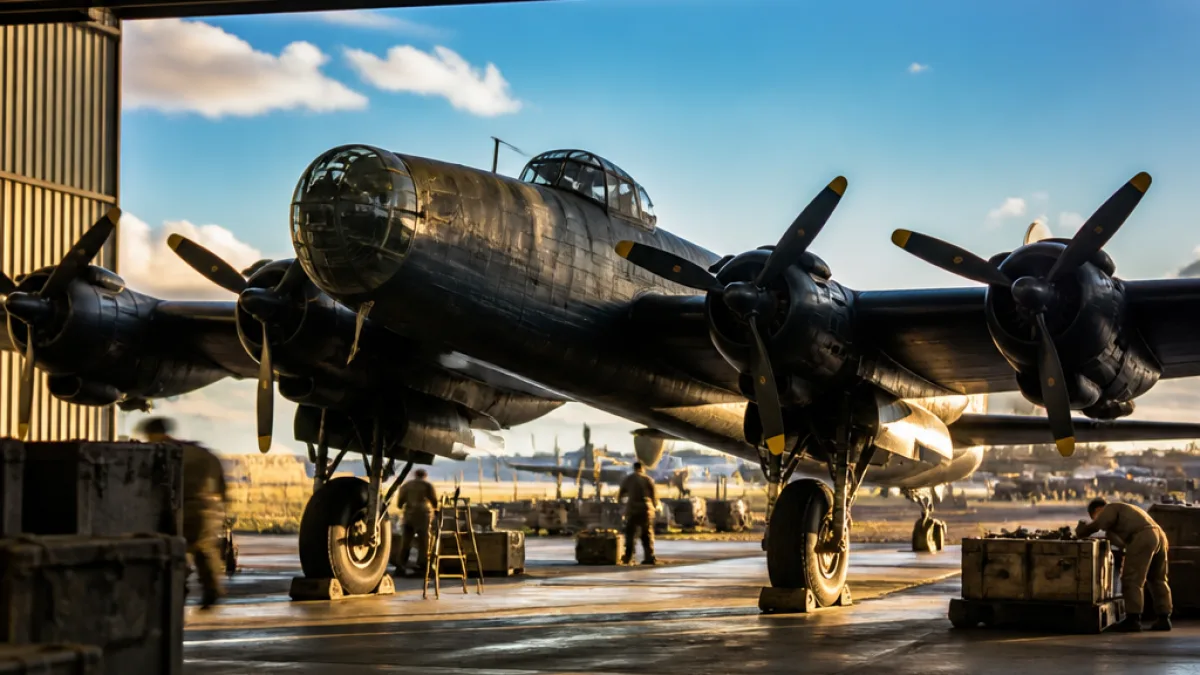
Design demand that mattered more than aerodynamics
The Short Stirling holds a particular place in RAF history as the service’s first four‑engine heavy bomber, entering service in February 1941. Yet the aircraft’s story is commonly told as one of potential hindered by a single, non‑aeronautical requirement: the Air Ministry’s insistence that the wingspan be no greater than 100 feet so the completed aeroplanes could pass through existing hangar doors.
Short Brothers complied, producing a machine with a wingspan of just under 100 feet. The constraint forced designers to adopt a tall, ungainly undercarriage to achieve the correct wing incidence for take‑off. The result was an aircraft with a cavernous fuselage and substantial internal volume, but one that could not achieve the heights expected of a strategic heavy bomber.
“The specification called for a maximum wingspan of 100 feet to allow the aircraft to fit into existing hangars.”
Operational consequences over enemy territory
The Stirling’s reduced wing area translated directly into a low service ceiling. In operational terms this meant the bomber typically cruised at around 16,500 feet, substantially lower than contemporaries such as the Halifax and the Lancaster, which could operate above 20,000 feet. That lower altitude had serious implications: Stirlings were routinely in the densest bands of anti‑aircraft fire and well within the reach of German night fighters.
Accounts of mixed raids record Stirlings flying at the lowest levels of the force and suffering correspondingly higher losses. That vulnerability shaped how the type was used through the war and influenced the development and favouring of other four‑engine types for strategic bombing.
Design trade‑offs and limitations
- Wingspan: capped at just under 100 ft to meet hangar constraints.
- Service ceiling: approximately 16,500 ft, lower than Halifax and Lancaster.
- Bomb bay: divided into cells and unable to accept bombardment loads larger than 2,000 lb.
Those limitations — particularly the restricted bomb bay — meant the Stirling could not carry some of the larger ordnance that later bombers could accommodate. Despite a fuselage large enough to suggest greater capability, the design compromises dictated by the hangar requirement were a persistent handicap.
Production and losses
| Metric | Figure |
|---|---|
| Built | About 2,383 |
| Lost in action | 582 |
| First entered service | February 1941 |
Some 2,383 Stirlings were produced, of which 582 were lost on operations. Those figures underline that, despite its shortcomings at altitude, the type was widely used and paid a heavy price in operational service.
Legacy and lessons
The Stirling’s story is often framed as a case study in how requirements set outside aerodynamic reasoning can shape — and sometimes hobble — aircraft development. Its designers achieved as much as the constraint allowed: an aeroplane that was enormous in fuselage volume and capable in some roles, yet fundamentally limited by a foregone conclusion in the specification stage.
For Stirling, the city whose name the bomber carries, the aircraft remains part of the wider wartime narrative of British industry, design compromise and the human cost of strategic bombing campaigns. The type also informed the development of successors such as the Lancaster, which benefited from different design freedoms and ultimately became the better‑known symbol of Bomber Command’s heavy force.
The Short Stirling therefore survives in the record not only as Britain’s first four‑engine heavy but as a reminder that seemingly small administrative decisions — in this case a hangar‑door limit — can have outsized operational consequences.