Apple has set out who may access its Education Store and, separately, which devices attract a reduced price. The technology firm allows only four categories of buyers to use the Education Store and requires proof of eligibility through a third‑party service or an in‑person check, while keeping certain offers and programmes distinct from its consumer and corporate pricing.
Who can shop the Education Store
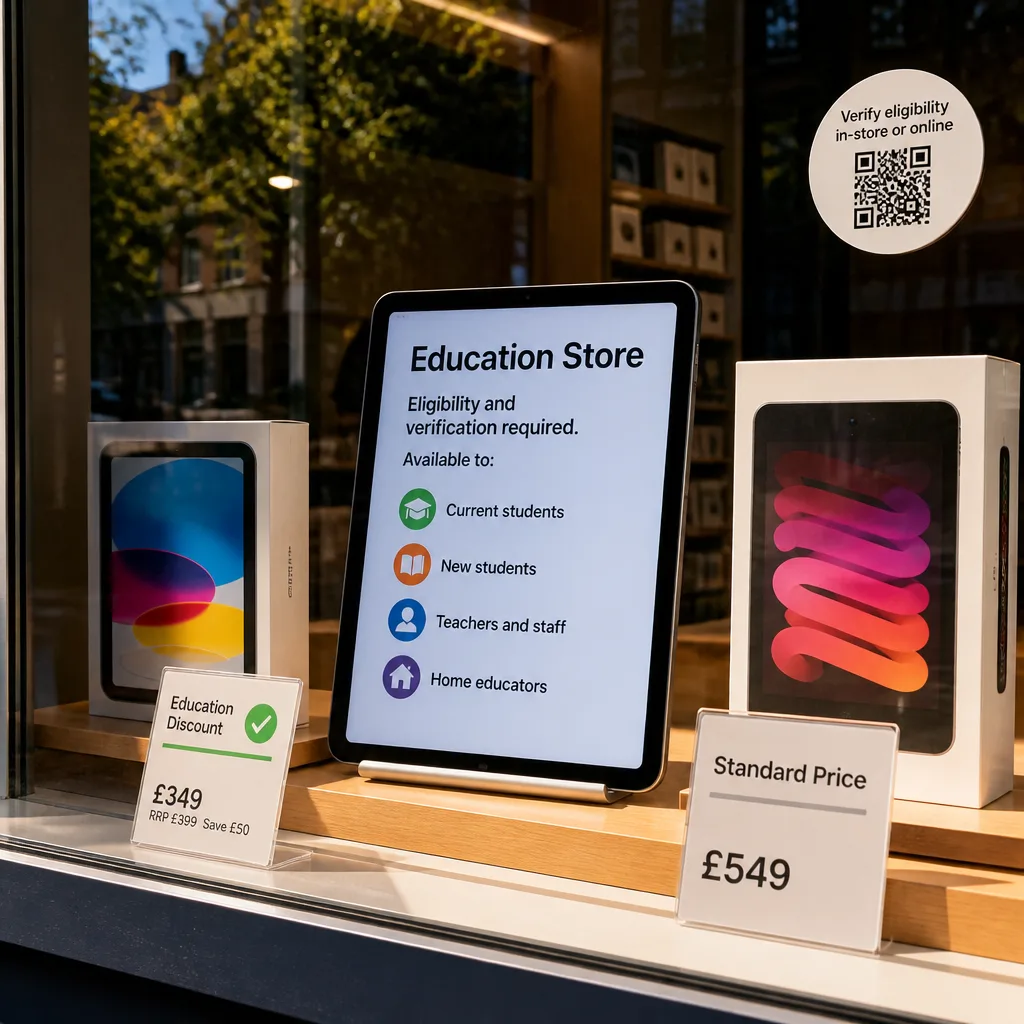
The store is open to a restricted list of customers. Apple states that the following groups are eligible:
- Current and newly accepted higher‑education students
- Parents purchasing on behalf of an eligible higher‑education student
- Faculty and staff employed by higher‑education institutions
- Employees of K‑12 institutions (the policy does not extend to K‑12 pupils or their parents in that category)
Verification for online orders is handled via UNiDAYS, the third‑party eligibility service, or by presenting proof in person at an Apple Store. Apple publishes no alternative online verification route.
| Eligible group | Verification method |
|---|---|
| Higher‑education students | UNiDAYS or in‑store |
| Parents (on behalf of student) | UNiDAYS or in‑store |
| Higher‑education faculty and staff | UNiDAYS or in‑store |
| K‑12 employees | UNiDAYS or in‑store |
Which products are discounted — and which are not
Being able to enter the Education Store is distinct from receiving a discount. Apple’s published pricing demonstrates actual savings on a selection of Mac computers and displays, while other product lines are offered at the same price as the consumer store.
Notably, the iPhone 18 Pro is listed at no discount compared with the general retail site. Conversely, devices such as the Mac mini do carry an education price for eligible buyers. Apple also maintains a separate Education Institution Price List for whole‑school or district purchasing, which operates on different terms to the consumer‑facing Education Store.
Apple’s terms explicitly segregate education pricing from its corporate and employee purchase programmes. The firm’s India store page, for example, notes that offers do not combine with either education discounts or corporate employee purchase plans — illustrating that multiple discount schemes are deliberately kept apart.
Implications for classrooms and families
For pupils, students and staff, the rules mean that access to cheaper Apple hardware depends as much on employment or student status as on parental relationships. Parents wanting to buy on behalf of a university entrant are covered, but families with school‑age children should note that K‑12 pupils and their parents are not listed among the eligible buyers for the K‑12 category — the latter is limited to employees.
Schools and college procurement teams will continue to rely on the institution price list when buying at scale. Individual staff and students seeking savings on personal purchases must therefore follow the eligibility routes Apple specifies, and be prepared to use UNiDAYS or present documentation in store.
The approach underlines a broader point about technology discounts in education: eligibility criteria and the catalogue of discounted goods are separate policy choices. One determines who can enter the purchasing channel; the other dictates what savings are available once inside. For teachers, students and parents keeping a close eye on budgets as device costs rise, both questions matter.
While Apple’s published pages make these distinctions clear, they also leave limited flexibility for alternative verification routes online, which may frustrate some prospective buyers outside the named groups or in areas where UNiDAYS is less widely used.