
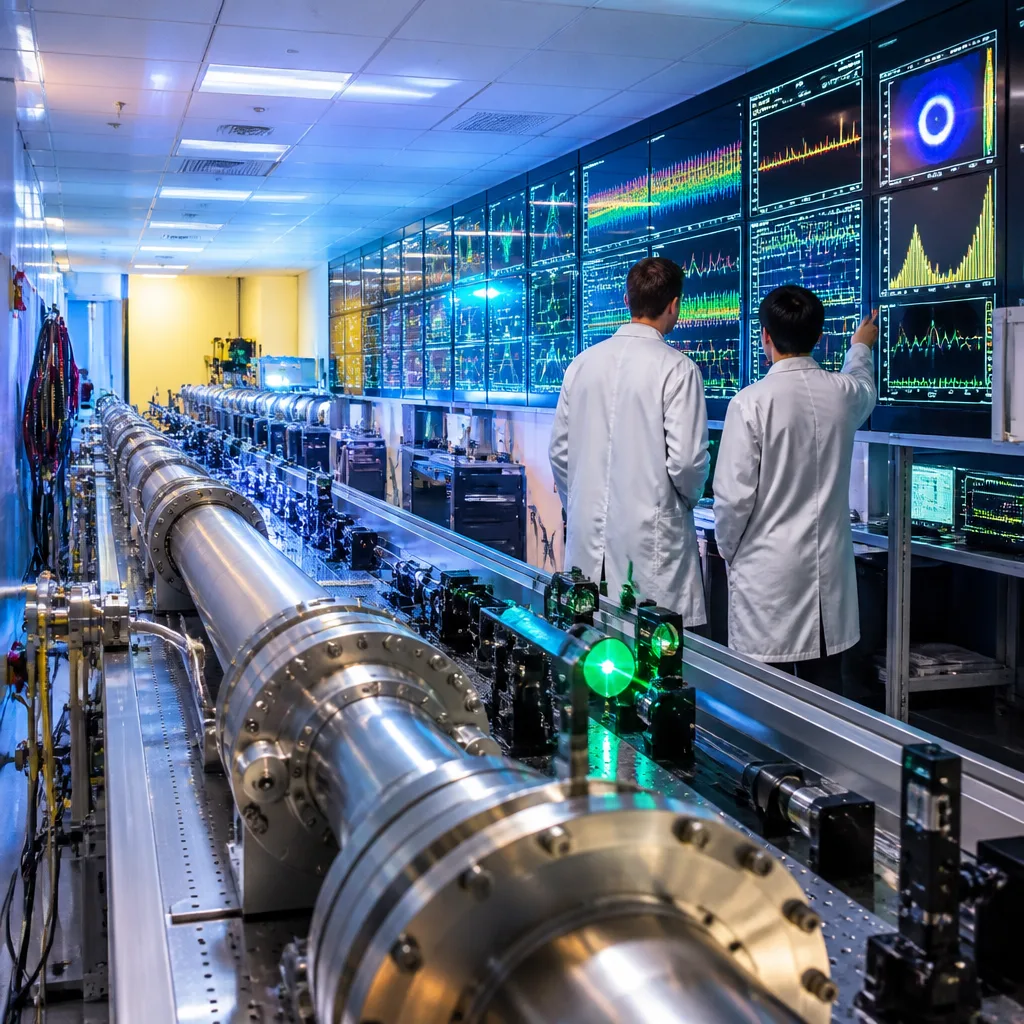
The U.S. National Science Foundation (NSF) has awarded $33 million in its second round of operations funding to the ZEUS laser facility at the University of Michigan, securing another five years of activity for what is described as the most powerful laser in the United States. The cash will support upgrades and allow the facility to deliver roughly 150 weeks of experiments to a growing community of national and international users.
What the funding enables
ZEUS entered operations mode in 2024 after reaching a peak power of about one petawatt — a quadrillion watts — matching the power of the previous leading U.S. system. Since opening to external researchers, the facility has already hosted about 72 weeks of experiments devised by teams from outside the University of Michigan.
The renewed grant is intended to pay for both running costs and a programme of upgrades that will broaden the range of experiments the laser can support. Users submit proposals which are assessed by an independent review panel; the facility also set up an advisory user group last year to help shape upgrade priorities and future planning.
Range of science and applications
ZEUS is being used across a wide sweep of basic and applied research. Projects include:
- fundamental studies into the behaviour of matter under extreme electromagnetic fields and plasmas;
- laboratory astrophysics recreating miniature analogues of processes found at the edges of black holes and on neutron star surfaces;
- developmental work on X‑ray sources intended to image soft tissue at low doses;
- experiments producing particle beams with potential applications in cancer therapy and in detection of illicit nuclear materials.
These activities span both curiosity‑driven physics and research that could underpin new technologies for medicine and national security.
“With this renewal, we can continue rebuilding U.S. leadership in laser science, serving a growing community of researchers who explore the extremes of light and matter as well as the new technologies those findings could enable,”
— Louise Willingale, director of the ZEUS laser facility.
Community and capacity
The grant acknowledges ZEUS’s role as a shared national user facility. The plan to provide approximately 150 weeks of experimental time over the funded period reflects demand from both U.S. and international researchers. Since its operational transition in 2024 the centre has established governance mechanisms — including the advisory user group — intended to ensure access and to inform upgrade choices.
Despite the focus on high‑energy physics, the portfolio of experiments signals an interest in translating lessons from the extremes into practical tools. For example, compact, laser‑driven X‑ray sources promise imaging that might reduce patient dose compared with some current modalities; similarly, laser‑generated particle beams are being explored for novel cancer treatment approaches and for scanning systems able to detect shielded nuclear materials.
Simple summary of recent metrics
| Metric | Value |
|---|---|
| NSF renewal | $33 million |
| Planned experiment weeks | ~150 weeks |
| Weeks already run | 72 weeks |
| Peak power | ~1 petawatt |
| Operations mode began | 2024 |
The investment underscores a broader international competition to host and operate facilities that reach previously unattainable electromagnetic intensities. For the United States, the award is cast as part of an effort to rebuild leadership in laser science by sustaining a platform where both fundamental questions and translational research can be pursued under one roof.
How effectively ZEUS converts its laboratory results into reliable technologies — and how access is balanced across academic, medical and defence communities — will shape the facility’s influence in the next five years. The new funding clears the path for that work to continue and for the user base to expand as experiments probe the extremes of light and matter.









