
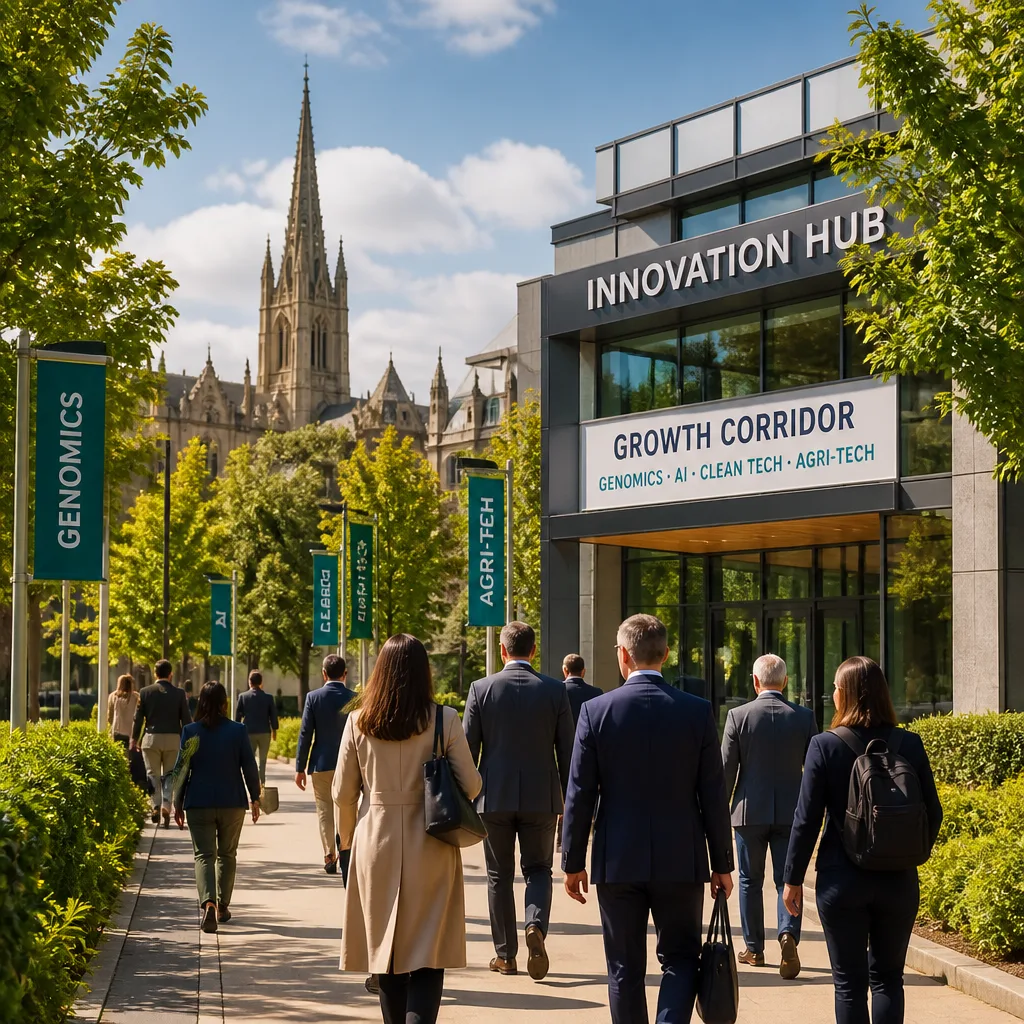
Ambassador promotes targeted UK–Israel research partnerships
Britain has moved from general diplomacies to a focused push for scientific and commercial collaboration with Israel, with the UK Ambassador to Israel touring the Oxford–Cambridge Growth Corridor to meet researchers, investors and industry leaders.
The visit, part of the government’s International Growth Partnerships programme, paired Israel with one of Britain’s principal research and innovation clusters to identify concrete areas for cooperation rather than broad declarations of intent.
Accompanied by representatives from the Department for Business, Innovation, Science & Trade, the UK‑Israel Tech Hub, the Science and Technology Network and the British Council, the ambassador and delegation convened discussions with academics, entrepreneurs, investors and corporate executives around opportunities to work together in high‑tech fields.
“The UK and Israel are innovative nations with a shared commitment to scientific excellence, entrepreneurship and technological progress,” the ambassador said. “The Oxford‑Cambridge Growth Corridor is home to some of the world's most exciting research institutions, businesses and investors, and there is enormous potential to deepen collaboration with Israel across science, technology, trade and investment.”
Practical focus on high‑value sectors
According to the delegation’s programme, conversations were deliberately concentrated on areas where both countries already have strengths and complementary capabilities. These included:
- Genomics and biodata — building on Cambridge’s and Oxford’s research base and Israel’s biotechnology sector.
- Life sciences and biotechnology — clinical research, translational science and commercialisation pathways.
- Agricultural technology — precision farming and agri‑tech innovation.
- Artificial intelligence — AI research, applications and data partnerships.
- Clean technology — low‑carbon solutions and advanced manufacturing.
The delegation sought to move discussions beyond high‑level statements to explore concrete collaborations between institutions and companies across the corridor — a region frequently highlighted as a national engine for research‑intensive growth.
| Partner | UK strengths highlighted |
|---|---|
| Oxford–Cambridge Growth Corridor | Research institutions, life sciences clusters, innovation ecosystems |
| Israeli partners | Genomics, biotech, agri‑tech, AI, clean tech companies and investors |
Officials framed the initiative as a test of how targeted regional pairings can translate into collaborative research projects, investment deals and commercial partnerships. The UK government’s scheme selects international partners to match with specific British growth clusters in order to accelerate trade, research links and inward investment.
Context and implications
The visit illustrates the UK’s pragmatic approach to international science diplomacy: seeking opportunities for mutually beneficial cooperation even where political differences exist at higher levels. By prioritising sectors such as genomics and AI, the delegation tapped into areas with potential for rapid scientific and commercial returns, while also raising questions about data governance, regulatory alignment and intellectual property — matters that will need to be worked through if collaborations are to scale.
For British research institutions, deeper ties with Israeli firms and laboratories could offer faster routes to market and access to complementary expertise. For investors and industry, the corridor’s concentration of spin‑outs and university‑industry partnerships presents a dense pipeline of opportunities for joint ventures and translational projects.
How partnerships progress will depend on follow‑up agreements, funding mechanisms and shared standards for data and clinical research where applicable. The presence of the Department for Business, Innovation, Science & Trade and the Science and Technology Network on the visit signals official intent to smooth those pathways.
Ultimately, the Oxford–Cambridge pairing with Israel will be judged on tangible outputs: joint grants, spin‑outs with cross‑border investment, and demonstrable technology transfers. The ambassador’s tour aimed to lay the groundwork for that next chapter of collaboration.









