
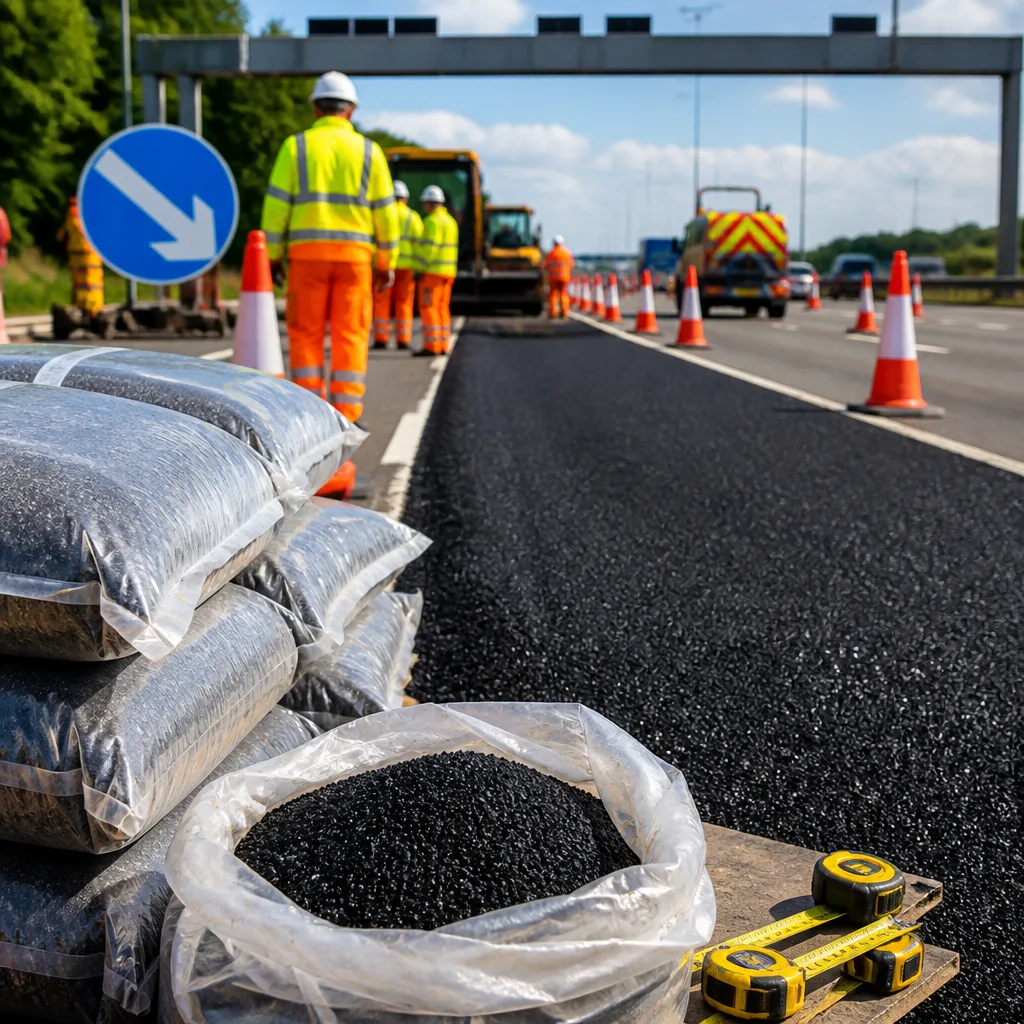
The north–south carriageway resurfacing trial on the M1 in 2019 used asphalt containing granulated tyre rubber, but the oft-repeated claim that each kilometre of road contains material from 750 scrapped tyres requires important caveats, according to documents from both government and the supplier.
What was laid on the M1
Highways England funded a trial of a tyre‑modified asphalt on the southbound M1 between junctions 23 and 22 near Leicester. The surfacing was a section of motorway carriageway treated with a rubber‑modified asphalt mix, not an entire motorway reconstructed from end to end using only tyre material.
Where the tyre figures come from
The commonly quoted maximum of 750 waste tyres per kilometre originates in a Highways England press release, which attributed the estimate to the road materials company Tarmac. The release said:
“It is estimated by Tarmac that up to 750 waste tyres could be used in every kilometre of road surfaced with the new material, depending on the thickness of the road.”
That sentence contains three qualifiers that are often lost when the number circulates as an absolute fact: it is an estimate, it is a company figure rather than an independent measurement, and it is conditional on the thickness of the surfacing layer used.
Different company figures and product context
Tarmac’s published material does not present a single, definitive tyre‑per‑kilometre count. In its 2021 sustainability report the company cited a lower upper bound of 500 tyres per kilometre, again noting the dependence on layer depth. Meanwhile, the product page for Tarmac’s ULTIPAVE R still references the larger 750‑tyre figure.
The practical implication is straightforward: the mass of rubber required per kilometre varies with how thick the rubber‑modified layer is laid, the proportion of crumb rubber in the mix and the construction specification for that stretch of road. A headline number that drops these conditions risks creating the misleading impression that every kilometre surfaced with the material necessarily consumes the same quantity of tyre rubber.
Why the detail matters
Two strands of public interest converge here. First, the environmental case: reusing waste tyres in road surfacing is attractive because it diverts rubber from landfill or incineration. Second, the procurement and engineering case: highways authorities and contractors need reliable, repeatable material specifications to approve, price and build resurfacing works. Mixing an experimental trial with a generalised claim about material composition can blur both debates.
- Trial location: M1 southbound, between junctions 23 and 22 (near Leicester).
- Supplier estimate A: up to 750 tyres per kilometre (Tarmac, press release).
- Supplier estimate B: up to 500 tyres per kilometre (Tarmac sustainability report, 2021).
| Source | Quoted upper figure (tyres/km) | Notes |
|---|---|---|
| Highways England press release | 750 | Attributed to Tarmac; explicitly depends on thickness. |
| Tarmac 2021 sustainability report | 500 | Also conditional on surfacing depth. |
The engineering reality is that the M1 trial used rubber‑modified asphalt: granulated tyre rubber is blended into conventional asphalt rather than replacing the aggregate entirely. That nuance helps explain why a single tyre count per kilometre is not a straightforward metric to report without specifying layer depth and mixture ratios.
What readers should take away
The M1 trial demonstrates a practical route for incorporating end‑of‑life tyres into road materials, which has clear environmental appeal. However, when assessing claims about the number of tyres reused, it is essential to preserve the conditional language — the figures are estimates; they come from the supplier; and they vary with construction choices.
As adoption widens, independent measurements and published construction specifications will be needed to convert company estimates into reliable, repeatable figures that highways authorities and the public can use to judge environmental benefit.









