
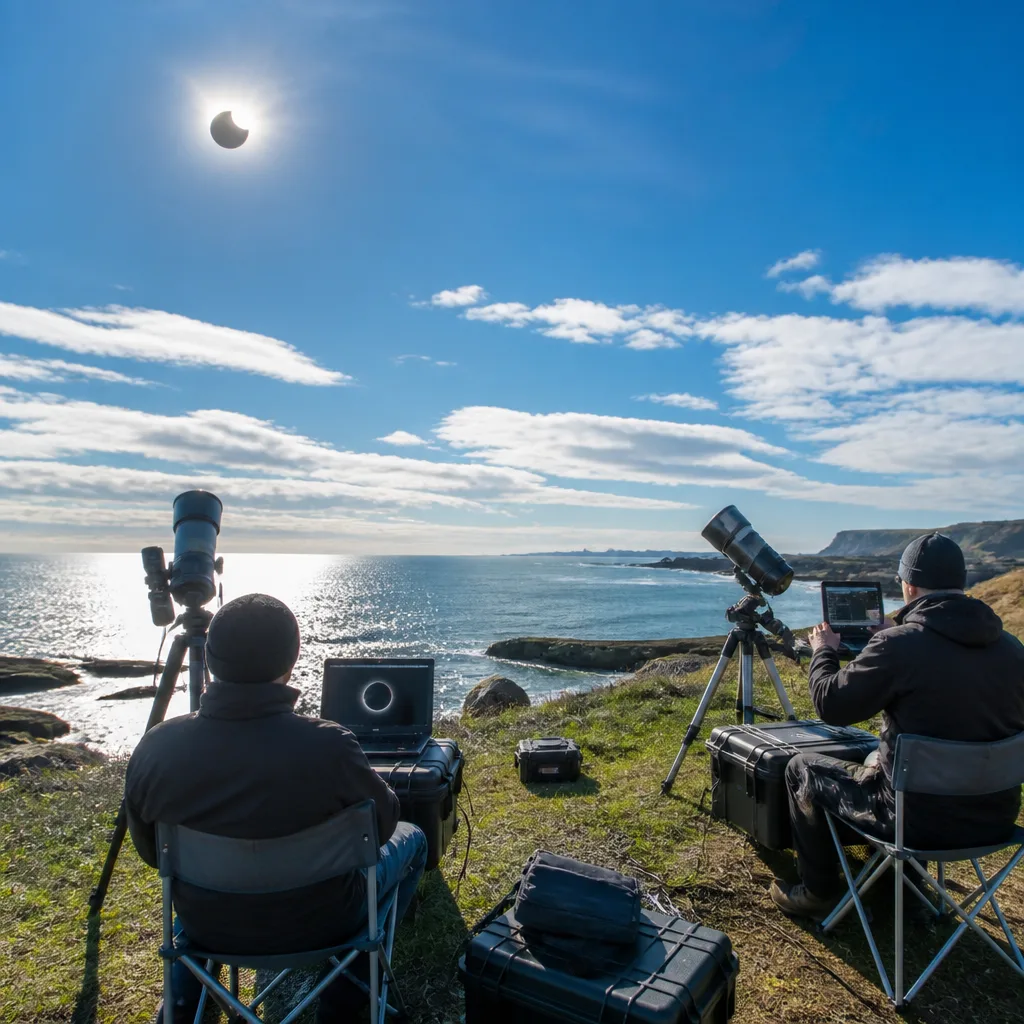
The partial solar eclipse that swept across the UK and much of Europe on Wednesday provided scientists with a rare observational window on the Sun’s outermost atmosphere, the corona, and an opportunity to measure how solar radiation influences the Earth’s atmosphere and technological systems.
Why a total or near-total eclipse matters to science
Although the Sun is the most familiar astronomical object, parts of it remain hard to observe. During an eclipse, the Moon obscures the bright solar disc and reveals the faint corona at the edge of the Sun — a region that is otherwise lost in glare. Instruments called coronagraphs perform a similar function by blocking the solar disc, but they do not fully recover the innermost corona close to the solar limb. For that reason, scientists say an eclipse supplies uniquely clean access to that near-Sun region.
Researchers highlight two principal scientific uses of the event:
- Direct imaging of the coronal structure near the Sun, which helps trace how heat and energy are channelled into the solar wind.
- Localised perturbation of daylight, allowing studies of how sudden changes in solar illumination affect the Earth’s atmosphere and surface conditions on a regional scale.
Historical context and modern goals
Eclipses have been pressed into service for major scientific questions before. A famous example often cited is the 1919 eclipse observed in Brazil, where photographs were used to test Albert Einstein’s prediction that gravity bends light — an early empirical success for general relativity. The contemporary effort is less about testing fundamental physics than about filling observational gaps in our understanding of the corona and its role in space weather.
Scientists pointed out that the corona is central to long-standing puzzles, notably how the Sun’s outer atmosphere attains temperatures and energies far above those of the visible surface, and how that energy supplies the solar wind that streams through the solar system. Improvements in imaging and coordinated measurements during the eclipse allow researchers to study small-scale structures and dynamics that feed into larger-scale heliospheric behaviour.
Practical pay-offs: atmosphere and technology
The eclipse’s localised dimming also yields a natural experiment for atmospheric scientists. Because the drop in solar illumination is confined geographically and temporally, researchers can examine how rapid changes in radiative forcing modify atmospheric temperature, winds and boundary-layer processes — information that helps test and refine models of short-timescale atmospheric response.
There are also practical implications for infrastructure. The Sun drives space weather that can disrupt satellites, radio communications and power systems. By improving knowledge of the corona and the origins of the solar wind, eclipse-driven observations contribute to better forecasting of events that might affect technology on Earth.
What the observations can — and cannot — do
Experts cautioned that while eclipses are scientifically valuable, they provide snapshots rather than continuous monitoring. The data are therefore most powerful when combined with regular observations from spacecraft and ground-based instruments. In particular, coronagraphs on telescopes and in space remain essential for long-term studies of coronal mass ejections and large-scale solar behaviour, even though they cannot perfectly replicate the view of the innermost corona accessible during an eclipse.
| Observation | Value to science |
|---|---|
| Coronal imaging during eclipse | Reveals innermost coronal structures obscured by glare in normal observations |
| Localised atmospheric dimming | Enables study of short-term atmospheric and surface responses to reduced sunlight |
Millions of people watched the celestial event, but among them were teams of scientists who coordinated telescopes, cameras and atmospheric sensors to extract as much information as possible from the brief opportunity. The data will be analysed in the coming months and compared with ongoing space-based measurements to build a more complete picture of how the Sun’s outer atmosphere behaves and how its variations cascade down to Earth.
In short, the eclipse was not just a spectacle: it was a laboratory in the sky that provided observations otherwise inaccessible, helping researchers to refine models of the corona, the solar wind, and the ways the Sun drives changes in our environment and technology.









