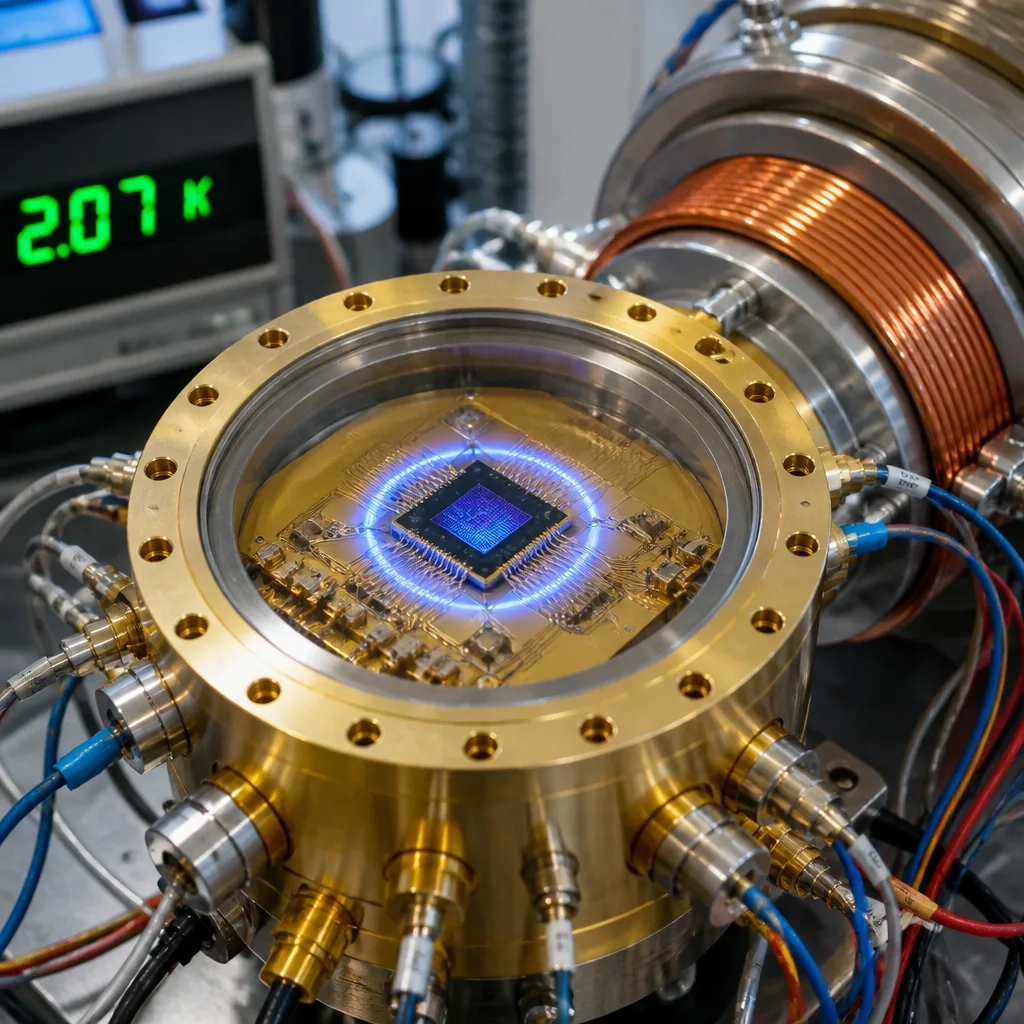
Researchers at Lawrence Berkeley National Laboratory have reported the observation of a Bose–Einstein condensate (BEC) of excitons in an atomically thin semiconductor that can be tuned by electrical gating and reconfigured with magnetic fields. The condensate was detected at temperatures up to roughly 2 kelvin, and the team says the exciton fluid displays an internal spin–valley structure that can be switched with an applied magnetic field.
How the team probed a solid-state quantum fluid
BECs are macroscopic quantum states in which many particles occupy the same quantum state and exhibit collective behaviour. Traditionally realised with ultra-cold atomic gases in vacuum, creating a comparable coherent state from excitons — bound electron–hole pairs in a solid — has long been an objective because a successful implementation could provide a compact, device-friendly route to macroscopic quantum coherence.
The Berkeley team worked with a bilayer two-dimensional semiconductor device assembled from atomically thin layers. By creating and stabilising long-lived excitons in the layered structure, and by applying electrical gates, they were able to reach conditions in which the excitons condensed into a coherent quantum fluid. Crucially, the condensate was not only persistent at elevated cryogenic temperatures (around 2 K) but was also controllable: electrical tuning altered the formation of the condensate, whilst an external magnetic field switched its internal spin–valley configuration.
Evidence and implications
The group reports that the exciton condensate overcomes a key hurdle that has dogged solid-state approaches: traditionally, optically generated excitons decay on timescales of about a nanosecond, which is far too brief to establish and study macroscopic coherence in a stable device. By contrast, the experimental design here produced excitons with lifetimes and densities sufficient to form a condensate that can be controlled electrically.
The result provides a tunable platform for exploring quantum fluids in a solid-state setting and may have consequences for several technological areas. The authors suggest potential applications in:
- quantum simulation using controllable many-body states;
- coherent optoelectronic components for advanced telecommunications and computing;
- future devices exploiting superfluid-like transport of excitonic currents.
Quantifying the advance and remaining questions
The key measured quantities reported are notable: the condensate survived up to about 2 K, and the platform allows both electrical and magnetic control over the state. These are concrete milestones that distinguish the work from earlier studies that relied on fleeting, optically created excitons.
Nevertheless, important questions remain. The stability and coherence time of the condensate under realistic device operating conditions, the scalability of the bilayer architecture, and the robustness of switching between internal configurations all demand detailed follow-up experiments. Understanding loss mechanisms, the role of disorder in atomically thin materials, and integration with existing semiconductor technologies will be necessary before practical applications can be realised.
“While previous studies have shown that electrons and holes can bind into excitons, there wasn’t a
The paper appears in Nature, and the authors frame the achievement as both a fundamental advance in the study of quantum fluids and a step towards exciton-based technologies. Because the result is achieved in a solid-state device with electrical control, it opens a pathway that is substantially more compatible with chip-scale integration than gas-phase BEC platforms.
| Quantity | Reported value |
|---|---|
| Condensate temperature | ≈ 2 K |
| Typical lifetime of optically generated excitons (for comparison) | ~1 nanosecond |
The discovery is likely to prompt further experimental and theoretical work worldwide. If the condensate can be engineered to operate under less stringent cooling, or if coherent excitonic circuits can be integrated with conventional semiconductor processing, the impact could extend to quantum information processing and low-power coherent optics. For now, the work is a careful demonstration of a controllable, many-body quantum state in a two-dimensional material — a laboratory for quantum fluid dynamics in solid form.