
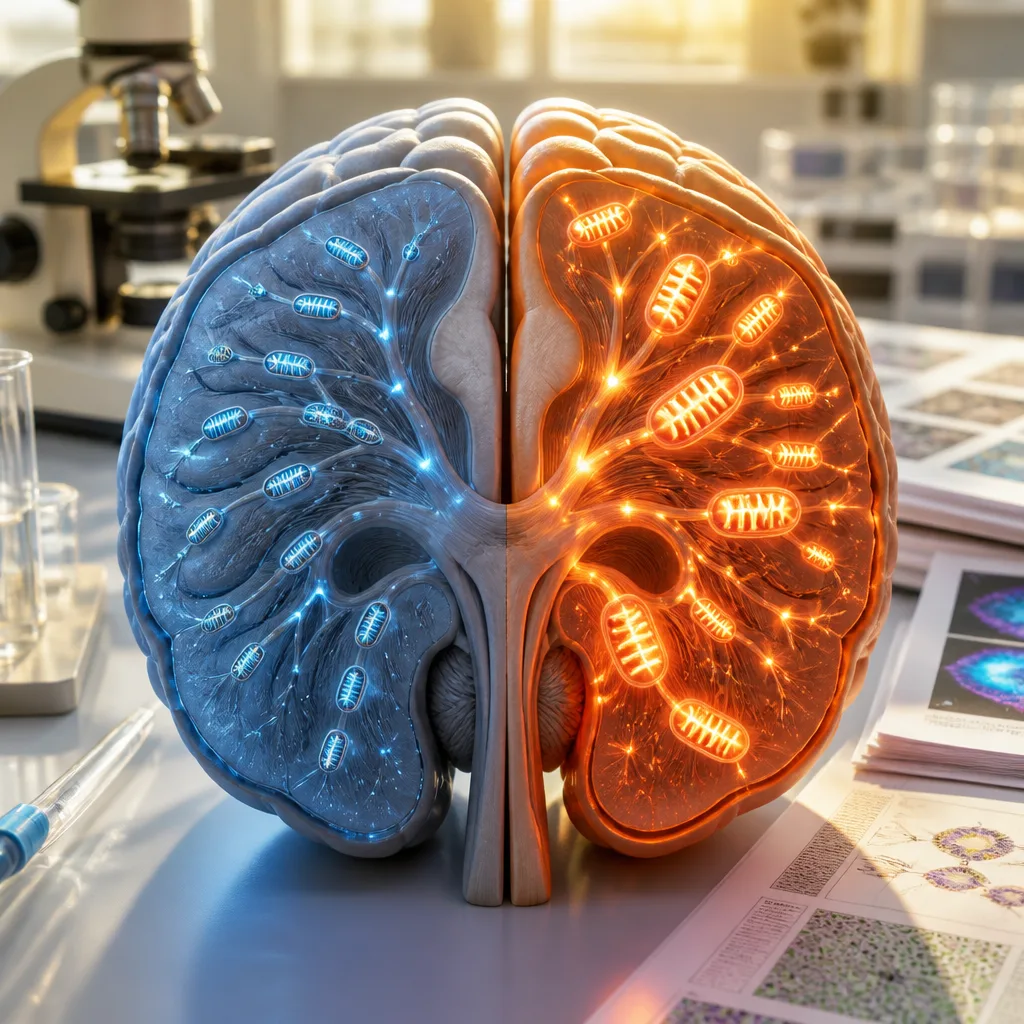
A review of more than 250 studies argues that mitochondria — long cast as the cell’s energy factories — play a more subtle and central role in the brain, setting the conditions under which neural circuits operate and, by extension, influencing behaviour and mood.
Two modes of mitochondrial support
The authors divide mitochondrial contributions into two distinct functional modes. In their account, a baseline mode maintains neurons and networks in a primed state over longer timescales, while an activity‑evoked mode delivers rapid, localised energy and signalling when a circuit fires.
| Mode | Primary role | Timescale |
|---|---|---|
| Baseline | Keep neurons and circuits ready to respond | Longer-term |
| Activity‑evoked | Provide immediate energy and signalling locally as circuits engage | Short, on‑demand |
Framing mitochondrial function in this way, the reviewers say, helps reconcile how systemic signals — such as stress hormones, immune activity and metabolic changes — can affect behaviour by altering either the steady readiness of circuits or their capacity to be supported during active engagement.
"Distinguishing these two modes helps to explain how behavioural modulators, including stress hormones, immune activity and metabolic signals, can shape behaviour by altering either baseline mitochondrial control of circuit readiness or activity‑evoked mitochondrial support during circuit engagement," the team wrote in their review.
Evidence and implications
The synthesis draws on a broad collection of animal studies and cellular work. One consistent finding the authors highlight is that interventions that enhance mitochondrial function in particular brain regions can reduce anxiety‑like behaviour in animals. That, they suggest, indicates anxiety may be partly driven by bioenergetic constraints within circuits — not solely by neurotransmitters or synaptic plasticity.
Beyond anxiety, the review links mitochondrial status to several cognitive domains, including learning, memory, reward and motivation. The picture that emerges is of mitochondria contributing both the fuel and the local biochemical cues that allow neurons to sustain high‑frequency firing and adapt during experience.
- Scope: synthesis of over 250 previously published studies.
- Novel framing: separation of long‑term circuit priming and rapid, localised support.
- Behavioural links: animal evidence that boosting mitochondria in specific regions reduces anxiety‑like behaviour.
What this does and does not show
The review is a conceptual consolidation rather than new experimental data. It organises and interprets existing findings to propose a unified framework for how mitochondria could influence brain function. While animal studies provide suggestive causal evidence, the extent to which these mechanisms operate in humans, and whether they can be targeted safely and effectively as treatments, remains to be established.
Nevertheless, the argument reframes mitochondria from passive energy suppliers to active modulators of circuit performance. That shift matters because it widens the set of biological levers scientists might consider when investigating neuropsychiatric conditions and cognitive decline: metabolic signalling, local energy dynamics, and mitochondrial‑derived messenger molecules all become part of the mechanistic toolkit.
If the two‑mode model proves robust, it could help explain why systemic conditions — including metabolic disease and inflammation — often co‑occur with mood and cognitive symptoms, by showing how those states influence either the background readiness of circuits or their capacity to meet acute energetic demand.
For clinicians and researchers, the next steps are clear: refine measures of mitochondrial function in living brains, map region‑specific effects on behaviour, and test whether targeted interventions that alter baseline or activity‑evoked mitochondrial support produce meaningful changes in mood and cognition in humans.
The review does not claim immediate clinical remedies, but it does offer a compelling, mechanistic lens through which to view longstanding puzzles about the biological underpinnings of mood and cognition.









