
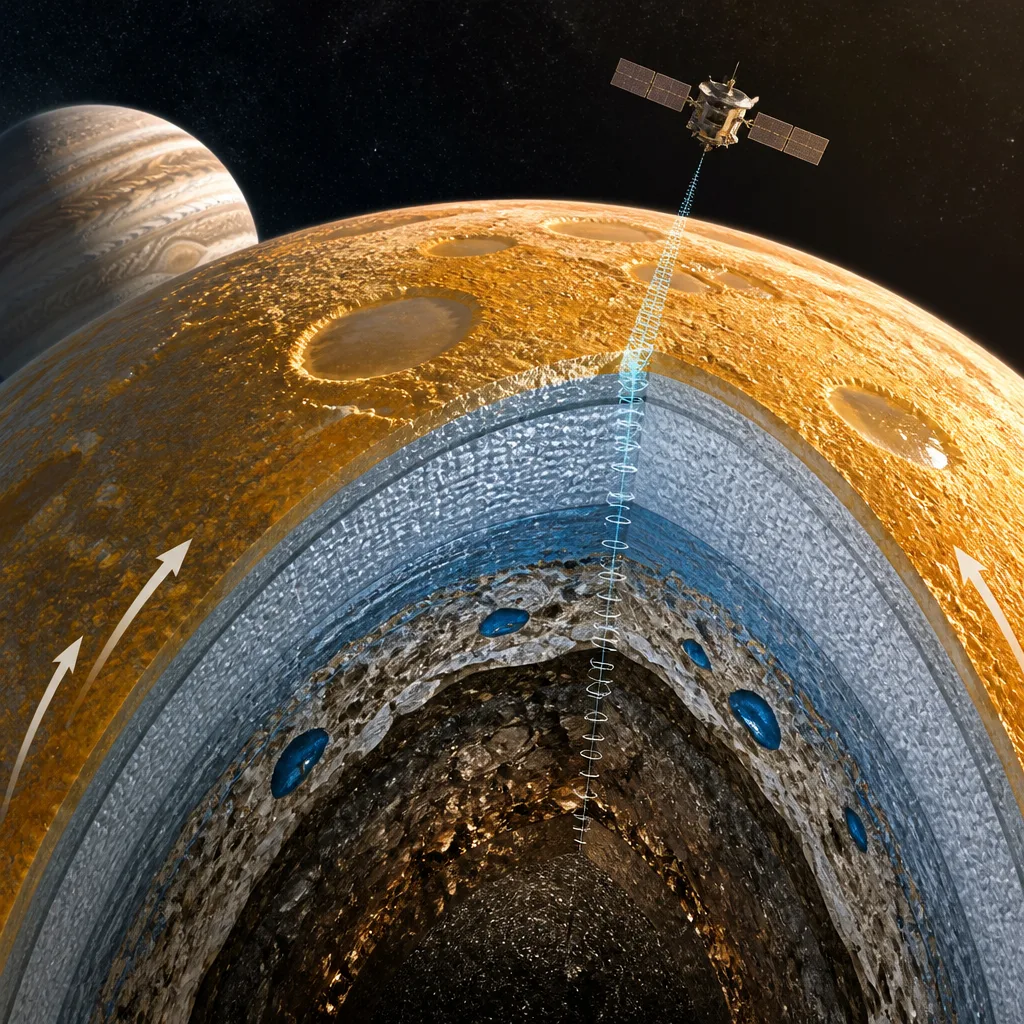
Titan, Saturn’s largest moon, may not conceal the vast, continuous ocean planetary scientists have long assumed. A reanalysis of spacecraft radio-tracking data, published on 17 December 2025, argues the moon’s measured tidal response contains a pronounced time delay that is inconsistent with simple global-ocean models. Instead, the study proposes a deep, complex hydrosphere dominated by warm, high-pressure ices, with slushy layers and isolated melt pockets close to a rocky core.
How the original ocean hypothesis formed
Titan takes 15.9 days to orbit Saturn along a slightly eccentric path. As the moon moves closer to and farther from the planet, varying tidal forces deform its outer shell. During the Cassini mission, engineers recorded minute shifts in the spacecraft’s velocity caused by Titan’s changing gravity field. Those Doppler shifts allowed scientists to estimate a parameter known as the degree-two Love number, written k2, which quantifies how much the moon’s figure responds to tidal forces.
A 2012 analysis of Cassini gravity data found a tidal response roughly twice the pre-mission expectation. The simplest explanation was a decoupling liquid layer beneath the frozen crust: a global subsurface ocean would let an outer ice shell flex independently of the deep interior, producing the measured amplitude of deformation.
The decisive new quantity: a time delay
The December 2025 reanalysis adds a crucial piece to the puzzle: not only does Titan deform under tidal forcing, but its deformation arrives late. The observed lag — a phase delay in the tidal response — implies significant friction and energy dissipation at depth. According to the new work, that behaviour cannot be matched by the global-ocean models that had become the standard interpretation.
Friction and internal heating are signatures of a mechanically complex interior. The authors therefore propose an alternative architecture: a thick hydrosphere where high-pressure ice phases, warmed by internal processes, dominate the mass between the outer crust and the rocky core. Within that regime, zones of partially melted, slushy material and isolated pockets of liquid could exist close to the silicate interior.
- Observational basis: radio Doppler tracking of Cassini during close flybys provided the gravity and tidal data.
- Key measurements: increased tidal amplitude (k2) measured in 2012; a later analysis identified a time lag in the tidal response.
- Proposed structure: thick hydrosphere of warm high-pressure ice, slush layers and isolated melt pockets, rather than a continuous global ocean.
What this revision means — and what it does not
The new interpretation is not a direct image of Titan’s interior. It is an inference derived from radio-tracking data combined with interior modelling. As with most remote-sensing inversions, several layered combinations of ice, liquid, rock and dissolved materials can produce similar bulk gravity and tidal signatures. The authors stress that the lag in the tidal response is the critical discriminator: global-ocean scenarios examined to date cannot reproduce both the amplitude and the delay simultaneously.
If confirmed, the change matters for two reasons. Scientifically, it revises our understanding of how heat is transported and dissipated within large icy moons; mechanically complex interiors behave differently from bodies with a simple liquid layer decoupling an outer shell. Practically, it alters the search for habitable niches: rather than a continuous ocean potentially accessible beneath a thin ice shell, habitability could be restricted to isolated pockets of melt near the rocky core.
| Feature | Global-ocean model | Reanalysis interpretation |
|---|---|---|
| k2 amplitude | High — consistent with decoupling by liquid | Also high — matches Cassini amplitude |
| Tidal phase (lag) | Minimal — models struggled to reproduce observed delay | Pronounced — implies frictional dissipation deep inside |
| Interior picture | Liquid global ocean beneath ice shell | Thick hydrosphere of high-pressure ice with slush and melt pockets |
The study therefore reframes Titan as neither fully frozen nor host to an unbroken sea — a body with a thermally and mechanically active intermediate layer. It remains an inference, albeit one grounded in a different reading of the same spacecraft data that produced the ocean hypothesis.
Future missions carrying instruments capable of complementary measurements — for example, seismic sensors, magnetometers tuned to induced fields or improved gravity sampling — would be needed to test the competing models directly. Until then, Titan’s interior will stay hidden beneath its orange haze, but this reanalysis shows how a fresh look at old data can sharpen, and sometimes overturn, long-held expectations.









