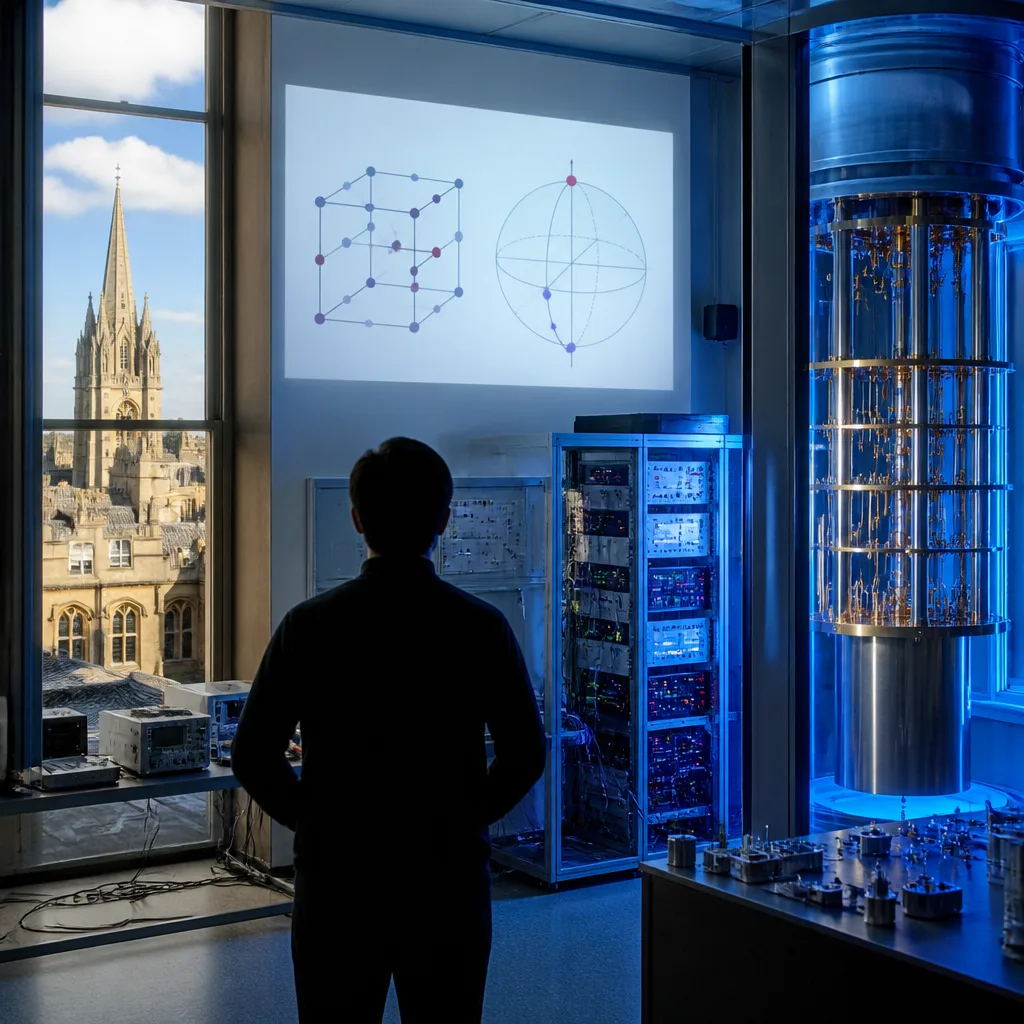
An Oxford scientist has outlined a method by which quantum computers might be used to probe whether the apparent randomness of quantum mechanics conceals a deeper, deterministic structure. The proposal, advanced by a Royal Society research professor in climate physics at the University of Oxford, challenges the orthodox view that quantum states are continuous and fundamentally probabilistic.
Questioning the continuum
The central idea is straightforward but profound: if the mathematical continuum used in standard quantum theory introduces possibilities that do not exist in nature, then a more restricted, discrete description could be closer to reality. That, in turn, would affect how quantum systems behave at scale. The Oxford researcher argues that experiments run on quantum computers could be tailored to expose discrepancies between predictions made by the conventional, continuous formalism and those of a putative discrete theory.
Quantum mechanics has, since its inception in the early 20th century, placed genuine randomness at the heart of physical law. Yet some physicists have long considered the theory incomplete — not because its predictions fail, but because it might be leaving out an underlying order. The Oxford proposal states that if quantum states are not truly continuous, quantum processors might ultimately fail to expand in capability in the way standard theory anticipates.
Why quantum computers are the testing ground
Quantum computers manipulate fragile superpositions and entanglement across many qubits. Their performance, particularly as systems grow larger, is predicted by standard quantum mechanics using continuum mathematics. The Oxford argument suggests those scaling predictions could diverge from reality if the continuum assumption is wrong. In practical terms, the machines could either validate the orthodox account by operating as expected, or reveal systematic departures that point to a different underlying structure.
- Continuum hypothesis: standard theory uses a smooth, gapless set of numbers to represent quantum states.
- Discrete alternative: a more limited set of states could be sufficient to describe nature and would forbid some mathematically allowed possibilities.
- Experimental test: large-scale quantum computation may expose whether the continuum assumption holds when systems become complex.
The proposal draws attention to a philosophical as well as empirical tension. For example, our use of numbers like π —an endlessly non-repeating decimal—illustrates the continuum concept: geometry and many parts of physics rely on such infinitely precise values. But the researcher points out that the observable universe may never require or realise infinite precision, raising the possibility that physical degrees of freedom are finite in a way that the current formalism does not capture.
Consequences for randomness and technology
If experimental work with quantum processors were to find deviations consistent with a discrete underlying description, the implications would be twofold. First, it would alter philosophical notions about chance: what we call luck might reflect hidden constraints rather than true indeterminacy. Second, it would have immediate technological consequences. Many projected applications of quantum computing —from cryptography to materials modelling— rely on the assumption that larger quantum devices will behave according to the continuum-based theory. A breakdown in that expectation would force a recalibration of both hardware and algorithmic roadmaps.
| Aspect | Continuum view | Discrete alternative |
|---|---|---|
| State space | Infinitely fine, gapless | Finite or effectively granular |
| Predictive scaling | Standard quantum scaling laws | Possible deviations at large system size |
| Philosophical implication | Genuine indeterminacy | Hidden determinism |
The idea is not presented as a finished experimental design but as a conceptual route to tests. It asks the community to consider designing benchmark problems and architectures specifically chosen to magnify where the two descriptions would diverge. If differences exist at all, they are likely to be subtle and will demand careful statistical analysis and robust control of experimental noise.
Critically, the researcher does not claim that current quantum experiments already contradict standard theory; rather, the proposition is that future quantum machines —as they attempt tasks impossible for classical devices— could confront the foundations of the theory itself. Such experiments would need to isolate genuine physical effects from engineering limitations, a demanding but not impossible challenge.
Whether the continuum is a mathematical convenience or a faithful depiction of microscopic reality remains an open question. The Oxford proposal elevates that philosophical debate into a testable scientific programme, using the very machines whose development could be upended by its findings. For physicists and technologists alike, the message is clear: as quantum devices scale, they may not only compute —they may also arbitrate deep questions about the nature of chance.