Fellowship targets mid‑career academics and professionals
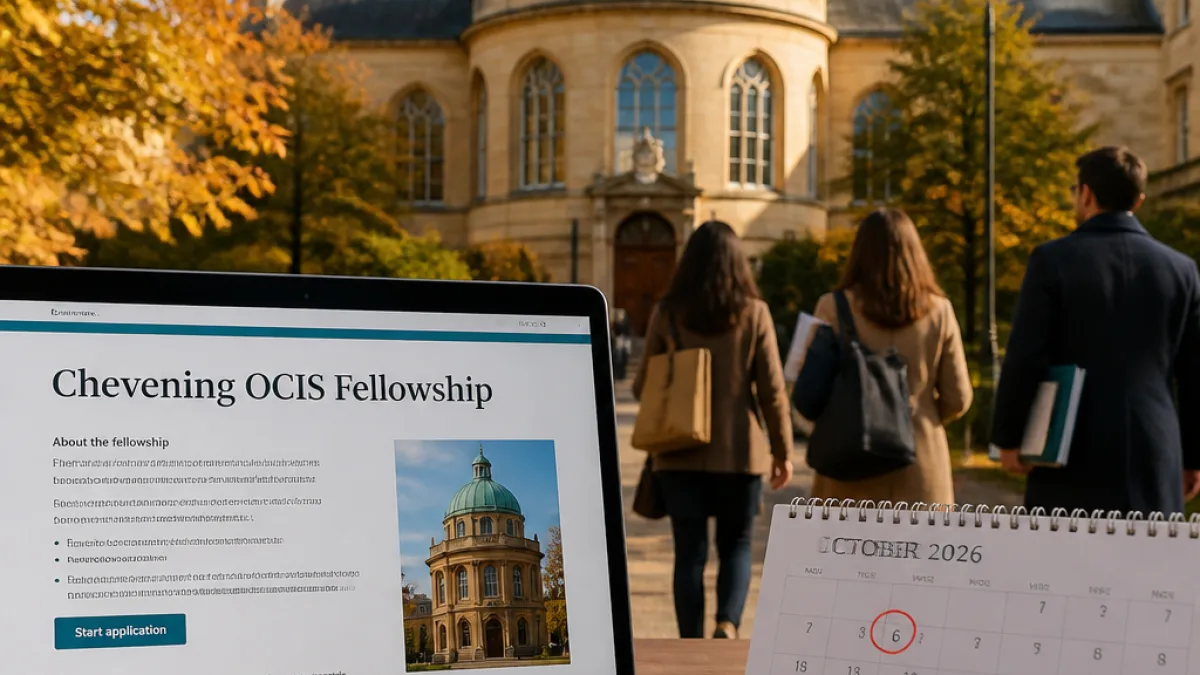
Applications have opened for the Chevening Oxford Centre for Islamic Studies (OCIS) Fellowship, a five‑month programme that will bring up to six mid‑career researchers and professionals to Oxford for the 2026–27 academic period. The fellowship is organised jointly by the OCIS and the UK Foreign, Commonwealth and Development Office (FCDO), and is scheduled to run from October to March.
The scheme is aimed at people with substantial experience in research or professional practice who want to pursue an individual research project while living in Oxford. Applicants must submit a short research proposal outlining their main question and how they plan to develop the work during their residence at OCIS.
What applicants need to know
Key administrative details are straightforward and time‑limited. The deadline for applications is 6 October 2026, closing at 11:00 UTC. Successful candidates will be expected to be in Oxford for five months of focused scholarly activity.
- Host institution: Oxford Centre for Islamic Studies
- Partner: FCDO
- Duration: Five months (October–March)
- Number of fellows: Six
- Application deadline: 6 October 2026, 11:00 UTC
Research themes and academic focus
The fellowship is intended to support projects that deepen understanding of Islamic culture and the histories, sciences and contemporary life of Muslim societies. Areas flagged as suitable for study include, but are not limited to:
- Culture and civilisation of Muslim societies
- Historical trajectories and Islamic history
- Classical Islamic sciences
- Economics and Islamic finance
- Public health and science and technology in the Muslim world
While the scheme emphasises individual research, applicants are expected to show how their work benefits from residence at OCIS and contributes to academic activity that fosters deeper insight into contemporary Muslim societies.
"The fellowship provides an opportunity to conduct self‑directed research while exploring the relationship between Islamic thought, diplomacy, contemporary policy and global challenges."
Local implications for Oxford
The OCIS is an established part of Oxford's academic landscape, and the Chevening fellowship is likely to bring a small, international cohort into the city each year. Short residencies such as this tend to enrich college and departmental conversations and may lead to seminars, public talks or collaborations with other local research groups. For Oxford residents, the presence of visiting fellows can mean additional public events and greater international scholarly exchange.
For applicants, the fellowship offers a concentrated period to advance a research project within Oxford's resources. For the centre itself, the programme continues its role in attracting scholars whose work examines how Islamic traditions intersect with contemporary policy and global questions.
| Element | Detail |
|---|---|
| Host | Oxford Centre for Islamic Studies |
| Partner | Foreign, Commonwealth and Development Office (FCDO) |
| Duration | Five months (October–March) |
| Places | Six fellows |
| Application deadline | 6 October 2026, 11:00 UTC |
Prospective candidates should prepare a concise research proposal that sets out their central question and the way their time at OCIS will support the work. Further practical information, including eligibility criteria and application procedures, is available from the Chevening and OCIS channels.
The fellowship is one of several schemes that position Oxford as a hub for international scholarship. For local residents and the wider university community, the annual arrival of visiting fellows offers fresh perspectives and the possibility of new joint projects that address questions linking religion, governance and contemporary global issues.