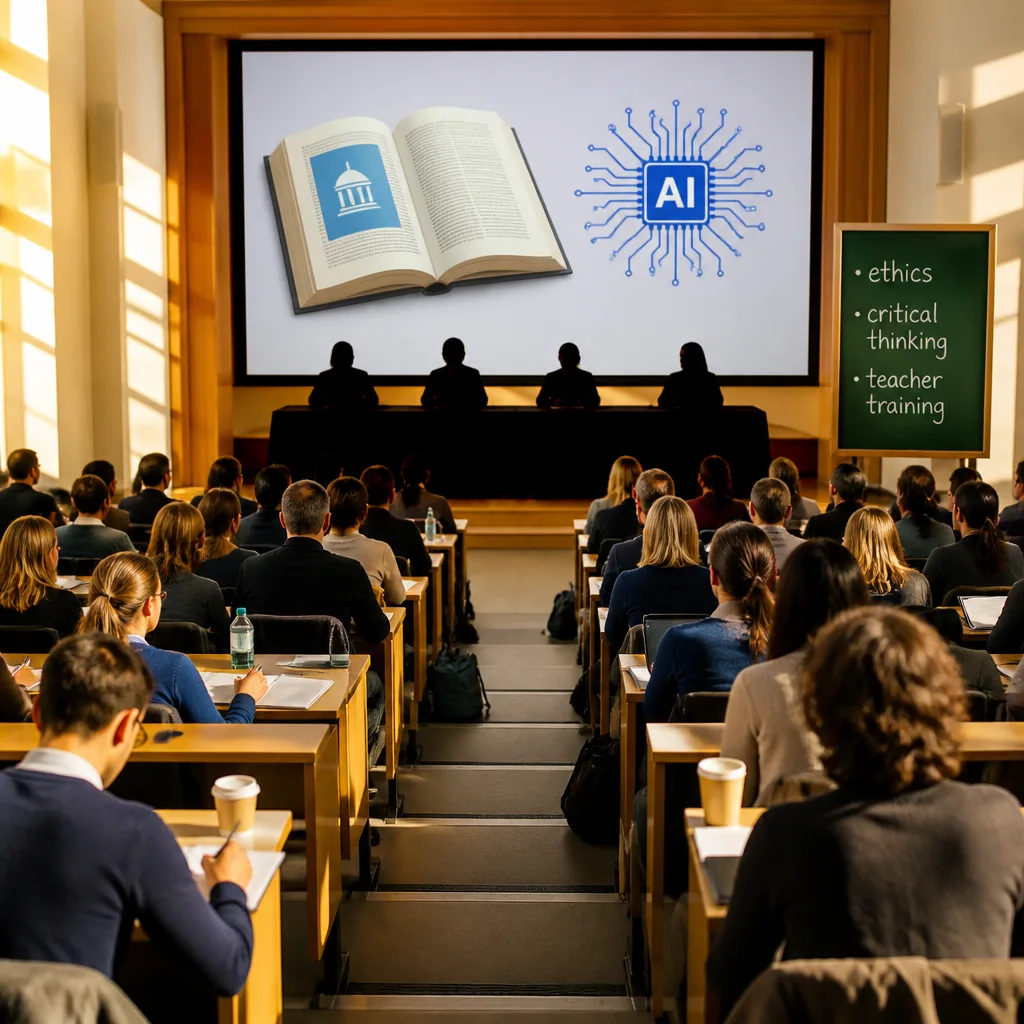
Scholars gathered to debate how artificial intelligence may reshape education and civic life, arguing that teachers and schools must protect pupils’ capacity to make moral judgments as automated systems become more pervasive.
Panel links papal guidance to classroom practice
The event, organised by the Boisi Center for Religion & American Public Life, centred on Pope Leo’s recent encyclical on AI, Magnifica Humanitas. Four academics — with expertise spanning bioethics, moral theology, management sciences and education research — examined whether current uses of AI risk disempowering individuals and communities.
Speakers raised concerns about the prevailing incentives behind many AI applications, noting they frequently prioritise efficiency and profit. Those incentives, the panel argued, can shape decisions in ways that sideline ethical reflection and diminish personal responsibility.
“Let me shift to say we have done this before,” said Sam Ransbotham, comparing the arrival of AI to past technological threats. “We have not actually dealt with artificial intelligence—we’re the first species that’s had to deal with artificial intelligence—but … we have dealt with people with mankind’s ending capability through, for example, nuclear.”
Andrea Vicini, an expert in bioethics, described AI as a social instrument whose deployment may be used to control or manipulate behaviours and choices. The conversation emphasised that such tendencies are not merely technological problems but ethical and educational challenges.
Implications for schools, teachers and curricula
Although the panel took place in an academic setting, the issues discussed have direct implications for classrooms and teacher-training programmes. Panel members argued that safeguarding students’ agency should be a priority if schools are to produce citizens capable of resisting reductive decision-making models embedded in some AI systems.
Key policy and practice implications highlighted by the speakers included:
- Embedding critical thinking and ethical reasoning across curricula, not just in specialist subjects.
- Training teachers to recognise where algorithmic processes are shaping choices and to support pupils in interrogating those influences.
- Ensuring schools retain a role in modelling deliberation and moral judgement rather than outsourcing decisions to opaque systems.
Speakers made clear that while technology can supplement learning, it should not replace the human responsibilities of educators or the developmental tasks of young people. The panel also drew attention to historical precedents for societal risk, using them as cautionary analogues rather than direct equivalents.
Who spoke and their focus
The discussion brought together specialists with different perspectives on technology and ethics. The following table summarises the panellists and their institutional roles as presented at the event.
| Panellist | Role |
|---|---|
| Andrea Vicini | Michael P. Walsh Professor of Bioethics; Professor Ordinarius |
| Christina McRorie | Associate Professor of Moral Theology |
| Brian K. Smith | Honorable David S. Nelson Chair; Associate Dean for Research, Lynch School of Education and Human Development |
| Sam Ransbotham | Professor; Peter F. Drucker Chair of Management Sciences |
The diversity of expertise produced a conversation that ranged from theological reflection to practical concerns for policy and classroom practice. Speakers repeatedly returned to the idea that technology ought to enhance rather than erode human capacities for judgement.
For education policy-makers, the panel’s message is clear: integrating new technologies into schools without parallel investment in ethical education and teacher development risks ceding important decisions to systems that do not account for human values. The debate underlines the need for a curriculum response that prepares young people not only to use AI tools, but to challenge and contextualise them.
As AI becomes more embedded in assessment, admissions, classroom management and personalised learning, the panel urged sustained attention to how those systems are governed and taught about. Preserving the conditions for students to exercise moral agency, panellists argued, will be essential if education is to fulfil its wider civic purposes.