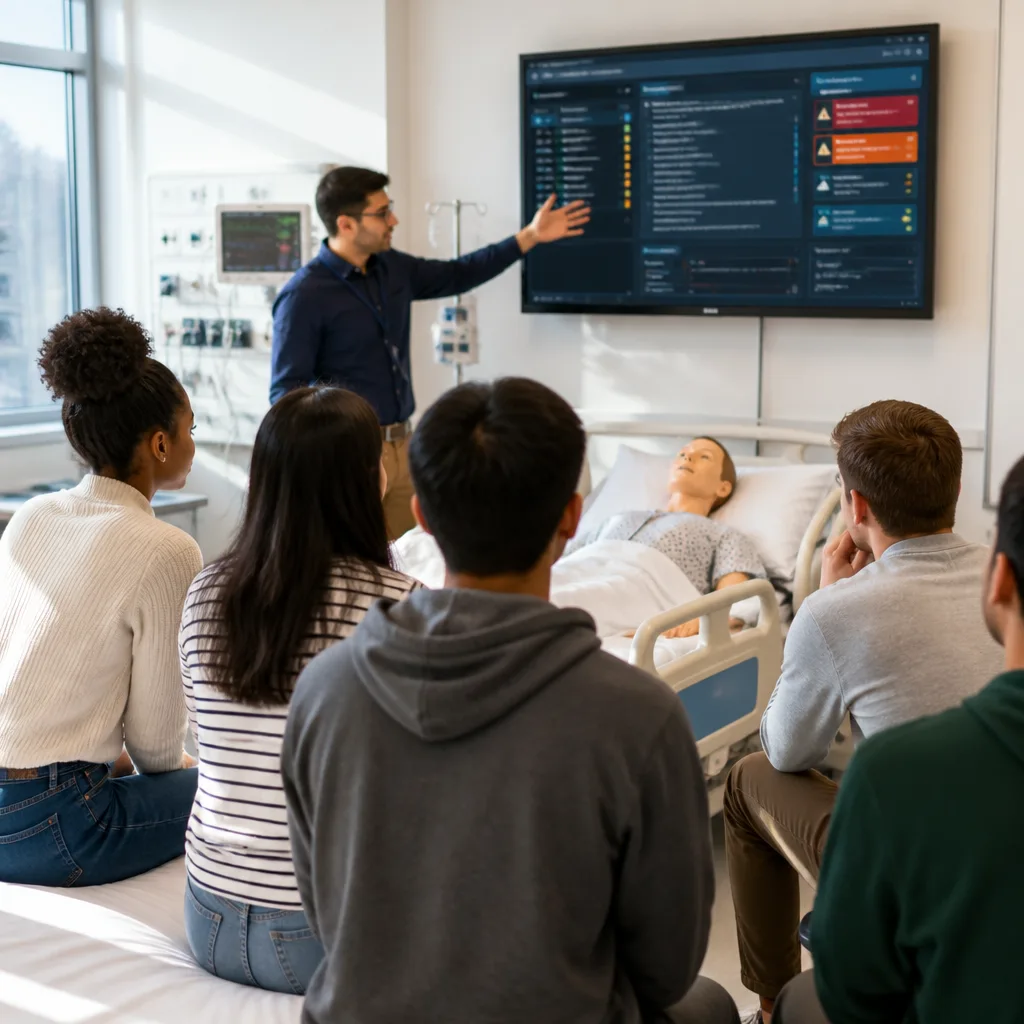
Medical education needs urgent reform to reflect the realities of the AI era, according to clinicians and educators examining how technology is already embedded in healthcare. With clinicians turning to algorithmic tools for routine tasks, schools must rebalance curricula away from rote learning and towards the human skills that machines cannot supply.
AI is already in everyday practice
Recent commentary notes that around eight in 10 doctors now use AI for activities ranging from clinical note-taking to summarising the latest research to inform diagnosis. That rapid adoption makes it imperative that undergraduate and postgraduate training prepares future doctors to work alongside, and not be replaced by, these systems.
"Medical educators must adjust their curricula in response to the AI age."
Advocates for change argue that this will mean placing less emphasis on memorisation and more on skills that remain fundamentally human: empathy, compassionate communication and the capacity to guide patients and families through emotionally fraught decisions.
Why empathy and communication matter
Medicine is not only a technical endeavour but also a relational one. Patients frequently encounter clinicians at moments of high vulnerability—receiving a serious diagnosis, facing life-limiting illness, or making complex treatment decisions. Surveys indicate that more than half of patients want doctors who display qualities such as compassion and a strong bedside manner.
Evidence links these qualities with clinical value: studies have associated stronger physician empathy and better bedside manner with improved outcomes for some conditions. Proponents say that, as AI handles information-heavy tasks, the relational elements of care will become an even clearer differentiator for effective clinicians.
Training to use AI wisely
Reformers also stress that students must learn to harness AI’s benefits while being alert to its limitations. Because machine learning systems are trained on historical human-generated data, they inherit human biases and blind spots. One study cited in expert commentary found that AI showed "significant performance disparities" by race, gender and age across almost 30% of cancer diagnostic tasks.
That finding highlights two imperatives for education: teaching clinicians how to interpret algorithmic outputs and to identify where tools may perform poorly; and equipping them to mitigate harms by combining technical understanding with ethical judgement and advocacy for equitable care.
- Curriculum shift: Move from memory-based testing towards assessment of communication, teamwork and clinical judgement.
- Practical AI literacy: Teach students what AI can and cannot do, including how to evaluate model performance and bias.
- Patient-centred skills: Reinforce empathy, shared decision-making and handling difficult conversations.
| Area | Opportunity | Risk |
|---|---|---|
| Diagnosis support | Faster access to evidence, improved detection | Performance disparities across patient groups |
| Routine tasks | Less clerical burden, more time for patient contact | Overreliance, deskilling if unregulated |
Policymakers, medical schools and teaching hospitals will need to collaborate to translate these priorities into concrete changes: updated assessment frameworks, new clinical placements that expose students to AI tools in practice, and faculty development so tutors can teach both technical and human skills.
Critically, reform should not treat AI as a technical add-on but as something that reshapes the balance of clinical work. If training emphasises the human aspects of care while giving graduates the literacy to spot and correct algorithmic bias, the UK’s future doctors will be better placed to deliver safe, equitable and compassionate care in a digitally augmented health service.
Education leaders must therefore weigh not only what students know, but how they communicate, empathise and steward technology on behalf of patients.