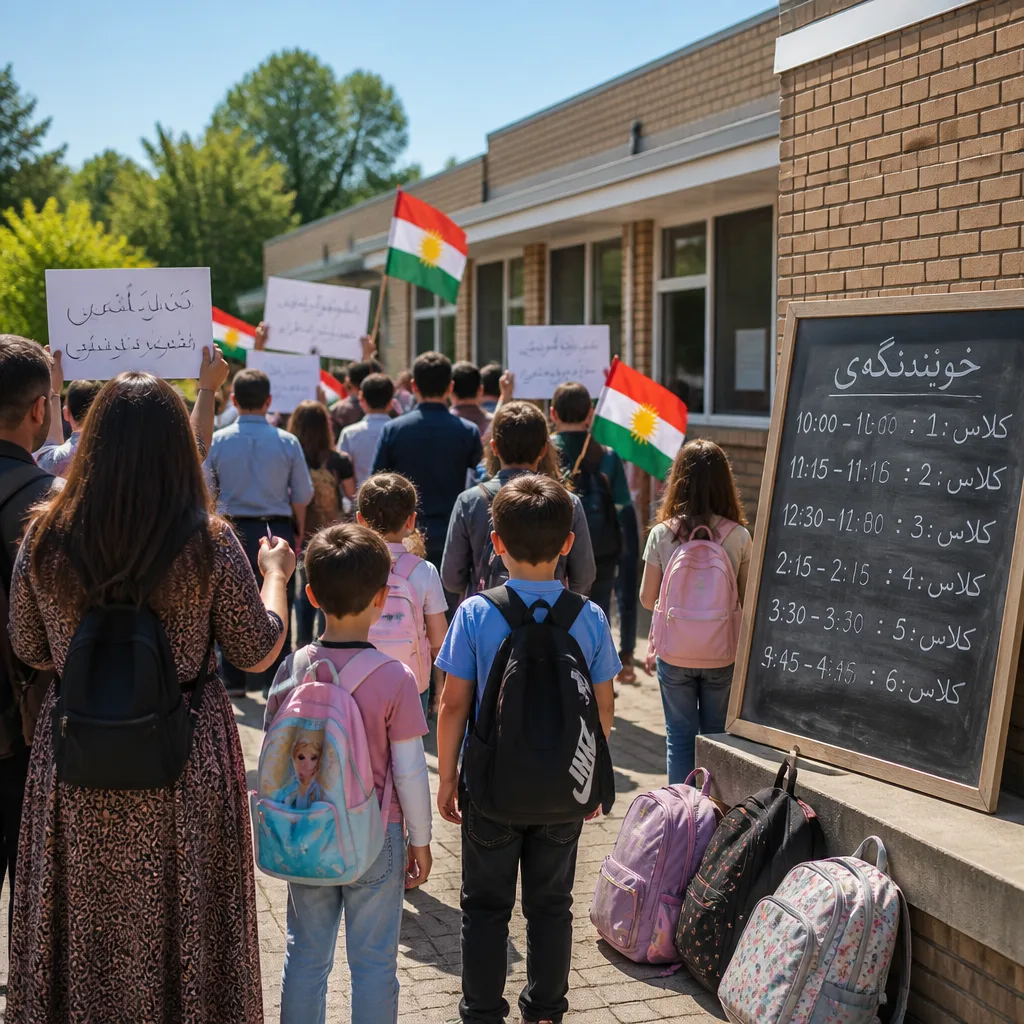
Residents and pupils in the city of Girkê Legê, in Syria’s al-Jazira region, have voiced strong opposition to a Ministry of Education directive that would limit the teaching of the Kurdish language to just three classes per week. Community members said the change, announced by the transitional government’s education authority, risks undermining pupils’ progress after many years of study in Kurdish and could damage future higher-education prospects.
Parents warn of disruption to learning
Speakers at local gatherings argued that a sudden switch in the language of instruction would be difficult for children who have been schooled in Kurdish for a prolonged period. They urged the government and relevant authorities to reconsider the measure, saying the priority should be protecting pupils’ academic continuity and long-term opportunities.
"We are not against the Arabic language...but it is difficult for our children to switch to studying in Arabic after having studied in Kurdish for years,"
Those protesting do not reject Arabic instruction. Instead, they say the curriculum should remain in Kurdish while Arabic is taught as a second language, allowing pupils to develop bilingual proficiency without sacrificing comprehension of core subjects.
Calls for formal recognition and respect for mother-tongue rights
Several community representatives pointed to the presence of universities and other higher-education institutions in the region, stressing that preserving Kurdish-language provision is important for access to tertiary study and employment. Some called for the Kurdish language to receive formal recognition in Syria’s constitution so that educational rights are safeguarded at the national level.
Those opposing the decision emphasised three main concerns:
- Immediate negative effects on pupils who have previously studied in Kurdish
- Possible disruption to academic progression and access to local universities
- The need for formal legal recognition of Kurdish to secure long-term educational rights
Local context and potential consequences
Mother-tongue teaching is widely accepted by educational researchers as crucial for early and continued comprehension, particularly in multilingual settings. In regions where communities have long used a language other than the national majority tongue for schooling, abrupt policy shifts can lead to falls in attainment, higher dropout rates and obstacles to progression into higher education.
Representatives in Girkê Legê said the policy change was being implemented after many pupils had already spent several years studying in Kurdish. They warned that swapping the language of instruction at this stage risked creating gaps in understanding, increasing pressure on teachers and families, and complicating the transition to secondary and tertiary curricula.
| Current provision | Proposed change |
|---|---|
| Curriculum primarily taught in Kurdish for many years | Kurdish limited to three classes per week; Arabic increased |
Parents reiterated that they welcome Arabic-language learning but seek a balanced approach that maintains Kurdish as the primary medium for teaching core subjects. Local campaigners are calling on the transitional government to engage with communities and education professionals to find a solution that protects pupils’ learning and future prospects.
The dispute highlights broader tensions in post-conflict and transitional contexts over language policy, minority rights and the role of education in shaping citizenship. How the Ministry responds will be closely watched by families in al-Jazira and by education stakeholders concerned with linguistic rights and equitable access to learning across Syria.