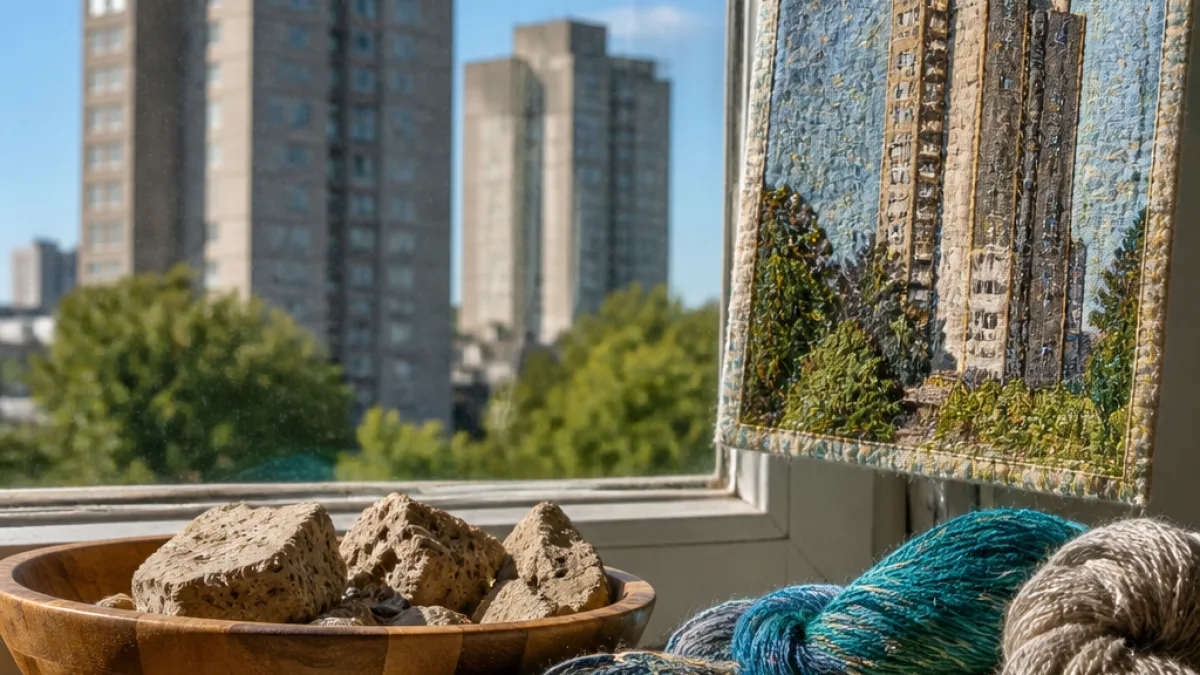
Harriet Mena Hill, an artist who has lived and worked around the Aylesbury Estate for nearly four decades, is using wool and paint to offer a new way of seeing the estate and its people. Her series Soft Concrete and the related The Aylesbury Fragments transform images of the estate’s concrete towers into intimate textile portraits that foreground texture, colour and memory rather than dereliction.
Reworking a difficult reputation
Built in the 1960s and 1970s and once home to about 11,000 residents, the Aylesbury Estate has long been depicted in the media primarily through accounts of crime and decay. The decision to demolish and rebuild parts of the estate was taken in 2005 and by 2020 sections had been partially cleared. Hill’s work responds to that history by collecting fragments of concrete and using them as prompts for small, carefully crafted textile works that show windows, corridors, graffiti and other domestic traces.
The pieces, woven and hand‑blended in wool, read from a distance almost like photographs or realist paintings. Up close, however, the softness of the fibres and the stitch work refuse the hard, reductive narrative of concrete, offering instead a sense of lived interiors and the human scale of the place.
Capturing loss and community memory
Hill first engaged closely with the estate in 2018, when she was commissioned to work there as part of a summer programme. Since then she has continued to document what remains and what has been taken away. During the demolition period around 2020 she began to gather stray pieces of concrete; these physical remnants provide a material link to the residents’ experience of loss and displacement.
“loss despite being relocated”
The phrase above paraphrases a sentiment recorded by the BBC in 2023 from a long‑time resident, reflecting the displacement felt even where people had been rehoused. Hill’s textiles respond to that emotional landscape rather than attempting a neutral architectural record.
- Materials: hand‑blended wool and paint
- Focus: domestic details, windows, wires, graffiti
- Purpose: to challenge the estate’s negative portrayal and preserve local memory
What this means locally
For Aylesbury readers, the project is a reminder that large housing estates carry complex social histories beyond headlines. Hill’s work is a prompt to think about how redevelopment changes not only the physical landscape but also how communities are remembered — or forgotten. Textile portraits, by their very nature, insist on labour, time and touch; they reintroduce the notion of everyday care into discussions too often dominated by planning jargon and figures.
Her pieces are small and intimate, intended for closer, slower viewing than the quick snapshots that have tended to represent the estate in national press. By concentrating on everyday domestic details Hill shifts the conversation away from sensational stories towards the quieter aspects of community life: the patterning of a stairwell, a window framed by a curtain, a tag on a wall that served as a marker for people who lived there.
| Year/Period | Event |
|---|---|
| 1960s–70s | Estate constructed; capacity c. 11,000 residents |
| 2005 | Decision taken to demolish and rebuild parts of the estate |
| 2018 | Hill’s commissioned summer project begins her sustained engagement |
| 2020 | Partial demolition; Hill collects concrete fragments |
| 2023 | BBC reports residents’ reflections on loss and relocation |
Hill’s approach will be of interest to community groups, housing campaigners and anyone engaged with the cultural afterlives of urban redevelopment. Her textiles do not offer solutions to the social and economic problems that prompted the estate’s clearance, but they act as an archival intervention: a way of preserving traces of community life in a medium that emphasises care and continuity.
Exhibiting these works in venues accessible to former residents and the wider public could help anchor conversations about what should be retained in memory as parts of the estate are rebuilt. At a moment when redevelopment schemes across the country raise similar questions about who counts when decisions are made, the Aylesbury project is a local example of art used to reframe and resist erasure.