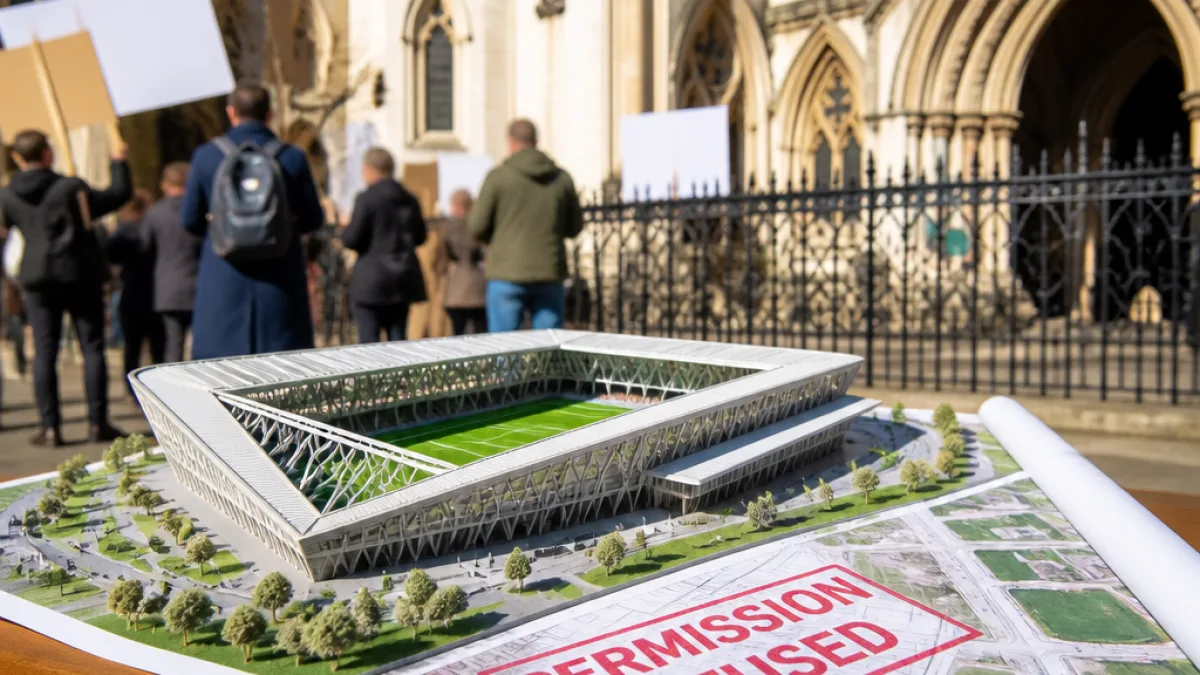
High Court refusal clears way for Triangle stadium to proceed
The High Court has denied a request for permission to mount a full judicial review of plans for a new stadium for Oxford United on land known as the Triangle south of Kidlington, bringing the project a step closer to realisation.
The redevelopment, which proposes a stadium with a capacity of 16,000, was originally approved by Cherwell District Council and subsequently backed by the government last year. Opponents belonging to campaign group Friends of Stratfield Brake (FoSB) had sought to overturn the decisions on environmental and traffic grounds.
At a permission hearing held at the Royal Courts of Justice, Mr Justice Johnson decided the grounds advanced by FoSB were not arguable and refused their application for a full judicial review. The group now has seven days to seek permission to take the case to the Court of Appeal.
“They believe that they have strong grounds of challenge. They're considering their options, including appeal.”
The comment above was provided by Ricardo Gama of the law firm Leigh Day, which is representing the campaigners. Mr Gama said FoSB were "disappointed" by the outcome and highlighted concerns about Natural England's approach to evidence that parts of Stratfield Brake might be ancient woodland.
Natural England earlier reversed an initial view that delayed Cherwell's permission after determining that the trees in question were not shown on the 18th or 19th century maps it had examined. That point has been a central strand in FoSB's contention that the area merits greater protection.
What happens next and what it means locally
- Legal options: FoSB may apply to appeal to the Court of Appeal within seven days of the judgment.
- Planning delivery: with the permission refusal, the club's planning consents remain intact and the project can move towards the implementation phase unless successfully appealed.
- Local impacts: issues raised by opponents include effects on wildlife and the implications of proposed road closures for nearby communities.
Oxford United issued a brief statement in response to the judge's decision, saying the judge had "concluded that the grounds of challenge were unarguable". The club has not outlined a detailed construction timetable in that statement.
| Event | Outcome / date |
|---|---|
| Cherwell District Council planning approval | Granted (earlier decision) |
| Government approval | Granted (last year) |
| FoSB legal challenge: initial appeal | Failed |
| Permission hearing at High Court | Refused (this week) |
Campaigners first lodged the legal complaint in April after launching a fundraiser to cover legal costs. Their concerns include the potential harm to local wildlife and the asserted status of parts of Stratfield Brake as ancient woodland, as well as questions about road closures proposed to serve the stadium.
Natural England’s reassessment — that the trees were not found on the historical maps it examined — removed one of the key obstacles to the council's earlier decision. That reversal was referenced in the hearing and is central to the dispute between the council, the club and the campaigners.
Local context and consequences
For residents of Kidlington and the surrounding parts of Oxfordshire, the ruling will be watched closely. Supporters of the club and proponents of regeneration argue the new stadium will bring economic activity and a modern facility for Oxford United. Opponents warn of lasting impacts on green space, wildlife and local traffic patterns.
Should FoSB proceed to the Court of Appeal, the legal battle may continue for months, delaying any physical works. If they do not, or if an appeal fails, planning consents stand and the club will be able to press on towards construction subject to any remaining conditions attached to the permissions.
The case highlights the tensions that often arise when major sporting developments intersect with environmental protections and local transport planning. Whatever the next step, residents can expect further scrutiny of how the stadium will be delivered and what mitigation will be put in place for wildlife and nearby communities.
More detailed statements from the club, Cherwell District Council and Natural England have not been published alongside the High Court decision; their responses will be material to the next phase should the matter return to court.