Researchers have reported that a single, time‑limited combination of three therapies eradicated detectable HIV infection in newborn nonhuman primates when begun within three days of exposure. The work, published in Nature Microbiology, used a regimen of standard antiretroviral drugs, broadly neutralising antibodies and an experimental monoclonal antibody called leronlimab, and the authors say the evidence points to a route that could move to clinical trials in newborn infants.
Method and result in brief
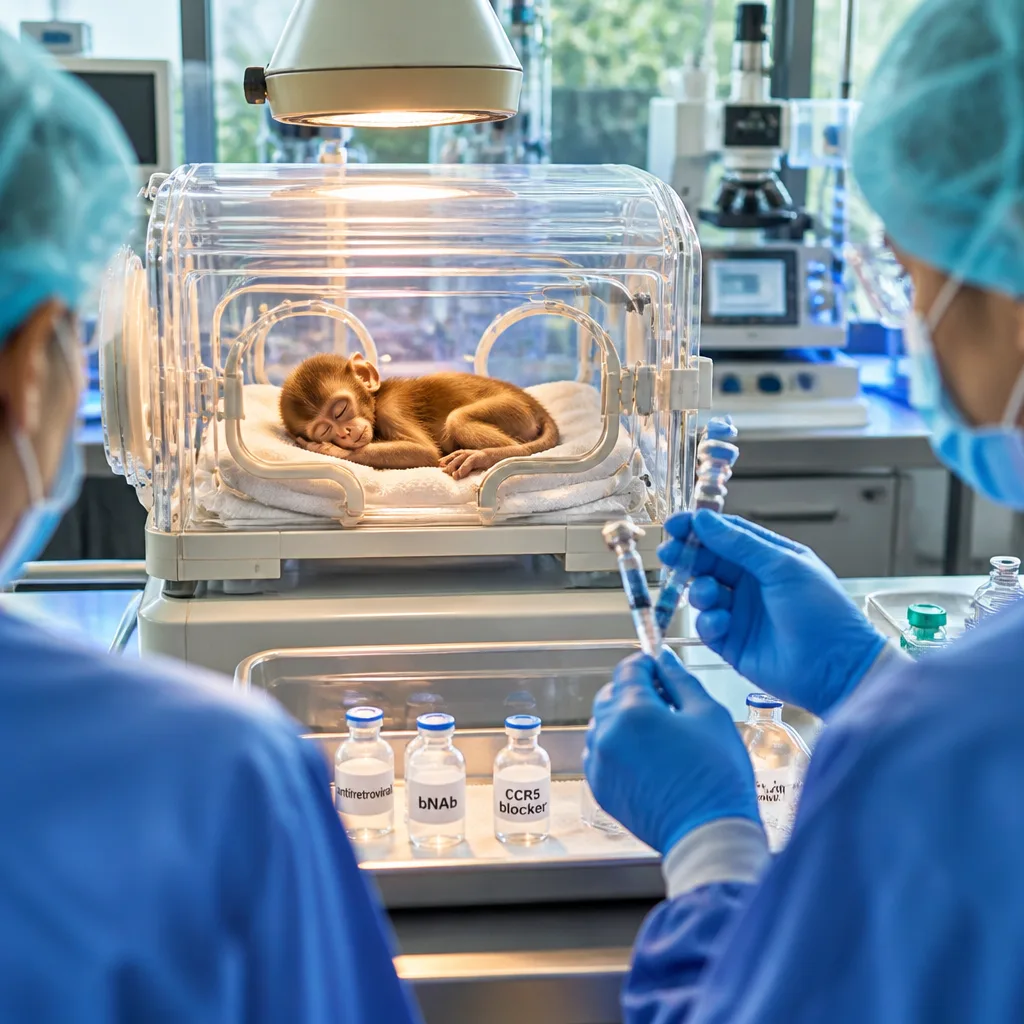
The study enrolled infant nonhuman primates at two US national primate research centres and treated them for several weeks with the three‑way therapy. According to the lead investigators, the combined approach permanently eliminated detectable virus in animals treated within three days of exposure — a result not achieved by any of the component therapies alone in prior experiments.
The experimental design brought together three distinct antiviral strategies:
- Antiretroviral therapy (ART) — the standard drugs used to suppress HIV replication;
- Broadly neutralising antibodies (bNAbs) — antibodies that can block a wide range of HIV strains;
- Leronlimab — a monoclonal antibody intended to block CCR5, the receptor HIV uses to enter certain immune cells.
| Therapy | Primary role in study |
|---|---|
| Antiretroviral therapy (ART) | Suppress ongoing viral replication |
| Broadly neutralising antibodies | Neutralise circulating virus, reduce reservoir seeding |
| Leronlimab (experimental) | Block CCR5 to prevent cell entry by virus |
Co‑lead author Jonah Sacha, a professor at Oregon Health & Science University, said the result was striking and that the combination could move rapidly into trials in newborns. His colleague Nancy Haigwood, a virologist and immunologist who helped develop the experimental strategy, described the outcome as “astounding” and “overjoying”.
"The really exciting part is that it could go to clinical trials immediately to eliminate HIV infection in newborns," said Jonah Sacha, Ph.D.
Why this matters
More than 120,000 babies worldwide acquire HIV each year. Today, infected infants typically require lifelong antiretroviral therapy to control replication and preserve health, a solution that depends on sustained access to medication and healthcare systems. A safe, short course given immediately after exposure that prevents establishment of persistent infection would represent a fundamental change in management for perinatal HIV.
Importantly, the authors stress the timing: animals were treated within three days of exposure. That early window is biologically plausible — few infections are seeded so early as to be irretrievable if aggressive interventions stop viral replication and prevent reservoir formation — but it also poses logistical challenges for human implementation, where diagnosis and rapid treatment initiation must be extremely prompt.
Limitations and next steps
The experiments were performed in nonhuman primates, a model that is highly informative but not identical to human infants. The therapies included components already approved for people (ART) and others in experimental or earlier clinical use (broadly neutralising antibodies, leronlimab). The investigators say the next step is clinical testing in newborns, and they also note interest in whether the approach could work in adults exposed very recently.
Until human trials produce data on safety, dosing and efficacy, the result should be seen as an important proof of concept rather than an immediate clinical breakthrough. The finding does, however, supply a clear rationale for expedited trials aimed at newborns, particularly in settings where perinatal transmission remains a public‑health problem.
The collaboration involved teams at the Oregon and California national primate research centres and draws on decades of work developing antibodies and antiretroviral strategies. If translation to humans mirrors the animal results, the public‑health implications would be profound: a one‑off or short course treatment that prevents lifelong infection in infants would reduce the burden on families and on healthcare systems worldwide.