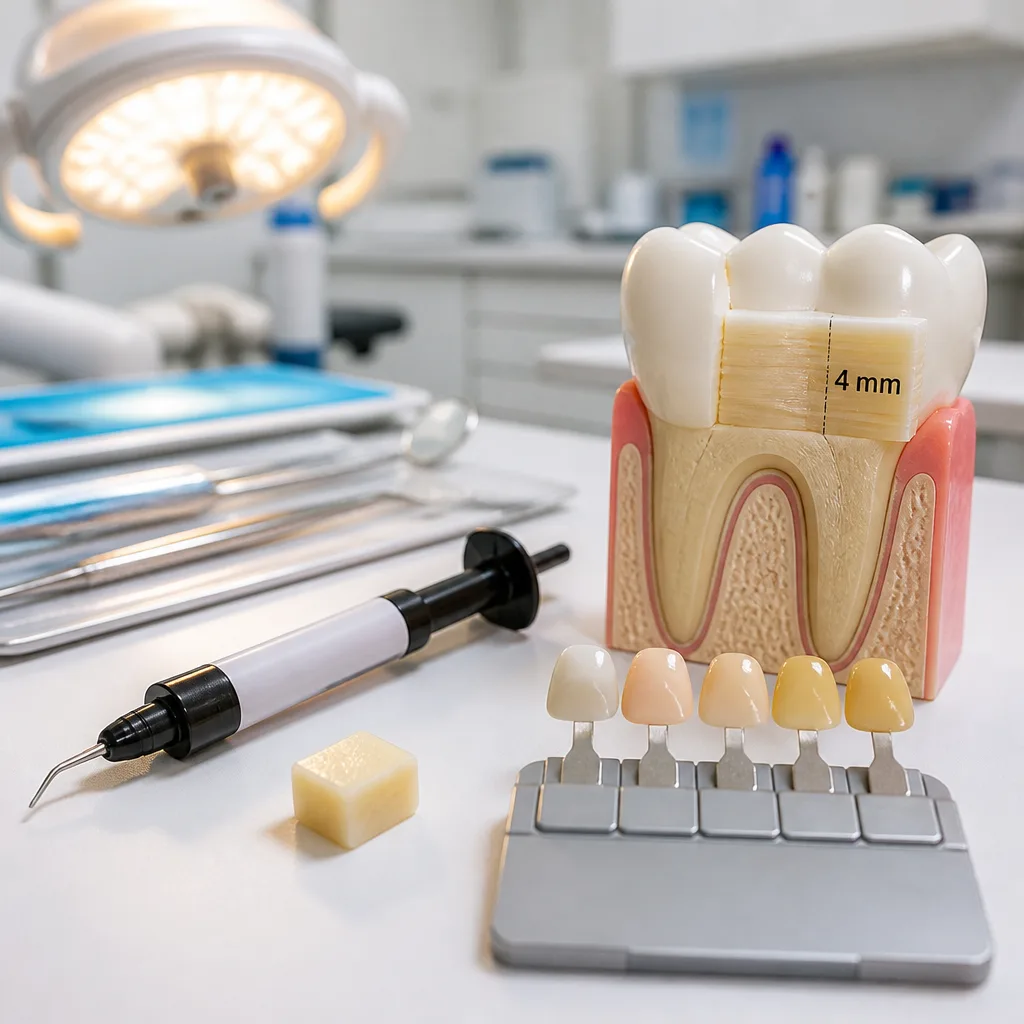
Voco this week unveiled GrandioSO 4U, a dental restorative composite that the company says is a “truly universal” material able to be placed in increments of up to 4 mm while retaining the esthetic and mechanical properties clinicians expect from contemporary resin-based restoratives.
What the new material claims to offer
The product is presented as the latest member of the GrandioSO family, which the manufacturer notes has been in continuous clinical use for more than 15 years. The new formulation emphasises a very high glass-filler ratio — reported as a 91% fill rate — intended to reduce the resin fraction and thereby limit initial polymerisation shrinkage, staining susceptibility and long‑term wear.
Alongside the filler increase, GrandioSO 4U introduces two features aimed at simplifying practice logistics and chairside technique:
- A capability to place and cure layers up to 4 mm, reducing the number of increments needed in many restorations compared with traditional incremental techniques.
- A five-shade cluster shade system designed to blend across the VITA spectrum, which the company says will shrink shade inventories while maintaining visual integration with adjacent tooth structure.
Technical innovations and clinical workflow
The manufacturer also highlights what it calls Visual Transformation Technology (VTT), a behaviour in the cured material that changes translucency and opacity relative to the uncured state. This is presented as a way to balance the demands of masking and natural appearance in visible restorations.
For clinicians the stated benefits are straightforward: fewer layers to place and cure, fewer shades to stock and a material that is intended to match both the mechanical demands of occlusal loading and the optical demands of anterior restorations. The article accompanying the launch presents a clinical case showing an anterior workflow using GrandioSO 4U to illustrate these points.
Quantifying the claims and remaining questions
All of the performance claims in the launch material derive from the product’s composition and the manufacturer’s in‑house testing and clinical experience with earlier GrandioSO formulations. The increase in filler content and the reduction of polymeric matrix logically reduce volumetric shrinkage and may improve modulus-related wear resistance, but the precise magnitude of those effects in routine practice depends on curing protocol, cavity geometry and operator technique.
Important details that clinicians and procurement leads will want to know — such as independent, peer‑reviewed clinical trial data comparing GrandioSO 4U with established bulk‑fill and universal composites over multiple years — are not supplied in the launch documentation. The company’s account does, however, sit within an established lineage of a material family recognised for a high filler load and tooth‑like elasticity.
| Property | Claimed value / feature |
|---|---|
| Filler loading | 91% |
| Maximum increment thickness | 4 mm |
| Shade system | Five cluster shades (covers VITA) |
| Noted technology | Visual Transformation Technology (VTT) |
Implications for practice and procurement
For dental practices the potential gains are pragmatic: shorter placement times, fewer curing cycles and a reduced need to hold a large inventory of individual shades. These efficiencies can be particularly attractive in high‑throughput NHS and private clinic settings where chair time and stock costs are major considerations.
At the same time, clinicians should weigh the launch claims against independent evidence and consider how the material behaves with different bonding systems, curing lamps and in deeper cavities. As ever with restorative materials, long‑term serviceability under variable oral environments — such as differing pH, abrasive diets and parafunctional loading — will be revealed only through post‑market surveillance and independent clinical studies.
GrandioSO 4U extends a recognised product family with specific alterations to composition and aesthetics that aim to resolve common trade‑offs between ease of placement and long‑term performance. Whether it becomes a widespread alternative to the many packable, flowable or bulk‑fill composites available now will depend on clinic‑level experience and the emergence of corroborating, peer‑reviewed data.