
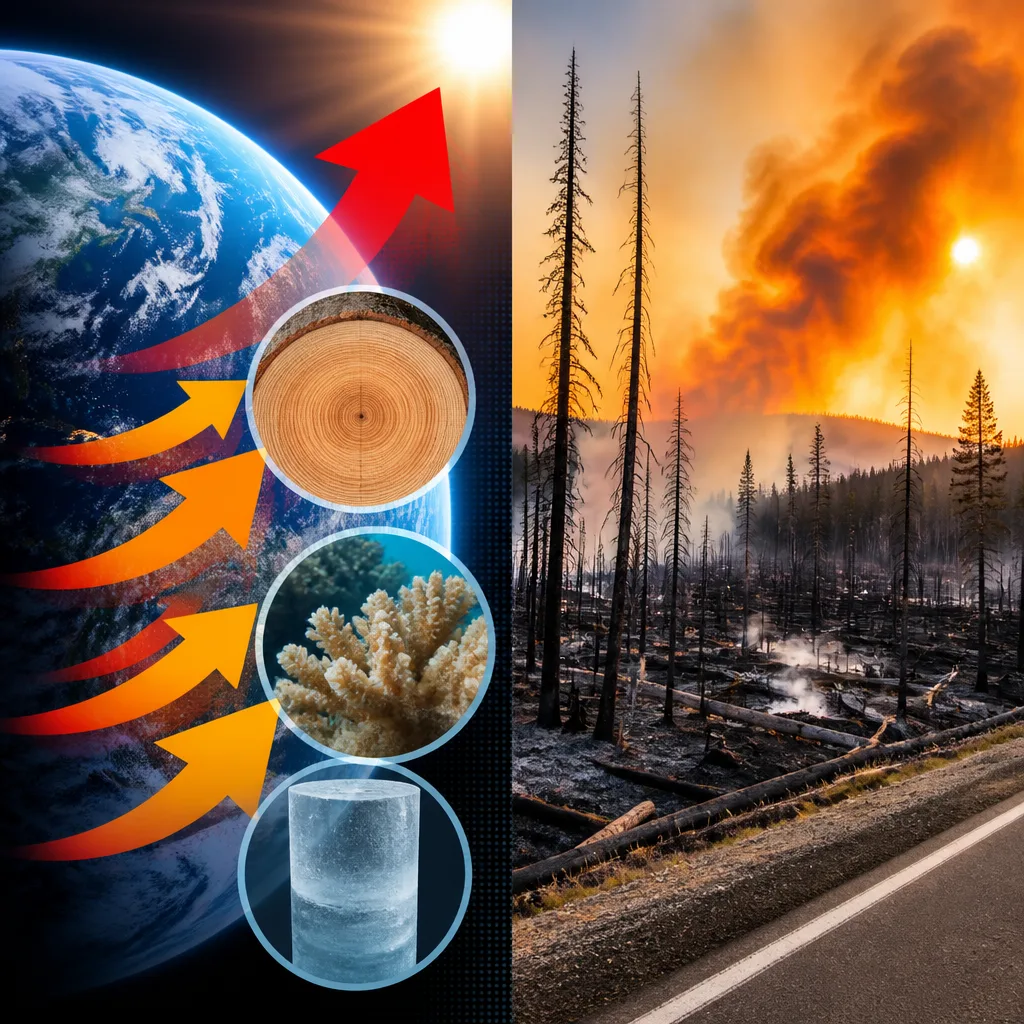
Recent research published in journals of the American Meteorological Society presents two striking conclusions about the Earth’s changing climate: the rate at which the planet is gaining energy under industrial‑era warming is without precedent in the last 1,000 years, and the average annual area burned across boreal and western US forests has risen to roughly three times its pre‑2000 extent.
Reconstructing the planet’s energy balance
Using natural archives — notably tree rings, corals and ice cores — scientists have produced what is described as the first reconstruction of net radiation at the top of the atmosphere over the past millennium. The reconstruction combines multiple proxy records to estimate how much solar and longwave radiation has entered and left the Earth system through time.
The authors report that the increase in the Earth’s energy uptake associated with industrial greenhouse‑gas emissions is unique within the last 1,000 years. Pre‑industrial variations in the reconstructed energy balance are attributed largely to episodic volcanic forcing, which tended to cool the planet for short intervals.
“unprecedented”
Forest fires: a threefold rise and its drivers
A separate, comprehensive literature review focused on boreal and western US fires finds a marked escalation in burned area since the turn of the century. The synthesis concludes the average yearly burn extent in those regions has increased by approximately a factor of three since 2000, accompanied by a rise in the frequency of very large fires and greater smoke loading across much of North America.
“threefold”
Crucially, the review identifies increasing aridity — itself a predicted consequence of global warming — as the dominant factor controlling both burn area and fire‑related carbon emissions. The authors judge that this provides strong evidence that warming, rather than shortcomings in fire management, is the principal cause of the observed trend.
Why these results matter
Both pieces of work speak to different aspects of the same underlying change: the climate system is accumulating energy at an accelerating rate, and the consequences of that extra energy are manifesting in practical hazards such as larger and more frequent wildfires.
Quantifying the energy imbalance over long timescales gives policymakers and modelmakers a clearer baseline for attribution studies and for estimating how much additional warming could occur under continued emissions. Meanwhile, synthesis of fire‑behaviour research links increased wildfire risk directly to climatic drying — a signal that planners and emergency services must treat as a long‑term shift, not solely as weather variability.
Key findings at a glance
- Energy reconstruction: First proxy‑based estimate of top‑of‑atmosphere radiation across the last 1,000 years finds the industrial era’s energy gain is unparalleled in that interval.
- Wildfire trends: Average boreal and western US burn area has risen by about 3× since 2000, with greater incidence of very large fires and increased smoke.
- Primary driver: Increased aridity linked to global warming is identified as the main control on burn area and fire emissions.
| Topic | Principal finding |
|---|---|
| Top‑of‑atmosphere radiation | Industrial‑era energy gain unprecedented in 1,000 years |
| Boreal & western US fires | Average annual burn area ~3× higher since 2000 |
Context and remaining questions
Both studies are published as early‑access articles in AMS journals and have undergone peer review, but the publisher notes that some material will be finalised before the definitive versions appear in print. As with any single study, the results must be weighed within the broader scientific literature. A reconstruction of radiation from proxies necessarily carries uncertainties tied to proxy calibration, spatial coverage and the methods used to combine records; likewise, attributing the full extent of fire‑trend changes requires consideration of land management, ignition patterns and other human factors alongside climate drivers.
Nevertheless, the convergence of independent lines of evidence — a reconstructed acceleration in planetary energy gain and a robust literature synthesis linking warming‑driven aridity to rising burn areas — strengthens the conclusion that the climate system is evolving in ways that amplify hazard and risk across multiple sectors.
Policymakers, planners and the public will need to treat these signals as long‑term changes to which adaptation and mitigation responses must be tuned. Better quantitative constraints on the Earth’s energy balance and clearer attribution of wildfire drivers will be essential tools in that endeavour.









