
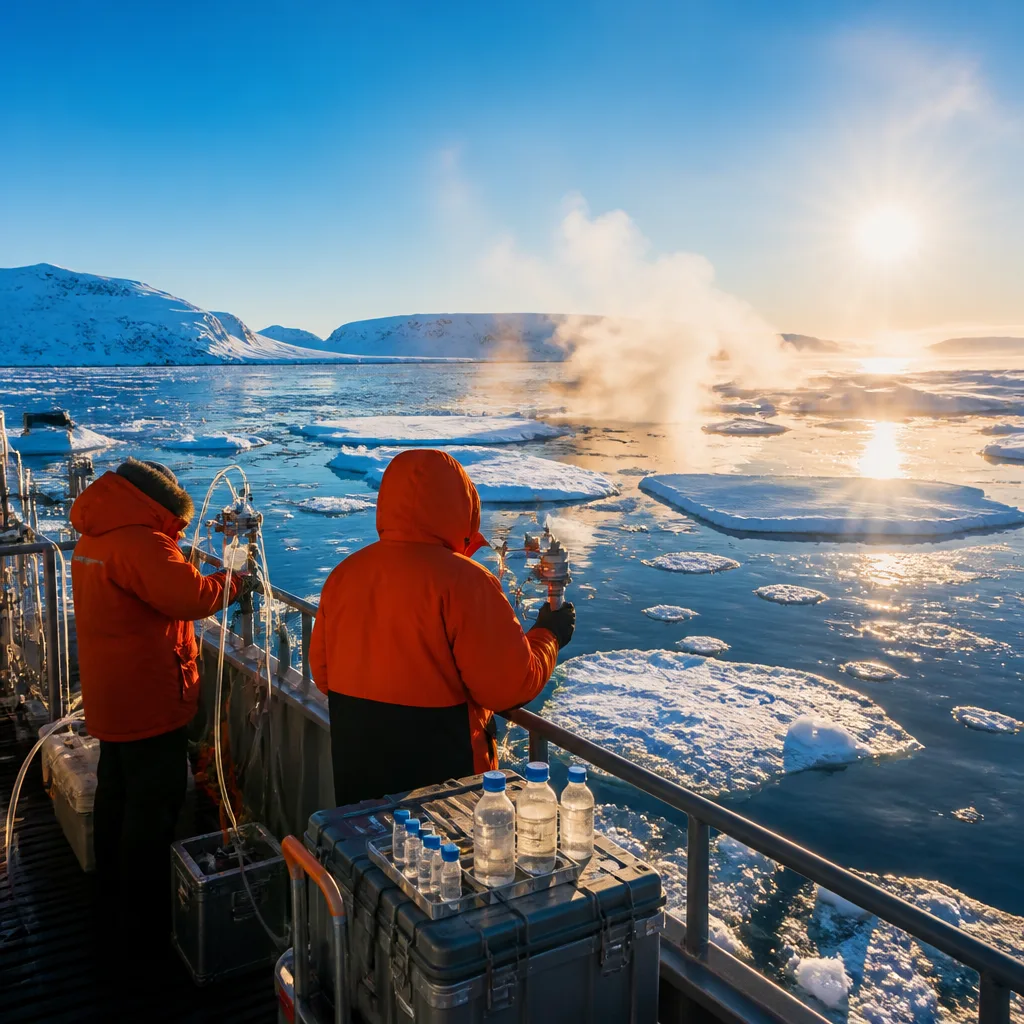
Scientists have identified a natural process at the Arctic sea-ice edge that can rapidly increase the number of particles that seed clouds, by as much as 50-fold in a day. The observations, reported in Nature Geoscience on 5 August, come from an international team led by the University of Birmingham and supported by the Natural Environment Research Council (NERC).
Field measurements confirm a laboratory mechanism
The discovery was made during an expedition aboard the Royal Research Ship Discovery, which sampled air and seawater around Greenland and the Davis Strait in spring and summer 2022. Researchers found that where sea ice meets open ocean — the biologically active ice edge — sunlight and chemicals emitted by marine life and sea ice combine to produce a mixture capable of spawning new atmospheric particles.
The process involves naturally occurring iodine, sulfur and organic compounds, and provides the first in situ validation of a particle-forming mechanism that had previously only been demonstrated under controlled conditions in the CLOUD chamber at CERN.
"Our findings provide the first real-world validation of a recently identified atmospheric chemistry mechanism involving iodine oxoacids and sulfuric acid. Until now, this process had only been demonstrated in laboratory experiments at the CLOUD chamber at CERN," said Dr James Brean, Assistant Professor in Atmospheric Science at the University of Birmingham.
What was measured and why it matters
Near the ice edge the team recorded dramatic increases in the concentration of particles capable of forming cloud droplets. In some locations particle counts rose by up to 50 times within a single day. Alongside this, the scientists detected a previously unknown class of atmospheric molecules that appear to play a role in particle growth.
Those additional particles are important because they can change cloud properties — including how readily clouds form and how reflective they are to incoming sunlight — with direct consequences for the Arctic’s energy budget. As the Arctic warms and sea ice retreats, a larger area of ice edge will be exposed and the conditions that foster this particle production may become more widespread.
- Expedition: Measurements taken from RRS Discovery around Greenland and the Davis Strait, spring–summer 2022.
- Key chemicals: Iodine, sulfur and organic compounds; mechanism involves iodine oxoacids and sulfuric acid.
- Observed effect: Particle concentrations capable of forming cloud droplets increased by up to 50× in a day.
- Significance: First field validation of a mechanism previously seen only in laboratory experiments.
Implications for climate modelling and the Arctic
Current climate models may not fully capture this locally intense particle production at melting ice margins. If the process amplifies as the seasonal ice edge expands, it could alter predicted cloud cover and the amount of solar radiation reflected back to space — processes that feed back into regional and possibly wider climate trends. The research therefore points to an atmospheric chemistry pathway that modellers should consider when refining projections for the Arctic.
The study was carried out by an international consortium with collaborators in China and Spain, and funded in part by NERC. The combination of ship-based measurements and chemical analysis moves the mechanism out of the laboratory and into the real world — a crucial step for assessing its climatic importance.
| Item | Detail |
|---|---|
| Publication | Nature Geoscience, 5 August |
| Platform | RRS Discovery (Greenland and Davis Strait) |
| Observed increase | Up to 50-fold rise in cloud-forming particle numbers in a day |
Further work will be needed to quantify how frequently and widely the process operates, and how large its net effect on Arctic cloudiness and the region’s radiation balance might be. For now, the measurements underline that subtle, locally specific chemistry at the sea-ice edge can exert outsized influence on atmospheric particle populations — a useful reminder that the Arctic remains a laboratory for surprising climate processes.









