Extremely sharp nanoscale wrinkles in graphene create local electric charges, experimental work at Rice University has shown, providing direct evidence that bending alone can generate electricity in a single-atom-thick material. The finding demonstrates flexoelectricity — electric polarisation caused by uneven curvature — in graphene and points to a route for controlling electronic properties through structure rather than chemistry.
How the experiment was done
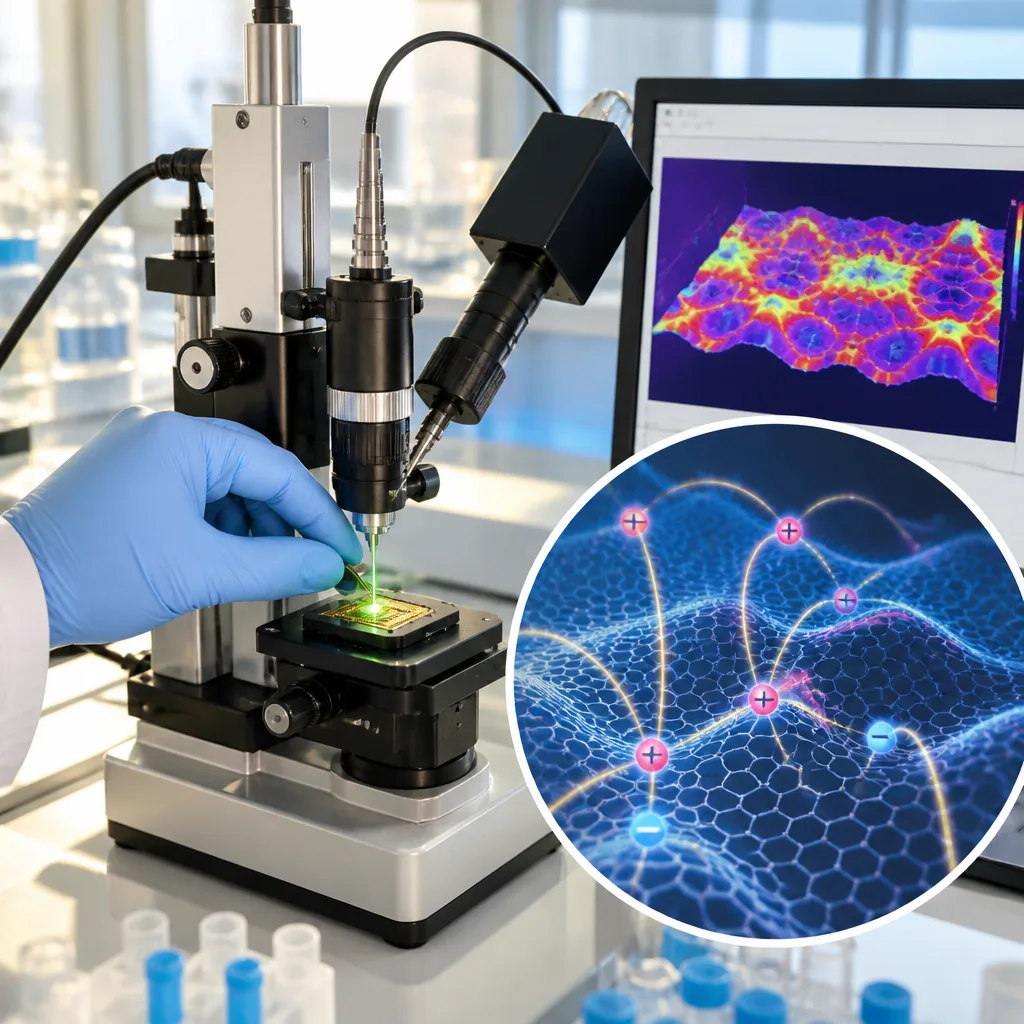
The team compared sharply curved, naturally occurring wrinkles in graphene with flat regions using a combination of advanced probes, laser-based Raman spectroscopy and computer modelling. This multi-technique approach allowed the researchers to isolate the effects of extreme curvature on electron distribution without introducing chemical dopants or external pressure.
| Method | What it measured |
|---|---|
| Specialised microscopic probes | Local electrical response at wrinkles |
| Raman spectroscopy | Structural and strain signatures |
| Computer simulations | Electron redistribution and polarisation models |
“Our work shows that even an ordinary wrinkle can become an extraordinary electronic feature when viewed at the atomic scale,”
said Pulickel Ajayan, Benjamin M. and Mary Greenwood Anderson Professor of Engineering and co-corresponding author of the study, summarising the central result: geometry can reshape electrical behaviour in graphene.
What was observed
Electrons were found to shift preferentially toward one side of a sharply curved bend, producing opposite charges on either side of the wrinkle — in effect a tiny, local battery. The electrical response appeared under applied voltages of roughly one volt and depended on the sharpness of the curvature rather than the wrinkle’s height.
Lead author Sathvik Ajay Iyengar, a former Rice doctoral student, emphasised the importance of focusing on extreme bends:
“Comparing the sharply curved wrinkles with flat graphene allowed us to clearly identify the role of extreme curvature.”
Why this matters
Graphene is celebrated for its exceptional electrical, thermal and mechanical properties, but conventional ways of tuning its behaviour often rely on chemical modification or stacking multiple layers. This study suggests an alternative: controlling the geometry of an atomically thin sheet to induce predictable electrical effects.
Potential implications include:
- Ultra-thin sensors that detect mechanical deformation by converting curvature into an electrical signal;
- Flexible electronics where patterned wrinkles could localise charge or direct current flow without additional materials;
- Energy-harvesting components that exploit bend-induced polarisation on the nanoscale.
Limitations and outlook
While the experiment demonstrates flexoelectricity in monolayer graphene under carefully characterised conditions, several questions remain before practical devices follow. The reproducibility of naturally formed wrinkles, the scalability of deliberate patterning, the stability of induced charges over time, and integration with existing fabrication processes all require further work.
The study nevertheless opens a distinct design philosophy: treat geometry as a material parameter with predictive power. In this view, an otherwise overlooked surface irregularity becomes a tool — not a defect — for engineering electronic function at atomic scales. That philosophical shift could be as significant for device design as the discovery itself.
By proving that bending at the atomic limit can produce measurable polarisation, the Rice team has given materials scientists a new variable to exploit. Future research will need to quantify performance limits, establish methods for reliably producing desired curvature patterns, and test device concepts that translate this fundamental effect into useful technology.